

It is one of the contributing things to prevent settlement of public anger that the
locus and distribution of responsibility becomes vague, is intentionally changed
or makes trivialized afterward. These injustices often trigger public outrage and
emotional trauma of society and individuals more serious. It also heavily destroys
public trust towards major actors and makes the recovery process slower and
ineffective significantly. Once it is damaged, the trust would never be restored in the
short term, as classical social psychological work demonstrated [14]. Loss of public
trust should cause deadlocked situation that spoils public interests in the same way
to Japanese case described in the earlier sections of this chapter.
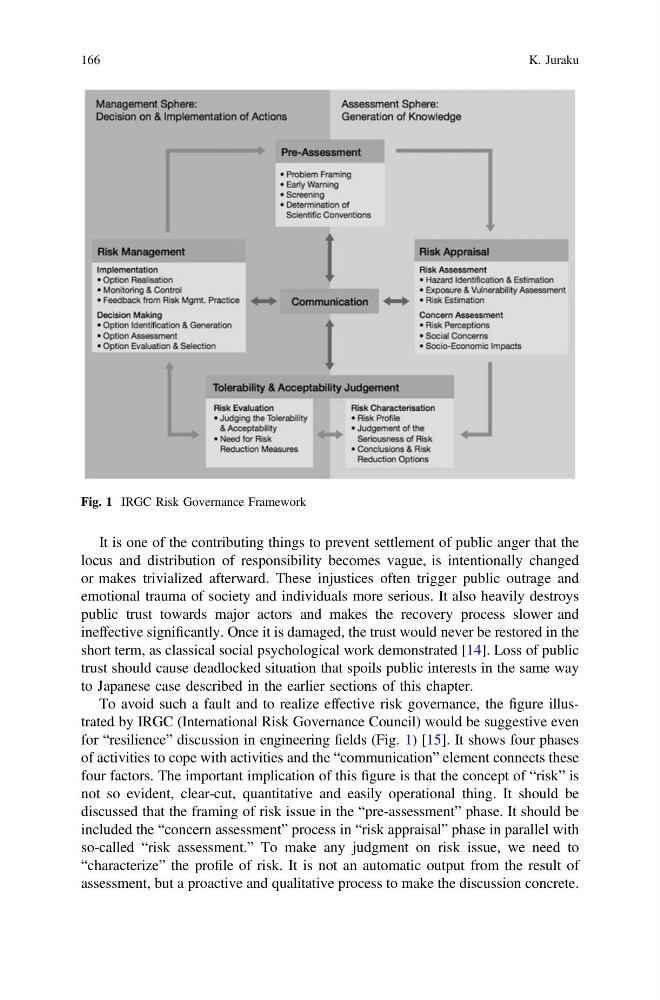
To avoid such a fault and to realize effective risk governance, the figure illustrated by IRGC (International Risk Governance Council) would be suggestive even
for “resilience” discussion in engineering fields (Fig. 1) [15]. It shows four phases
of activities to cope with activities and the “communication” element connects these
four factors. The important implication of this figure is that the concept of “risk” is
not so evident, clear-cut, quantitative and easily operational thing. It should be
discussed that the framing of risk issue in the “pre-assessment” phase. It should be
included the “concern assessment” process in “risk appraisal” phase in parallel with
so-called “risk assessment.” To make any judgment on risk issue, we need to
“characterize” the profile of risk. It is not an automatic output from the result of
assessment, but a proactive and qualitative process to make the discussion concrete.
Fig. 1 IRGC Risk Governance Framework
166
K. Juraku
locus and distribution of responsibility becomes vague, is intentionally changed
or makes trivialized afterward. These injustices often trigger public outrage and
emotional trauma of society and individuals more serious. It also heavily destroys
public trust towards major actors and makes the recovery process slower and
ineffective significantly. Once it is damaged, the trust would never be restored in the
short term, as classical social psychological work demonstrated [14]. Loss of public
trust should cause deadlocked situation that spoils public interests in the same way
to Japanese case described in the earlier sections of this chapter.
To avoid such a fault and to realize effective risk governance, the figure illustrated by IRGC (International Risk Governance Council) would be suggestive even
for “resilience” discussion in engineering fields (Fig. 1) [15]. It shows four phases
of activities to cope with activities and the “communication” element connects these
four factors. The important implication of this figure is that the concept of “risk” is
not so evident, clear-cut, quantitative and easily operational thing. It should be
discussed that the framing of risk issue in the “pre-assessment” phase. It should be
included the “concern assessment” process in “risk appraisal” phase in parallel with
so-called “risk assessment.” To make any judgment on risk issue, we need to
“characterize” the profile of risk. It is not an automatic output from the result of
assessment, but a proactive and qualitative process to make the discussion concrete.
Fig. 1 IRGC Risk Governance Framework
166
K. Juraku