

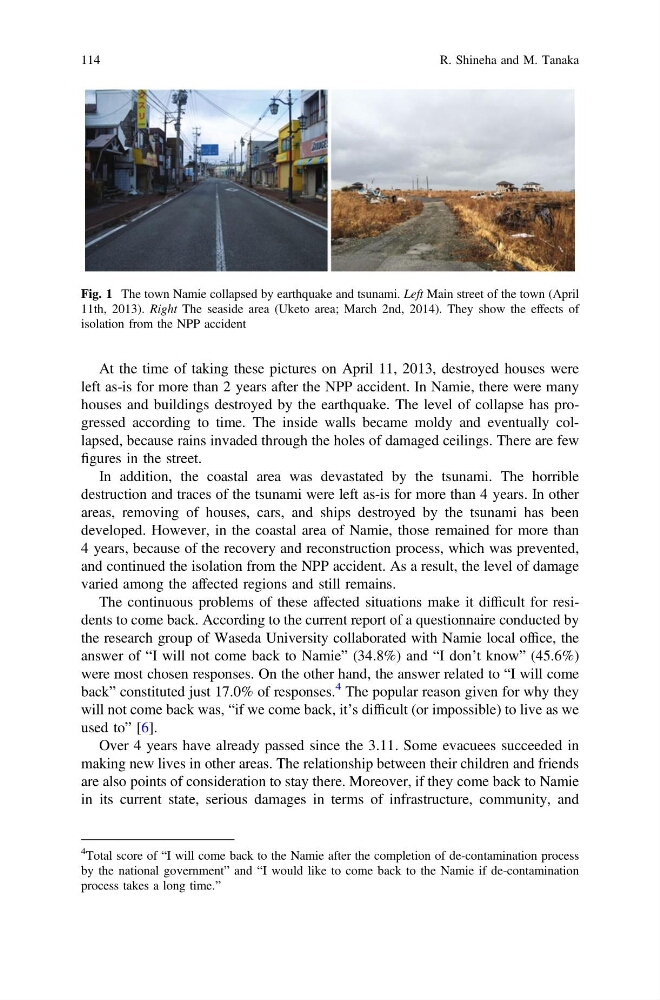
At the time of taking these pictures on April 11, 2013, destroyed houses were
left as-is for more than 2 years after the NPP accident. In Namie, there were many
houses and buildings destroyed by the earthquake. The level of collapse has progressed according to time. The inside walls became moldy and eventually collapsed, because rains invaded through the holes of damaged ceilings. There are few
figures in the street.
In addition, the coastal area was devastated by the tsunami. The horrible
destruction and traces of the tsunami were left as-is for more than 4 years. In other
areas, removing of houses, cars, and ships destroyed by the tsunami has been
developed. However, in the coastal area of Namie, those remained for more than
4 years, because of the recovery and reconstruction process, which was prevented,
and continued the isolation from the NPP accident. As a result, the level of damage
varied among the affected regions and still remains.
The continuous problems of these affected situations make it difficult for residents to come back. According to the current report of a questionnaire conducted by
the research group of Waseda University collaborated with Namie local office, the
answer of “I will not come back to Namie” (34.8%) and “I don’t know” (45.6%)
were most chosen responses. On the other hand, the answer related to “I will come
back” constituted just 17.0% of responses.
4 The popular reason given for why they
will not come back was, “if we come back, it’s difficult (or impossible) to live as we
used to” [6].
Over 4 years have already passed since the 3.11. Some evacuees succeeded in
making new lives in other areas. The relationship between their children and friends
are also points of consideration to stay there. Moreover, if they come back to Namie
in its current state, serious damages in terms of infrastructure, community, and
Fig. 1 The town Namie collapsed by earthquake and tsunami. Left Main street of the town (April
11th, 2013). Right The seaside area (Uketo area; March 2nd, 2014). They show the effects of
isolation from the NPP accident
4
Total score of “I will come back to the Namie after the completion of de-contamination process
by the national government” and “I would like to come back to the Namie if de-contamination
process takes a long time.”
114
R. Shineha and M. Tanaka
left as-is for more than 2 years after the NPP accident. In Namie, there were many
houses and buildings destroyed by the earthquake. The level of collapse has progressed according to time. The inside walls became moldy and eventually collapsed, because rains invaded through the holes of damaged ceilings. There are few
figures in the street.
In addition, the coastal area was devastated by the tsunami. The horrible
destruction and traces of the tsunami were left as-is for more than 4 years. In other
areas, removing of houses, cars, and ships destroyed by the tsunami has been
developed. However, in the coastal area of Namie, those remained for more than
4 years, because of the recovery and reconstruction process, which was prevented,
and continued the isolation from the NPP accident. As a result, the level of damage
varied among the affected regions and still remains.
The continuous problems of these affected situations make it difficult for residents to come back. According to the current report of a questionnaire conducted by
the research group of Waseda University collaborated with Namie local office, the
answer of “I will not come back to Namie” (34.8%) and “I don’t know” (45.6%)
were most chosen responses. On the other hand, the answer related to “I will come
back” constituted just 17.0% of responses.
4 The popular reason given for why they
will not come back was, “if we come back, it’s difficult (or impossible) to live as we
used to” [6].
Over 4 years have already passed since the 3.11. Some evacuees succeeded in
making new lives in other areas. The relationship between their children and friends
are also points of consideration to stay there. Moreover, if they come back to Namie
in its current state, serious damages in terms of infrastructure, community, and
Fig. 1 The town Namie collapsed by earthquake and tsunami. Left Main street of the town (April
11th, 2013). Right The seaside area (Uketo area; March 2nd, 2014). They show the effects of
isolation from the NPP accident
4
Total score of “I will come back to the Namie after the completion of de-contamination process
by the national government” and “I would like to come back to the Namie if de-contamination
process takes a long time.”
114
R. Shineha and M. Tanaka