

society) have been reinforced more and more in some areas of damaged sites after
the 3.11.
In addition to the terrible natural disasters, we also faced the severe accident of
NPPs. In “Risk Society,” Ulrich Beck discussed the globalization of risk and
inequality on the distribution of risk and benefit [4]. Such discussions regarding risk
society point out a collision of risk receiver and benefit receiver as well as risk gap
according to social stratum and area. Generally speaking, the weak members of
society tend to become risk receivers.
2
1.2 The Effect of the Fukushima-Daiichi Nuclear Power
Plant Accident
In addition to the huge damage of the earthquake and tsunami, evacuation zones
were set up after the NPP accident and many people were forced to leave their
towns, particularly in the Futaba area of the Fukushima prefecture. At the first, the
evacuation zone was set within a radius of 20 km from the NPP. However, after
April 1, 2013, the evacuation zone was redefined in three categories according to
the amount of radiation: Difficult-to-return zone (Kitaku-Konnan Kuiki);
No-residence zone (Kyojyu-Seigen Kuiki); and zone being prepared for lifting of
evacuation order (Hinan-Shiji Kaijo Junbi Kuiki).
3
Figure 1 shows the current situation of Namie, a town that was established as a
mandatory evacuation zone after the NPP accidents. However, after the
re-categorization of evacuation areas on April 1, 2013, a part of Namie became
available for short-time stays with the local government’s permission. At the current
status, Namie has three different types of evacuation areas.
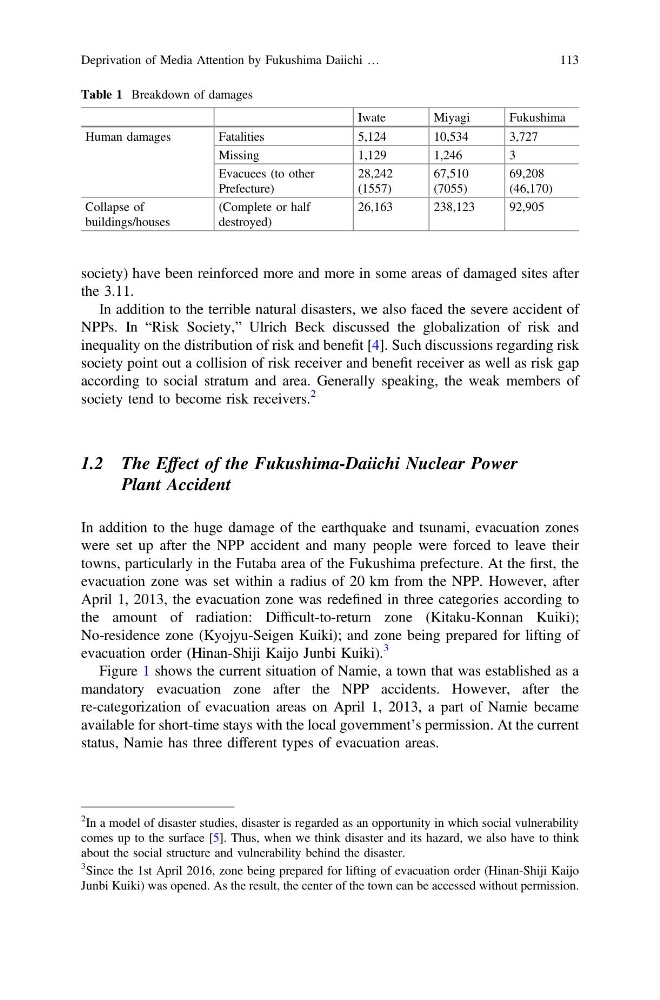
Table 1 Breakdown of damages
Iwate
Miyagi
Fukushima
Human damages
Fatalities
5,124
10,534
3,727
Missing
1,129
1,246
3
Evacuees (to other
Prefecture)
28,242
(1557)
67,510
(7055)
69,208
(46,170)
Collapse of
buildings/houses
(Complete or half
destroyed)
26,163
238,123
92,905
2
In a model of disaster studies, disaster is regarded as an opportunity in which social vulnerability
comes up to the surface [5]. Thus, when we think disaster and its hazard, we also have to think
about the social structure and vulnerability behind the disaster.
3
Since the 1st April 2016, zone being prepared for lifting of evacuation order (Hinan-Shiji Kaijo
Junbi Kuiki) was opened. As the result, the center of the town can be accessed without permission.
Deprivation of Media Attention by Fukushima Daiichi …
113
the 3.11.
In addition to the terrible natural disasters, we also faced the severe accident of
NPPs. In “Risk Society,” Ulrich Beck discussed the globalization of risk and
inequality on the distribution of risk and benefit [4]. Such discussions regarding risk
society point out a collision of risk receiver and benefit receiver as well as risk gap
according to social stratum and area. Generally speaking, the weak members of
society tend to become risk receivers.
2
1.2 The Effect of the Fukushima-Daiichi Nuclear Power
Plant Accident
In addition to the huge damage of the earthquake and tsunami, evacuation zones
were set up after the NPP accident and many people were forced to leave their
towns, particularly in the Futaba area of the Fukushima prefecture. At the first, the
evacuation zone was set within a radius of 20 km from the NPP. However, after
April 1, 2013, the evacuation zone was redefined in three categories according to
the amount of radiation: Difficult-to-return zone (Kitaku-Konnan Kuiki);
No-residence zone (Kyojyu-Seigen Kuiki); and zone being prepared for lifting of
evacuation order (Hinan-Shiji Kaijo Junbi Kuiki).
3
Figure 1 shows the current situation of Namie, a town that was established as a
mandatory evacuation zone after the NPP accidents. However, after the
re-categorization of evacuation areas on April 1, 2013, a part of Namie became
available for short-time stays with the local government’s permission. At the current
status, Namie has three different types of evacuation areas.
Table 1 Breakdown of damages
Iwate
Miyagi
Fukushima
Human damages
Fatalities
5,124
10,534
3,727
Missing
1,129
1,246
3
Evacuees (to other
Prefecture)
28,242
(1557)
67,510
(7055)
69,208
(46,170)
Collapse of
buildings/houses
(Complete or half
destroyed)
26,163
238,123
92,905
2
In a model of disaster studies, disaster is regarded as an opportunity in which social vulnerability
comes up to the surface [5]. Thus, when we think disaster and its hazard, we also have to think
about the social structure and vulnerability behind the disaster.
3
Since the 1st April 2016, zone being prepared for lifting of evacuation order (Hinan-Shiji Kaijo
Junbi Kuiki) was opened. As the result, the center of the town can be accessed without permission.
Deprivation of Media Attention by Fukushima Daiichi …
113