

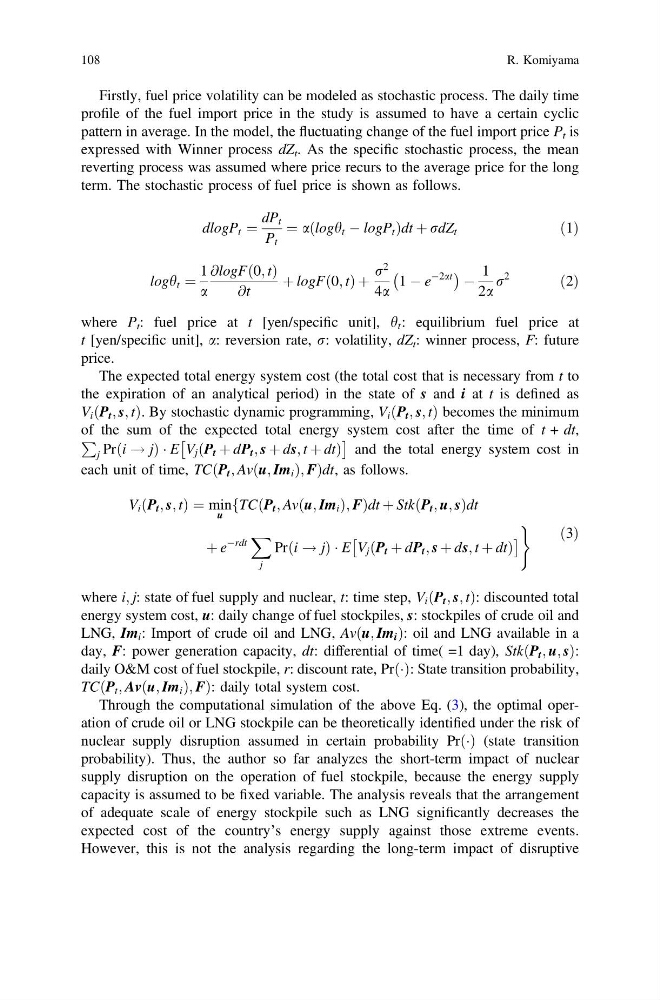
Firstly, fuel price volatility can be modeled as stochastic process. The daily time
profile of the fuel import price in the study is assumed to have a certain cyclic
pattern in average. In the model, the fluctuating change of the fuel import price P t is
expressed with Winner process dZ t . As the specific stochastic process, the mean
reverting process was assumed where price recurs to the average price for the long
term. The stochastic process of fuel price is shown as follows.
dlogP t ¼
dP t
P t
¼ a logh t À logP t
ð
Þ dt þ rdZ t
ð1Þ
logh t ¼
1
a
@logF 0; t
ð Þ
@t
þ logF 0; t
ð Þþ
r
2
4a
1 À e
À2at
À
Á À
1
2a
r
2
ð2Þ
where P t : fuel price at t [yen/specific unit], h t : equilibrium fuel price at
t [yen/specific unit], a: reversion rate, r: volatility, dZ t : winner process, F: future
price.
The expected total energy system cost (the total cost that is necessary from t to
the expiration of an analytical period) in the state of s and i at t is defined as
V i P t ; s; t
ð
Þ. By stochastic dynamic programming, V i P t ; s; t
ð
Þbecomes the minimum
of the sum of the expected total energy system cost after the time of t + dt,
P
j Pr i ! j
ð
ÞÁE V j P t þ dP t ; s þ ds; t þ dt
ð
Þ
Â
Ã
and the total energy system cost in
each unit of time, TC P t ; Av u; Im i
ð
Þ; F
ð
Þ dt, as follows.
V i P t ; s; t
ð
Þ¼min
u
TC P t ; Avðu; Im i Þ; F
ð
Þ dt þ StkðP t ; u; sÞdt
f
þ e
Àrdt
X
j
Prði ! jÞ Á E V j P t þ dP t ; s þ ds; t þ dt
ð
Þ
Â
Ã
)
ð3Þ
where i; j: state of fuel supply and nuclear, t: time step, V i ðP t ; s; tÞ: discounted total
energy system cost, u: daily change of fuel stockpiles, s: stockpiles of crude oil and
LNG, Im i : Import of crude oil and LNG, Avðu; Im i Þ: oil and LNG available in a
day, F: power generation capacity, dt: differential of time( =1 day), StkðP t ; u; sÞ:
daily O&M cost of fuel stockpile, r: discount rate, PrðÁÞ: State transition probability,
TC P t ; Av u; Im i
ð
Þ; F
ð
Þ : daily total system cost.
Through the computational simulation of the above Eq. (3), the optimal operation of crude oil or LNG stockpile can be theoretically identified under the risk of
nuclear supply disruption assumed in certain probability PrðÁÞ (state transition
probability). Thus, the author so far analyzes the short-term impact of nuclear
supply disruption on the operation of fuel stockpile, because the energy supply
capacity is assumed to be fixed variable. The analysis reveals that the arrangement
of adequate scale of energy stockpile such as LNG significantly decreases the
expected cost of the country’s energy supply against those extreme events.
However, this is not the analysis regarding the long-term impact of disruptive
108
R. Komiyama
profile of the fuel import price in the study is assumed to have a certain cyclic
pattern in average. In the model, the fluctuating change of the fuel import price P t is
expressed with Winner process dZ t . As the specific stochastic process, the mean
reverting process was assumed where price recurs to the average price for the long
term. The stochastic process of fuel price is shown as follows.
dlogP t ¼
dP t
P t
¼ a logh t À logP t
ð
Þ dt þ rdZ t
ð1Þ
logh t ¼
1
a
@logF 0; t
ð Þ
@t
þ logF 0; t
ð Þþ
r
2
4a
1 À e
À2at
À
Á À
1
2a
r
2
ð2Þ
where P t : fuel price at t [yen/specific unit], h t : equilibrium fuel price at
t [yen/specific unit], a: reversion rate, r: volatility, dZ t : winner process, F: future
price.
The expected total energy system cost (the total cost that is necessary from t to
the expiration of an analytical period) in the state of s and i at t is defined as
V i P t ; s; t
ð
Þ. By stochastic dynamic programming, V i P t ; s; t
ð
Þbecomes the minimum
of the sum of the expected total energy system cost after the time of t + dt,
P
j Pr i ! j
ð
ÞÁE V j P t þ dP t ; s þ ds; t þ dt
ð
Þ
Â
Ã
and the total energy system cost in
each unit of time, TC P t ; Av u; Im i
ð
Þ; F
ð
Þ dt, as follows.
V i P t ; s; t
ð
Þ¼min
u
TC P t ; Avðu; Im i Þ; F
ð
Þ dt þ StkðP t ; u; sÞdt
f
þ e
Àrdt
X
j
Prði ! jÞ Á E V j P t þ dP t ; s þ ds; t þ dt
ð
Þ
Â
Ã
)
ð3Þ
where i; j: state of fuel supply and nuclear, t: time step, V i ðP t ; s; tÞ: discounted total
energy system cost, u: daily change of fuel stockpiles, s: stockpiles of crude oil and
LNG, Im i : Import of crude oil and LNG, Avðu; Im i Þ: oil and LNG available in a
day, F: power generation capacity, dt: differential of time( =1 day), StkðP t ; u; sÞ:
daily O&M cost of fuel stockpile, r: discount rate, PrðÁÞ: State transition probability,
TC P t ; Av u; Im i
ð
Þ; F
ð
Þ : daily total system cost.
Through the computational simulation of the above Eq. (3), the optimal operation of crude oil or LNG stockpile can be theoretically identified under the risk of
nuclear supply disruption assumed in certain probability PrðÁÞ (state transition
probability). Thus, the author so far analyzes the short-term impact of nuclear
supply disruption on the operation of fuel stockpile, because the energy supply
capacity is assumed to be fixed variable. The analysis reveals that the arrangement
of adequate scale of energy stockpile such as LNG significantly decreases the
expected cost of the country’s energy supply against those extreme events.
However, this is not the analysis regarding the long-term impact of disruptive
108
R. Komiyama