

is relatively expensive in the context of an international comparison, its further
increase can be understood as an additional financial burden.
CO 2 emissions will increase as well, because of increased usage of fossil fuel to
replace the loss of nuclear power after Fukushima. The utility power companies
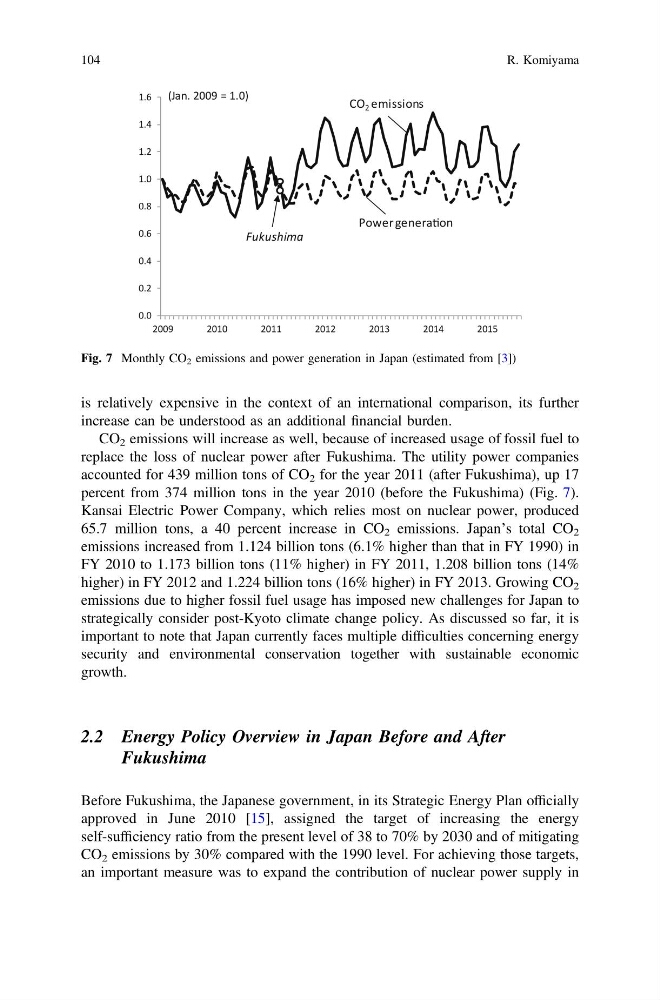
accounted for 439 million tons of CO 2 for the year 2011 (after Fukushima), up 17
percent from 374 million tons in the year 2010 (before the Fukushima) (Fig. 7).
Kansai Electric Power Company, which relies most on nuclear power, produced
65.7 million tons, a 40 percent increase in CO 2 emissions. Japan’s total CO 2
emissions increased from 1.124 billion tons (6.1% higher than that in FY 1990) in
FY 2010 to 1.173 billion tons (11% higher) in FY 2011, 1.208 billion tons (14%
higher) in FY 2012 and 1.224 billion tons (16% higher) in FY 2013. Growing CO 2
emissions due to higher fossil fuel usage has imposed new challenges for Japan to
strategically consider post-Kyoto climate change policy. As discussed so far, it is
important to note that Japan currently faces multiple difficulties concerning energy
security and environmental conservation together with sustainable economic
growth.
2.2 Energy Policy Overview in Japan Before and After
Fukushima
Before Fukushima, the Japanese government, in its Strategic Energy Plan officially
approved in June 2010 [15], assigned the target of increasing the energy
self-sufficiency ratio from the present level of 38 to 70% by 2030 and of mitigating
CO 2 emissions by 30% compared with the 1990 level. For achieving those targets,
an important measure was to expand the contribution of nuclear power supply in
0.0
0.2
0.4
0.6
0.8
1.0
1.2
1.4
1.6
2009
2010
2011
2012
2013
2014
2015
(Jan. 2009 = 1.0)
Power generaƟon
CO 2 emissions
Fukushima
Fig. 7 Monthly CO 2 emissions and power generation in Japan (estimated from [3])
104
R. Komiyama
increase can be understood as an additional financial burden.
CO 2 emissions will increase as well, because of increased usage of fossil fuel to
replace the loss of nuclear power after Fukushima. The utility power companies
accounted for 439 million tons of CO 2 for the year 2011 (after Fukushima), up 17
percent from 374 million tons in the year 2010 (before the Fukushima) (Fig. 7).
Kansai Electric Power Company, which relies most on nuclear power, produced
65.7 million tons, a 40 percent increase in CO 2 emissions. Japan’s total CO 2
emissions increased from 1.124 billion tons (6.1% higher than that in FY 1990) in
FY 2010 to 1.173 billion tons (11% higher) in FY 2011, 1.208 billion tons (14%
higher) in FY 2012 and 1.224 billion tons (16% higher) in FY 2013. Growing CO 2
emissions due to higher fossil fuel usage has imposed new challenges for Japan to
strategically consider post-Kyoto climate change policy. As discussed so far, it is
important to note that Japan currently faces multiple difficulties concerning energy
security and environmental conservation together with sustainable economic
growth.
2.2 Energy Policy Overview in Japan Before and After
Fukushima
Before Fukushima, the Japanese government, in its Strategic Energy Plan officially
approved in June 2010 [15], assigned the target of increasing the energy
self-sufficiency ratio from the present level of 38 to 70% by 2030 and of mitigating
CO 2 emissions by 30% compared with the 1990 level. For achieving those targets,
an important measure was to expand the contribution of nuclear power supply in
0.0
0.2
0.4
0.6
0.8
1.0
1.2
1.4
1.6
2009
2010
2011
2012
2013
2014
2015
(Jan. 2009 = 1.0)
Power generaƟon
CO 2 emissions
Fukushima
Fig. 7 Monthly CO 2 emissions and power generation in Japan (estimated from [3])
104
R. Komiyama