

3.11 Crowd Disasters
49
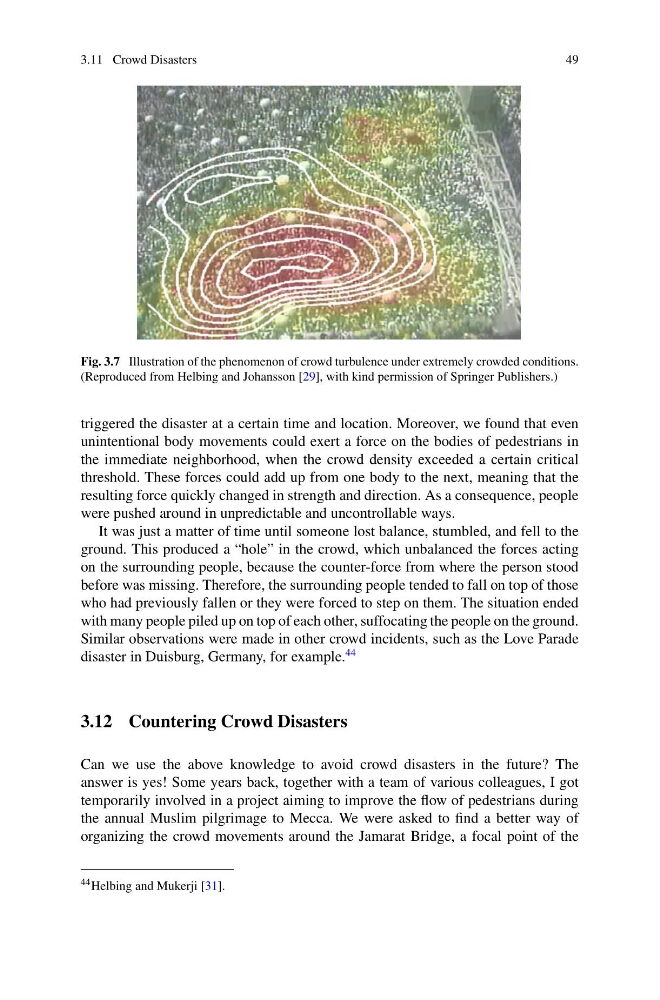
Fig. 3.7 Illustration of the phenomenon of crowd turbulence under extremely crowded conditions.
(Reproduced from Helbing and Johansson [29], with kind permission of Springer Publishers.)
triggered the disaster at a certain time and location. Moreover, we found that even
unintentional body movements could exert a force on the bodies of pedestrians in
the immediate neighborhood, when the crowd density exceeded a certain critical
threshold. These forces could add up from one body to the next, meaning that the
resulting force quickly changed in strength and direction. As a consequence, people
were pushed around in unpredictable and uncontrollable ways.
It was just a matter of time until someone lost balance, stumbled, and fell to the
ground. This produced a “hole” in the crowd, which unbalanced the forces acting
on the surrounding people, because the counter-force from where the person stood
before was missing. Therefore, the surrounding people tended to fall on top of those
who had previously fallen or they were forced to step on them. The situation ended
with many people piled up on top of each other, suffocating the people on the ground.
Similar observations were made in other crowd incidents, such as the Love Parade
disaster in Duisburg, Germany, for example.
44
3.12 Countering Crowd Disasters
Can we use the above knowledge to avoid crowd disasters in the future? The
answer is yes! Some years back, together with a team of various colleagues, I got
temporarily involved in a project aiming to improve the flow of pedestrians during
the annual Muslim pilgrimage to Mecca. We were asked to find a better way of
organizing the crowd movements around the Jamarat Bridge, a focal point of the
44 Helbing and Mukerji [31].
49
Fig. 3.7 Illustration of the phenomenon of crowd turbulence under extremely crowded conditions.
(Reproduced from Helbing and Johansson [29], with kind permission of Springer Publishers.)
triggered the disaster at a certain time and location. Moreover, we found that even
unintentional body movements could exert a force on the bodies of pedestrians in
the immediate neighborhood, when the crowd density exceeded a certain critical
threshold. These forces could add up from one body to the next, meaning that the
resulting force quickly changed in strength and direction. As a consequence, people
were pushed around in unpredictable and uncontrollable ways.
It was just a matter of time until someone lost balance, stumbled, and fell to the
ground. This produced a “hole” in the crowd, which unbalanced the forces acting
on the surrounding people, because the counter-force from where the person stood
before was missing. Therefore, the surrounding people tended to fall on top of those
who had previously fallen or they were forced to step on them. The situation ended
with many people piled up on top of each other, suffocating the people on the ground.
Similar observations were made in other crowd incidents, such as the Love Parade
disaster in Duisburg, Germany, for example.
44
3.12 Countering Crowd Disasters
Can we use the above knowledge to avoid crowd disasters in the future? The
answer is yes! Some years back, together with a team of various colleagues, I got
temporarily involved in a project aiming to improve the flow of pedestrians during
the annual Muslim pilgrimage to Mecca. We were asked to find a better way of
organizing the crowd movements around the Jamarat Bridge, a focal point of the
44 Helbing and Mukerji [31].