

48
3 Social Forces
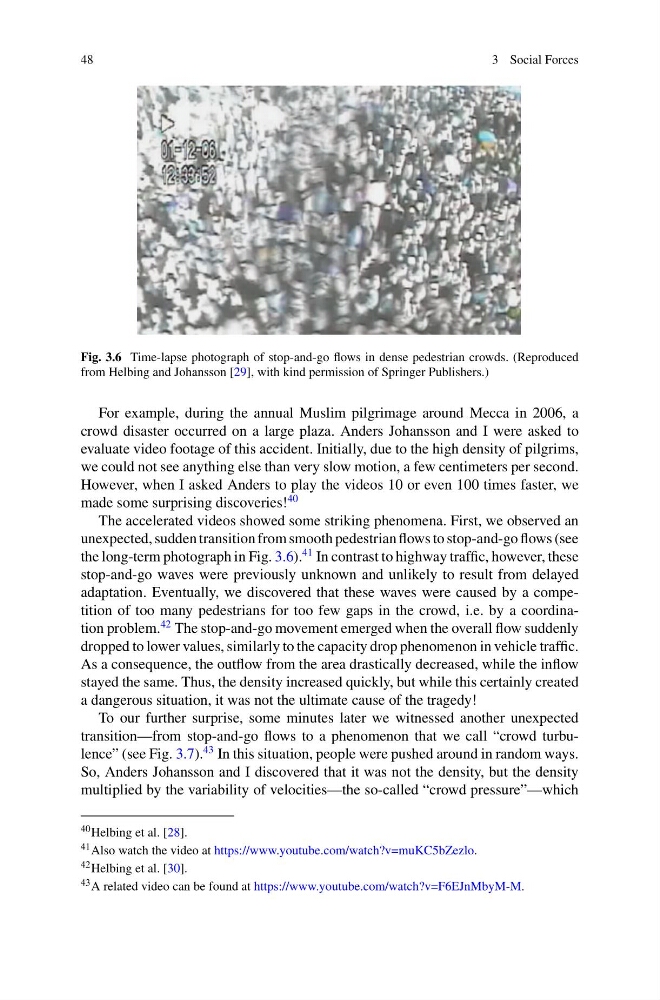
Fig. 3.6 Time-lapse photograph of stop-and-go flows in dense pedestrian crowds. (Reproduced
from Helbing and Johansson [29], with kind permission of Springer Publishers.)
For example, during the annual Muslim pilgrimage around Mecca in 2006, a
crowd disaster occurred on a large plaza. Anders Johansson and I were asked to
evaluate video footage of this accident. Initially, due to the high density of pilgrims,
we could not see anything else than very slow motion, a few centimeters per second.
However, when I asked Anders to play the videos 10 or even 100 times faster, we
made some surprising discoveries!
40
The accelerated videos showed some striking phenomena. First, we observed an
unexpected, sudden transition from smooth pedestrian flows to stop-and-go flows (see
the long-term photograph in Fig. 3.6).
41 In contrast to highway traffic, however, these
stop-and-go waves were previously unknown and unlikely to result from delayed
adaptation. Eventually, we discovered that these waves were caused by a competition of too many pedestrians for too few gaps in the crowd, i.e. by a coordination problem.
42 The stop-and-go movement emerged when the overall flow suddenly
dropped to lower values, similarly to the capacity drop phenomenon in vehicle traffic.
As a consequence, the outflow from the area drastically decreased, while the inflow
stayed the same. Thus, the density increased quickly, but while this certainly created
a dangerous situation, it was not the ultimate cause of the tragedy!
To our further surprise, some minutes later we witnessed another unexpected
transition—from stop-and-go flows to a phenomenon that we call “crowd turbulence” (see Fig. 3.7).
43 In this situation, people were pushed around in random ways.
So, Anders Johansson and I discovered that it was not the density, but the density
multiplied by the variability of velocities—the so-called “crowd pressure”—which
40 Helbing et al. [28].
41 Also watch the video at https://www.youtube.com/watch?v=muKC5bZezlo.
42 Helbing et al. [30].
43 A related video can be found at https://www.youtube.com/watch?v=F6EJnMbyM-M.
3 Social Forces
Fig. 3.6 Time-lapse photograph of stop-and-go flows in dense pedestrian crowds. (Reproduced
from Helbing and Johansson [29], with kind permission of Springer Publishers.)
For example, during the annual Muslim pilgrimage around Mecca in 2006, a
crowd disaster occurred on a large plaza. Anders Johansson and I were asked to
evaluate video footage of this accident. Initially, due to the high density of pilgrims,
we could not see anything else than very slow motion, a few centimeters per second.
However, when I asked Anders to play the videos 10 or even 100 times faster, we
made some surprising discoveries!
40
The accelerated videos showed some striking phenomena. First, we observed an
unexpected, sudden transition from smooth pedestrian flows to stop-and-go flows (see
the long-term photograph in Fig. 3.6).
41 In contrast to highway traffic, however, these
stop-and-go waves were previously unknown and unlikely to result from delayed
adaptation. Eventually, we discovered that these waves were caused by a competition of too many pedestrians for too few gaps in the crowd, i.e. by a coordination problem.
42 The stop-and-go movement emerged when the overall flow suddenly
dropped to lower values, similarly to the capacity drop phenomenon in vehicle traffic.
As a consequence, the outflow from the area drastically decreased, while the inflow
stayed the same. Thus, the density increased quickly, but while this certainly created
a dangerous situation, it was not the ultimate cause of the tragedy!
To our further surprise, some minutes later we witnessed another unexpected
transition—from stop-and-go flows to a phenomenon that we call “crowd turbulence” (see Fig. 3.7).
43 In this situation, people were pushed around in random ways.
So, Anders Johansson and I discovered that it was not the density, but the density
multiplied by the variability of velocities—the so-called “crowd pressure”—which
40 Helbing et al. [28].
41 Also watch the video at https://www.youtube.com/watch?v=muKC5bZezlo.
42 Helbing et al. [30].
43 A related video can be found at https://www.youtube.com/watch?v=F6EJnMbyM-M.