

298
14 Summary: What’s Wrong with AI?
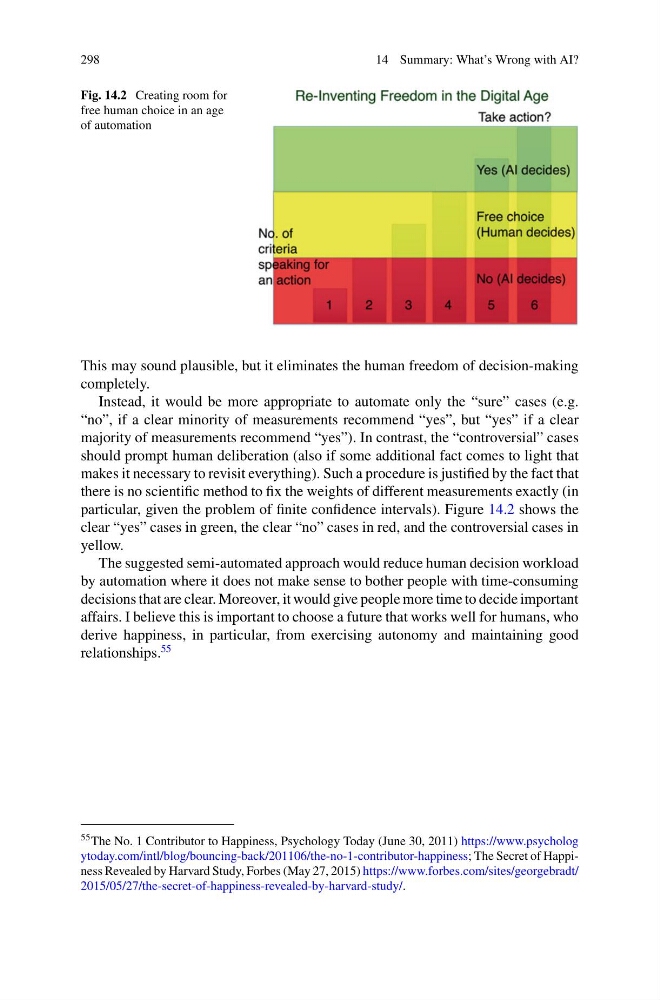
Fig. 14.2 Creating room for
free human choice in an age
of automation
This may sound plausible, but it eliminates the human freedom of decision-making
completely.
Instead, it would be more appropriate to automate only the “sure” cases (e.g.
“no”, if a clear minority of measurements recommend “yes”, but “yes” if a clear
majority of measurements recommend “yes”). In contrast, the “controversial” cases
should prompt human deliberation (also if some additional fact comes to light that
makes it necessary to revisit everything). Such a procedure is justified by the fact that
there is no scientific method to fix the weights of different measurements exactly (in
particular, given the problem of finite confidence intervals). Figure 14.2 shows the
clear “yes” cases in green, the clear “no” cases in red, and the controversial cases in
yellow.
The suggested semi-automated approach would reduce human decision workload
by automation where it does not make sense to bother people with time-consuming
decisions that are clear. Moreover, it would give people more time to decide important
affairs. I believe this is important to choose a future that works well for humans, who
derive happiness, in particular, from exercising autonomy and maintaining good
relationships.
55
55 The No. 1 Contributor to Happiness, Psychology Today (June 30, 2011) https://www.psycholog
ytoday.com/intl/blog/bouncing-back/201106/the-no-1-contributor-happiness; The Secret of Happiness Revealed by Harvard Study, Forbes (May 27, 2015) https://www.forbes.com/sites/georgebradt/
2015/05/27/the-secret-of-happiness-revealed-by-harvard-study/.
14 Summary: What’s Wrong with AI?
Fig. 14.2 Creating room for
free human choice in an age
of automation
This may sound plausible, but it eliminates the human freedom of decision-making
completely.
Instead, it would be more appropriate to automate only the “sure” cases (e.g.
“no”, if a clear minority of measurements recommend “yes”, but “yes” if a clear
majority of measurements recommend “yes”). In contrast, the “controversial” cases
should prompt human deliberation (also if some additional fact comes to light that
makes it necessary to revisit everything). Such a procedure is justified by the fact that
there is no scientific method to fix the weights of different measurements exactly (in
particular, given the problem of finite confidence intervals). Figure 14.2 shows the
clear “yes” cases in green, the clear “no” cases in red, and the controversial cases in
yellow.
The suggested semi-automated approach would reduce human decision workload
by automation where it does not make sense to bother people with time-consuming
decisions that are clear. Moreover, it would give people more time to decide important
affairs. I believe this is important to choose a future that works well for humans, who
derive happiness, in particular, from exercising autonomy and maintaining good
relationships.
55
55 The No. 1 Contributor to Happiness, Psychology Today (June 30, 2011) https://www.psycholog
ytoday.com/intl/blog/bouncing-back/201106/the-no-1-contributor-happiness; The Secret of Happiness Revealed by Harvard Study, Forbes (May 27, 2015) https://www.forbes.com/sites/georgebradt/
2015/05/27/the-secret-of-happiness-revealed-by-harvard-study/.