

14.2 Can We Trust It?
297
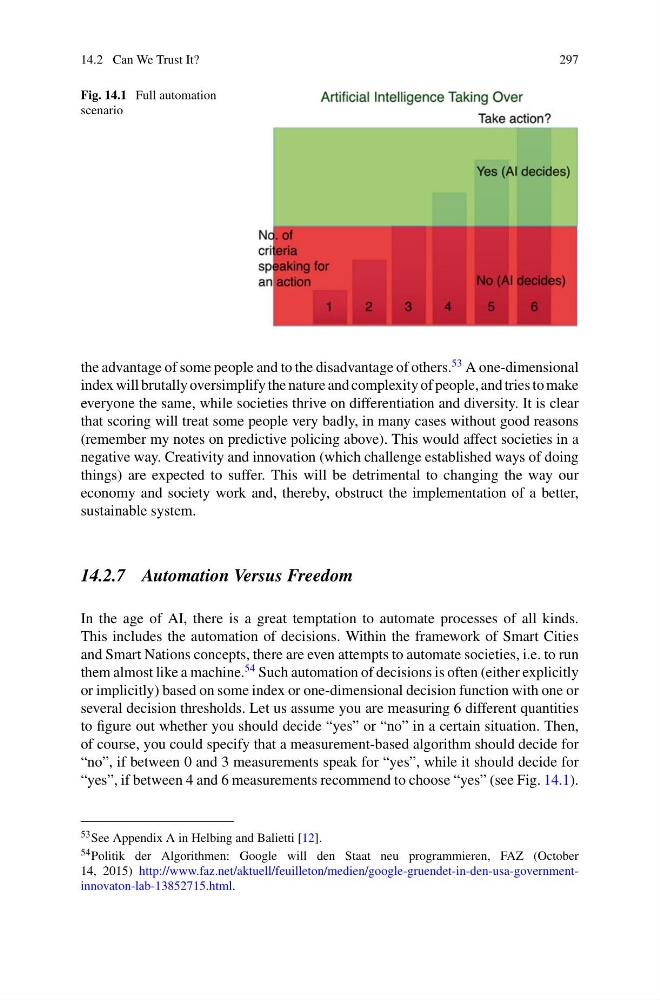
Fig. 14.1 Full automation
scenario
the advantage of some people and to the disadvantage of others.
53 A one-dimensional
index will brutally oversimplify the nature and complexity of people, and tries to make
everyone the same, while societies thrive on differentiation and diversity. It is clear
that scoring will treat some people very badly, in many cases without good reasons
(remember my notes on predictive policing above). This would affect societies in a
negative way. Creativity and innovation (which challenge established ways of doing
things) are expected to suffer. This will be detrimental to changing the way our
economy and society work and, thereby, obstruct the implementation of a better,
sustainable system.
14.2.7 Automation Versus Freedom
In the age of AI, there is a great temptation to automate processes of all kinds.
This includes the automation of decisions. Within the framework of Smart Cities
and Smart Nations concepts, there are even attempts to automate societies, i.e. to run
them almost like a machine.
54 Such automation of decisions is often (either explicitly
or implicitly) based on some index or one-dimensional decision function with one or
several decision thresholds. Let us assume you are measuring 6 different quantities
to figure out whether you should decide “yes” or “no” in a certain situation. Then,
of course, you could specify that a measurement-based algorithm should decide for
“no”, if between 0 and 3 measurements speak for “yes”, while it should decide for
“yes”, if between 4 and 6 measurements recommend to choose “yes” (see Fig. 14.1).
53 See Appendix A in Helbing and Balietti [12].
54 Politik der Algorithmen: Google will den Staat neu programmieren, FAZ (October
14, 2015) http://www.faz.net/aktuell/feuilleton/medien/google-gruendet-in-den-usa-governmentinnovaton-lab-13852715.html.
297
Fig. 14.1 Full automation
scenario
the advantage of some people and to the disadvantage of others.
53 A one-dimensional
index will brutally oversimplify the nature and complexity of people, and tries to make
everyone the same, while societies thrive on differentiation and diversity. It is clear
that scoring will treat some people very badly, in many cases without good reasons
(remember my notes on predictive policing above). This would affect societies in a
negative way. Creativity and innovation (which challenge established ways of doing
things) are expected to suffer. This will be detrimental to changing the way our
economy and society work and, thereby, obstruct the implementation of a better,
sustainable system.
14.2.7 Automation Versus Freedom
In the age of AI, there is a great temptation to automate processes of all kinds.
This includes the automation of decisions. Within the framework of Smart Cities
and Smart Nations concepts, there are even attempts to automate societies, i.e. to run
them almost like a machine.
54 Such automation of decisions is often (either explicitly
or implicitly) based on some index or one-dimensional decision function with one or
several decision thresholds. Let us assume you are measuring 6 different quantities
to figure out whether you should decide “yes” or “no” in a certain situation. Then,
of course, you could specify that a measurement-based algorithm should decide for
“no”, if between 0 and 3 measurements speak for “yes”, while it should decide for
“yes”, if between 4 and 6 measurements recommend to choose “yes” (see Fig. 14.1).
53 See Appendix A in Helbing and Balietti [12].
54 Politik der Algorithmen: Google will den Staat neu programmieren, FAZ (October
14, 2015) http://www.faz.net/aktuell/feuilleton/medien/google-gruendet-in-den-usa-governmentinnovaton-lab-13852715.html.