

146
7 Digitally Assisted Self-Organization
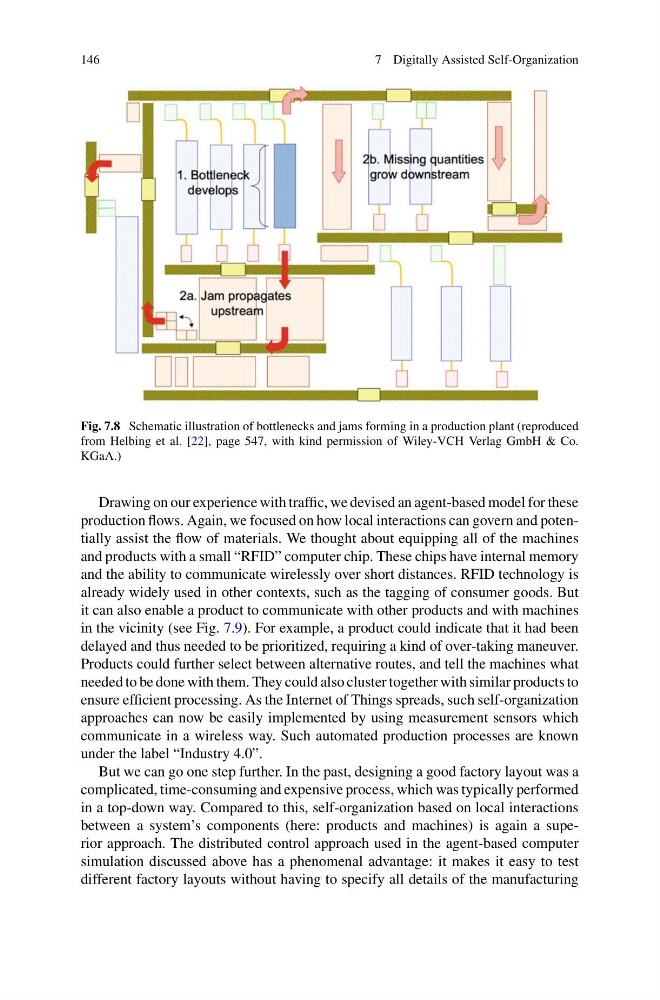
Fig. 7.8 Schematic illustration of bottlenecks and jams forming in a production plant (reproduced
from Helbing et al. [22], page 547, with kind permission of Wiley-VCH Verlag GmbH & Co.
KGaA.)
Drawing on our experience with traffic, we devised an agent-based model for these
production flows. Again, we focused on how local interactions can govern and potentially assist the flow of materials. We thought about equipping all of the machines
and products with a small “RFID” computer chip. These chips have internal memory
and the ability to communicate wirelessly over short distances. RFID technology is
already widely used in other contexts, such as the tagging of consumer goods. But
it can also enable a product to communicate with other products and with machines
in the vicinity (see Fig. 7.9). For example, a product could indicate that it had been
delayed and thus needed to be prioritized, requiring a kind of over-taking maneuver.
Products could further select between alternative routes, and tell the machines what
needed to be done with them. They could also cluster together with similar products to
ensure efficient processing. As the Internet of Things spreads, such self-organization
approaches can now be easily implemented by using measurement sensors which
communicate in a wireless way. Such automated production processes are known
under the label “Industry 4.0”.
But we can go one step further. In the past, designing a good factory layout was a
complicated, time-consuming and expensive process, which was typically performed
in a top-down way. Compared to this, self-organization based on local interactions
between a system’s components (here: products and machines) is again a superior approach. The distributed control approach used in the agent-based computer
simulation discussed above has a phenomenal advantage: it makes it easy to test
different factory layouts without having to specify all details of the manufacturing
7 Digitally Assisted Self-Organization
Fig. 7.8 Schematic illustration of bottlenecks and jams forming in a production plant (reproduced
from Helbing et al. [22], page 547, with kind permission of Wiley-VCH Verlag GmbH & Co.
KGaA.)
Drawing on our experience with traffic, we devised an agent-based model for these
production flows. Again, we focused on how local interactions can govern and potentially assist the flow of materials. We thought about equipping all of the machines
and products with a small “RFID” computer chip. These chips have internal memory
and the ability to communicate wirelessly over short distances. RFID technology is
already widely used in other contexts, such as the tagging of consumer goods. But
it can also enable a product to communicate with other products and with machines
in the vicinity (see Fig. 7.9). For example, a product could indicate that it had been
delayed and thus needed to be prioritized, requiring a kind of over-taking maneuver.
Products could further select between alternative routes, and tell the machines what
needed to be done with them. They could also cluster together with similar products to
ensure efficient processing. As the Internet of Things spreads, such self-organization
approaches can now be easily implemented by using measurement sensors which
communicate in a wireless way. Such automated production processes are known
under the label “Industry 4.0”.
But we can go one step further. In the past, designing a good factory layout was a
complicated, time-consuming and expensive process, which was typically performed
in a top-down way. Compared to this, self-organization based on local interactions
between a system’s components (here: products and machines) is again a superior approach. The distributed control approach used in the agent-based computer
simulation discussed above has a phenomenal advantage: it makes it easy to test
different factory layouts without having to specify all details of the manufacturing