

7.9 How to Outsmart Centralized Control
141
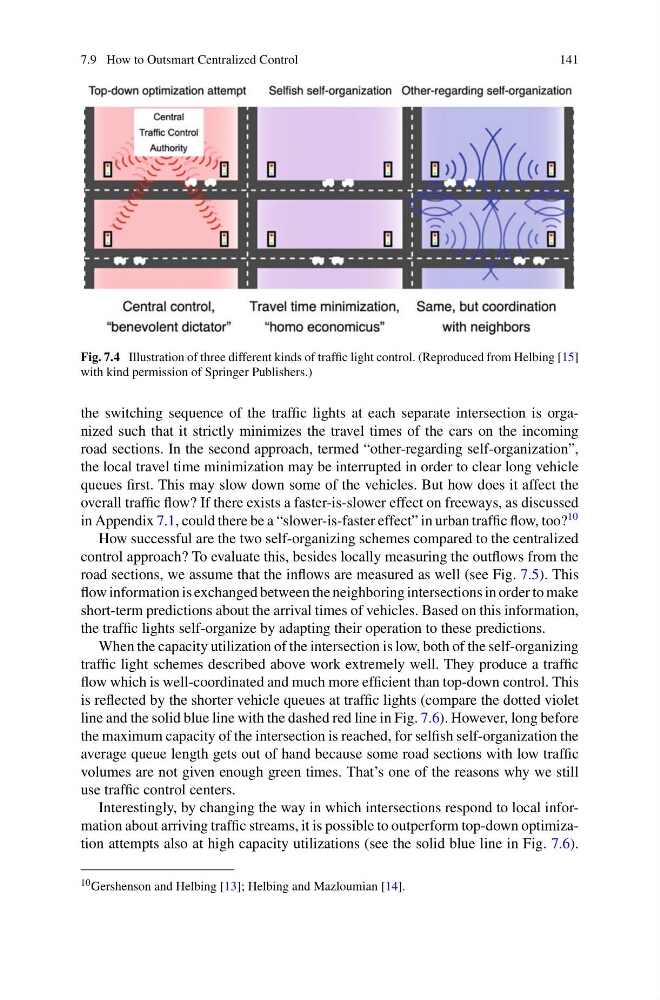
Fig. 7.4 Illustration of three different kinds of traffic light control. (Reproduced from Helbing [15]
with kind permission of Springer Publishers.)
the switching sequence of the traffic lights at each separate intersection is organized such that it strictly minimizes the travel times of the cars on the incoming
road sections. In the second approach, termed “other-regarding self-organization”,
the local travel time minimization may be interrupted in order to clear long vehicle
queues first. This may slow down some of the vehicles. But how does it affect the
overall traffic flow? If there exists a faster-is-slower effect on freeways, as discussed
in Appendix 7.1, could there be a “slower-is-faster effect” in urban traffic flow, too?
10
How successful are the two self-organizing schemes compared to the centralized
control approach? To evaluate this, besides locally measuring the outflows from the
road sections, we assume that the inflows are measured as well (see Fig. 7.5). This
flow information is exchanged between the neighboring intersections in order to make
short-term predictions about the arrival times of vehicles. Based on this information,
the traffic lights self-organize by adapting their operation to these predictions.
When the capacity utilization of the intersection is low, both of the self-organizing
traffic light schemes described above work extremely well. They produce a traffic
flow which is well-coordinated and much more efficient than top-down control. This
is reflected by the shorter vehicle queues at traffic lights (compare the dotted violet
line and the solid blue line with the dashed red line in Fig. 7.6). However, long before
the maximum capacity of the intersection is reached, for selfish self-organization the
average queue length gets out of hand because some road sections with low traffic
volumes are not given enough green times. That’s one of the reasons why we still
use traffic control centers.
Interestingly, by changing the way in which intersections respond to local information about arriving traffic streams, it is possible to outperform top-down optimization attempts also at high capacity utilizations (see the solid blue line in Fig. 7.6).
10 Gershenson and Helbing [13]; Helbing and Mazloumian [14].
141
Fig. 7.4 Illustration of three different kinds of traffic light control. (Reproduced from Helbing [15]
with kind permission of Springer Publishers.)
the switching sequence of the traffic lights at each separate intersection is organized such that it strictly minimizes the travel times of the cars on the incoming
road sections. In the second approach, termed “other-regarding self-organization”,
the local travel time minimization may be interrupted in order to clear long vehicle
queues first. This may slow down some of the vehicles. But how does it affect the
overall traffic flow? If there exists a faster-is-slower effect on freeways, as discussed
in Appendix 7.1, could there be a “slower-is-faster effect” in urban traffic flow, too?
10
How successful are the two self-organizing schemes compared to the centralized
control approach? To evaluate this, besides locally measuring the outflows from the
road sections, we assume that the inflows are measured as well (see Fig. 7.5). This
flow information is exchanged between the neighboring intersections in order to make
short-term predictions about the arrival times of vehicles. Based on this information,
the traffic lights self-organize by adapting their operation to these predictions.
When the capacity utilization of the intersection is low, both of the self-organizing
traffic light schemes described above work extremely well. They produce a traffic
flow which is well-coordinated and much more efficient than top-down control. This
is reflected by the shorter vehicle queues at traffic lights (compare the dotted violet
line and the solid blue line with the dashed red line in Fig. 7.6). However, long before
the maximum capacity of the intersection is reached, for selfish self-organization the
average queue length gets out of hand because some road sections with low traffic
volumes are not given enough green times. That’s one of the reasons why we still
use traffic control centers.
Interestingly, by changing the way in which intersections respond to local information about arriving traffic streams, it is possible to outperform top-down optimization attempts also at high capacity utilizations (see the solid blue line in Fig. 7.6).
10 Gershenson and Helbing [13]; Helbing and Mazloumian [14].