

134
7 Digitally Assisted Self-Organization
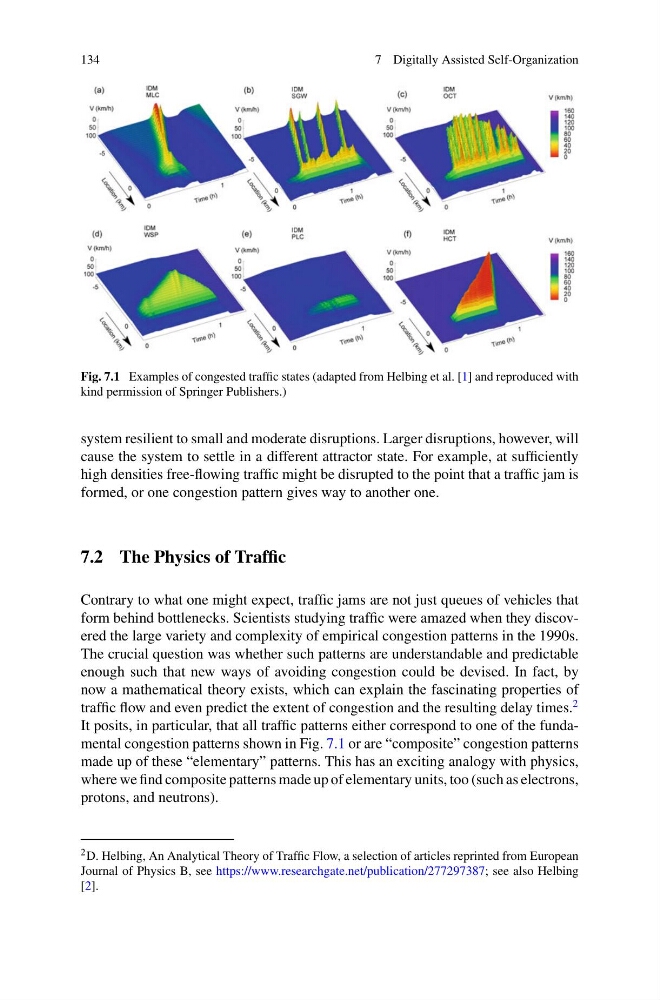
Fig. 7.1 Examples of congested traffic states (adapted from Helbing et al. [1] and reproduced with
kind permission of Springer Publishers.)
system resilient to small and moderate disruptions. Larger disruptions, however, will
cause the system to settle in a different attractor state. For example, at sufficiently
high densities free-flowing traffic might be disrupted to the point that a traffic jam is
formed, or one congestion pattern gives way to another one.
7.2 The Physics of Traffic
Contrary to what one might expect, traffic jams are not just queues of vehicles that
form behind bottlenecks. Scientists studying traffic were amazed when they discovered the large variety and complexity of empirical congestion patterns in the 1990s.
The crucial question was whether such patterns are understandable and predictable
enough such that new ways of avoiding congestion could be devised. In fact, by
now a mathematical theory exists, which can explain the fascinating properties of
traffic flow and even predict the extent of congestion and the resulting delay times.
2
It posits, in particular, that all traffic patterns either correspond to one of the fundamental congestion patterns shown in Fig. 7.1 or are “composite” congestion patterns
made up of these “elementary” patterns. This has an exciting analogy with physics,
where we find composite patterns made up of elementary units, too (such as electrons,
protons, and neutrons).
2 D. Helbing, An Analytical Theory of Traffic Flow, a selection of articles reprinted from European
Journal of Physics B, see https://www.researchgate.net/publication/277297387; see also Helbing
[2].
7 Digitally Assisted Self-Organization
Fig. 7.1 Examples of congested traffic states (adapted from Helbing et al. [1] and reproduced with
kind permission of Springer Publishers.)
system resilient to small and moderate disruptions. Larger disruptions, however, will
cause the system to settle in a different attractor state. For example, at sufficiently
high densities free-flowing traffic might be disrupted to the point that a traffic jam is
formed, or one congestion pattern gives way to another one.
7.2 The Physics of Traffic
Contrary to what one might expect, traffic jams are not just queues of vehicles that
form behind bottlenecks. Scientists studying traffic were amazed when they discovered the large variety and complexity of empirical congestion patterns in the 1990s.
The crucial question was whether such patterns are understandable and predictable
enough such that new ways of avoiding congestion could be devised. In fact, by
now a mathematical theory exists, which can explain the fascinating properties of
traffic flow and even predict the extent of congestion and the resulting delay times.
2
It posits, in particular, that all traffic patterns either correspond to one of the fundamental congestion patterns shown in Fig. 7.1 or are “composite” congestion patterns
made up of these “elementary” patterns. This has an exciting analogy with physics,
where we find composite patterns made up of elementary units, too (such as electrons,
protons, and neutrons).
2 D. Helbing, An Analytical Theory of Traffic Flow, a selection of articles reprinted from European
Journal of Physics B, see https://www.researchgate.net/publication/277297387; see also Helbing
[2].