

74
R. S. MacKay
˙
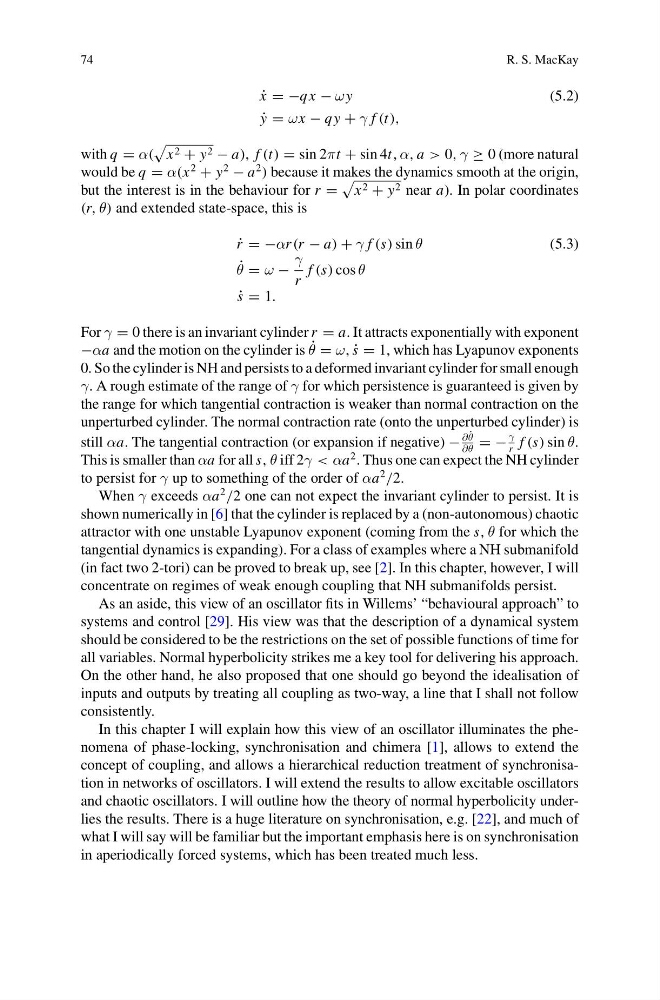
x = −qx − ω y
(5.2)
˙
y = ωx − qy + γ f (t),
with q = α(
x 2 + y 2 − a), f (t) = sin 2πt + sin 4t, α, a > 0, γ ≥ 0 (more natural
would be q = α(x
2
+ y
2
− a
2
) because it makes the dynamics smooth at the origin,
but the interest is in the behaviour for r =
x 2 + y 2 near a). In polar coordinates
(r, θ) and extended state-space, this is
˙
r = −αr (r − a) + γ f (s) sin θ
(5.3)
˙
θ = ω −
γ
r
f (s) cos θ
˙
s = 1.
For γ = 0 there is an invariant cylinder r = a. It attracts exponentially with exponent
−αa and the motion on the cylinder is ˙
θ = ω, ˙
s = 1, which has Lyapunov exponents
0. So the cylinder is NH and persists to a deformed invariant cylinder for small enough
γ. A rough estimate of the range of γ for which persistence is guaranteed is given by
the range for which tangential contraction is weaker than normal contraction on the
unperturbed cylinder. The normal contraction rate (onto the unperturbed cylinder) is
still αa. The tangential contraction (or expansion if negative) −
∂ ˙
θ
∂θ
= −
γ
r
f (s) sin θ.
This is smaller than αa for all s, θ iff 2γ < αa
2 . Thus one can expect the NH cylinder
to persist for γ up to something of the order of αa
2
/2.
When γ exceeds αa
2
/2 one can not expect the invariant cylinder to persist. It is
shown numerically in [6] that the cylinder is replaced by a (non-autonomous) chaotic
attractor with one unstable Lyapunov exponent (coming from the s, θ for which the
tangential dynamics is expanding). For a class of examples where a NH submanifold
(in fact two 2-tori) can be proved to break up, see [2]. In this chapter, however, I will
concentrate on regimes of weak enough coupling that NH submanifolds persist.
As an aside, this view of an oscillator fits in Willems’ “behavioural approach” to
systems and control [29]. His view was that the description of a dynamical system
should be considered to be the restrictions on the set of possible functions of time for
all variables. Normal hyperbolicity strikes me a key tool for delivering his approach.
On the other hand, he also proposed that one should go beyond the idealisation of
inputs and outputs by treating all coupling as two-way, a line that I shall not follow
consistently.
In this chapter I will explain how this view of an oscillator illuminates the phenomena of phase-locking, synchronisation and chimera [1], allows to extend the
concept of coupling, and allows a hierarchical reduction treatment of synchronisation in networks of oscillators. I will extend the results to allow excitable oscillators
and chaotic oscillators. I will outline how the theory of normal hyperbolicity underlies the results. There is a huge literature on synchronisation, e.g. [22], and much of
what I will say will be familiar but the important emphasis here is on synchronisation
in aperiodically forced systems, which has been treated much less.
R. S. MacKay
˙
x = −qx − ω y
(5.2)
˙
y = ωx − qy + γ f (t),
with q = α(
x 2 + y 2 − a), f (t) = sin 2πt + sin 4t, α, a > 0, γ ≥ 0 (more natural
would be q = α(x
2
+ y
2
− a
2
) because it makes the dynamics smooth at the origin,
but the interest is in the behaviour for r =
x 2 + y 2 near a). In polar coordinates
(r, θ) and extended state-space, this is
˙
r = −αr (r − a) + γ f (s) sin θ
(5.3)
˙
θ = ω −
γ
r
f (s) cos θ
˙
s = 1.
For γ = 0 there is an invariant cylinder r = a. It attracts exponentially with exponent
−αa and the motion on the cylinder is ˙
θ = ω, ˙
s = 1, which has Lyapunov exponents
0. So the cylinder is NH and persists to a deformed invariant cylinder for small enough
γ. A rough estimate of the range of γ for which persistence is guaranteed is given by
the range for which tangential contraction is weaker than normal contraction on the
unperturbed cylinder. The normal contraction rate (onto the unperturbed cylinder) is
still αa. The tangential contraction (or expansion if negative) −
∂ ˙
θ
∂θ
= −
γ
r
f (s) sin θ.
This is smaller than αa for all s, θ iff 2γ < αa
2 . Thus one can expect the NH cylinder
to persist for γ up to something of the order of αa
2
/2.
When γ exceeds αa
2
/2 one can not expect the invariant cylinder to persist. It is
shown numerically in [6] that the cylinder is replaced by a (non-autonomous) chaotic
attractor with one unstable Lyapunov exponent (coming from the s, θ for which the
tangential dynamics is expanding). For a class of examples where a NH submanifold
(in fact two 2-tori) can be proved to break up, see [2]. In this chapter, however, I will
concentrate on regimes of weak enough coupling that NH submanifolds persist.
As an aside, this view of an oscillator fits in Willems’ “behavioural approach” to
systems and control [29]. His view was that the description of a dynamical system
should be considered to be the restrictions on the set of possible functions of time for
all variables. Normal hyperbolicity strikes me a key tool for delivering his approach.
On the other hand, he also proposed that one should go beyond the idealisation of
inputs and outputs by treating all coupling as two-way, a line that I shall not follow
consistently.
In this chapter I will explain how this view of an oscillator illuminates the phenomena of phase-locking, synchronisation and chimera [1], allows to extend the
concept of coupling, and allows a hierarchical reduction treatment of synchronisation in networks of oscillators. I will extend the results to allow excitable oscillators
and chaotic oscillators. I will outline how the theory of normal hyperbolicity underlies the results. There is a huge literature on synchronisation, e.g. [22], and much of
what I will say will be familiar but the important emphasis here is on synchronisation
in aperiodically forced systems, which has been treated much less.