

5 Normal Hyperbolicity for Non-autonomous Oscillators and Oscillator Networks
73
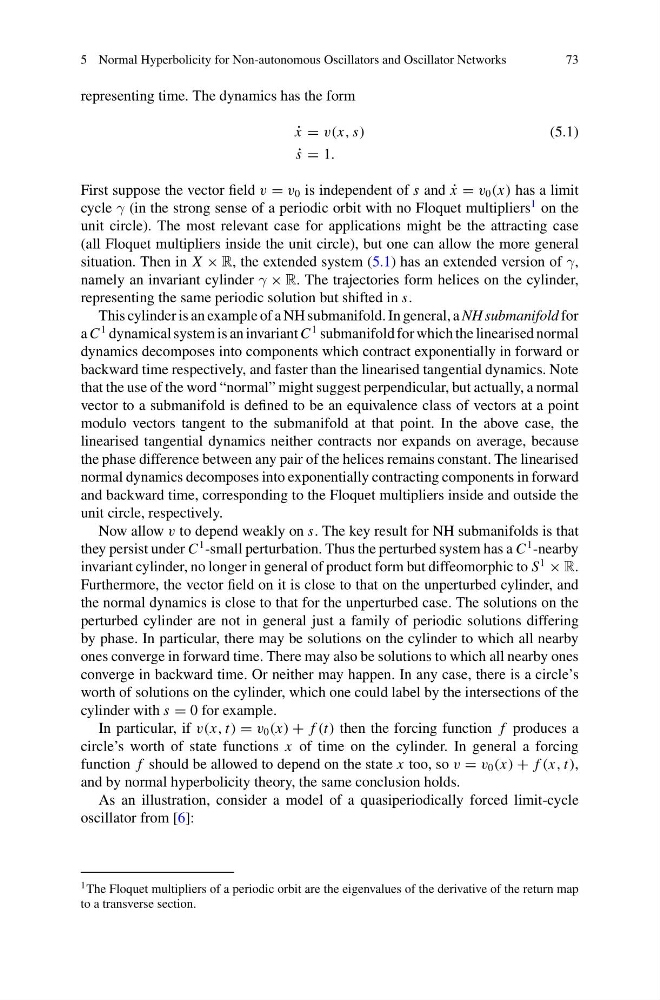
representing time. The dynamics has the form
˙
x = v(x, s)
(5.1)
˙
s = 1.
First suppose the vector field v = v 0 is independent of s and ˙
x = v 0 (x) has a limit
cycle γ (in the strong sense of a periodic orbit with no Floquet multipliers
1 on the
unit circle). The most relevant case for applications might be the attracting case
(all Floquet multipliers inside the unit circle), but one can allow the more general
situation. Then in X × R, the extended system (5.1) has an extended version of γ,
namely an invariant cylinder γ × R. The trajectories form helices on the cylinder,
representing the same periodic solution but shifted in s.
This cylinder is an example of a NH submanifold. In general, a NH submanifold for
a C
1 dynamical system is an invariant C
1 submanifold for which the linearised normal
dynamics decomposes into components which contract exponentially in forward or
backward time respectively, and faster than the linearised tangential dynamics. Note
that the use of the word “normal” might suggest perpendicular, but actually, a normal
vector to a submanifold is defined to be an equivalence class of vectors at a point
modulo vectors tangent to the submanifold at that point. In the above case, the
linearised tangential dynamics neither contracts nor expands on average, because
the phase difference between any pair of the helices remains constant. The linearised
normal dynamics decomposes into exponentially contracting components in forward
and backward time, corresponding to the Floquet multipliers inside and outside the
unit circle, respectively.
Now allow v to depend weakly on s. The key result for NH submanifolds is that
they persist under C
1 -small perturbation. Thus the perturbed system has a C
1 -nearby
invariant cylinder, no longer in general of product form but diffeomorphic to S
1
× R.
Furthermore, the vector field on it is close to that on the unperturbed cylinder, and
the normal dynamics is close to that for the unperturbed case. The solutions on the
perturbed cylinder are not in general just a family of periodic solutions differing
by phase. In particular, there may be solutions on the cylinder to which all nearby
ones converge in forward time. There may also be solutions to which all nearby ones
converge in backward time. Or neither may happen. In any case, there is a circle’s
worth of solutions on the cylinder, which one could label by the intersections of the
cylinder with s = 0 for example.
In particular, if v(x, t) = v 0 (x) + f (t) then the forcing function f produces a
circle’s worth of state functions x of time on the cylinder. In general a forcing
function f should be allowed to depend on the state x too, so v = v 0 (x) + f (x, t),
and by normal hyperbolicity theory, the same conclusion holds.
As an illustration, consider a model of a quasiperiodically forced limit-cycle
oscillator from [6]:
1 The Floquet multipliers of a periodic orbit are the eigenvalues of the derivative of the return map
to a transverse section.
73
representing time. The dynamics has the form
˙
x = v(x, s)
(5.1)
˙
s = 1.
First suppose the vector field v = v 0 is independent of s and ˙
x = v 0 (x) has a limit
cycle γ (in the strong sense of a periodic orbit with no Floquet multipliers
1 on the
unit circle). The most relevant case for applications might be the attracting case
(all Floquet multipliers inside the unit circle), but one can allow the more general
situation. Then in X × R, the extended system (5.1) has an extended version of γ,
namely an invariant cylinder γ × R. The trajectories form helices on the cylinder,
representing the same periodic solution but shifted in s.
This cylinder is an example of a NH submanifold. In general, a NH submanifold for
a C
1 dynamical system is an invariant C
1 submanifold for which the linearised normal
dynamics decomposes into components which contract exponentially in forward or
backward time respectively, and faster than the linearised tangential dynamics. Note
that the use of the word “normal” might suggest perpendicular, but actually, a normal
vector to a submanifold is defined to be an equivalence class of vectors at a point
modulo vectors tangent to the submanifold at that point. In the above case, the
linearised tangential dynamics neither contracts nor expands on average, because
the phase difference between any pair of the helices remains constant. The linearised
normal dynamics decomposes into exponentially contracting components in forward
and backward time, corresponding to the Floquet multipliers inside and outside the
unit circle, respectively.
Now allow v to depend weakly on s. The key result for NH submanifolds is that
they persist under C
1 -small perturbation. Thus the perturbed system has a C
1 -nearby
invariant cylinder, no longer in general of product form but diffeomorphic to S
1
× R.
Furthermore, the vector field on it is close to that on the unperturbed cylinder, and
the normal dynamics is close to that for the unperturbed case. The solutions on the
perturbed cylinder are not in general just a family of periodic solutions differing
by phase. In particular, there may be solutions on the cylinder to which all nearby
ones converge in forward time. There may also be solutions to which all nearby ones
converge in backward time. Or neither may happen. In any case, there is a circle’s
worth of solutions on the cylinder, which one could label by the intersections of the
cylinder with s = 0 for example.
In particular, if v(x, t) = v 0 (x) + f (t) then the forcing function f produces a
circle’s worth of state functions x of time on the cylinder. In general a forcing
function f should be allowed to depend on the state x too, so v = v 0 (x) + f (x, t),
and by normal hyperbolicity theory, the same conclusion holds.
As an illustration, consider a model of a quasiperiodically forced limit-cycle
oscillator from [6]:
1 The Floquet multipliers of a periodic orbit are the eigenvalues of the derivative of the return map
to a transverse section.