

3 Reduced Phase Models of Oscillatory Neural Networks
49
As to connectivity effects, we have to conclude that a reduced phase model cannot
account for changes in the underlying network topology. Realistic structural connectivity has devastating impact on the network dynamics in that the collective behavior
drastically differs from that for homogeneous connectivity. Even the numerically
reduced phase model was no longer capable of capturing the actual network dynamics and could also no longer outperform the other reduction techniques. All phase
reduction techniques performed equally well. Neither the Kuramoto order parameter dynamics nor the phase diagrams were informative for the network states with
realistic structural connectivity. It may hence be helpful to first identify meaningful
observables that link structure and dynamics of the network. Once this has been
achieved for networks of general oscillators vis-á-vis networks of phase oscillators,
we may be able to answer the question whether a reduced phase model retains the
same structural-dynamical properties of the full network and can thus be used to
predict also exotic network effects that arise due to complex structural connectivity.
Appendix
Following the literature [43, 45], we considered E and I as bifurcation parameters
and fixed the other parameters of the Wilson-Cowan neural mass model Eq. (3.1) as
a E = 1, a I = 1, c E E = c E I = c I E = 10, c I I = −2.
(3.8)
The numerical phase reduction technique correctly predicts the stability of the
globally synchronized state for parameters (( E , , I ) = (−3, −9.38), of the incoherent state for (( E , , I ) = (−3, −8.9), and of the balanced two-cluster state for
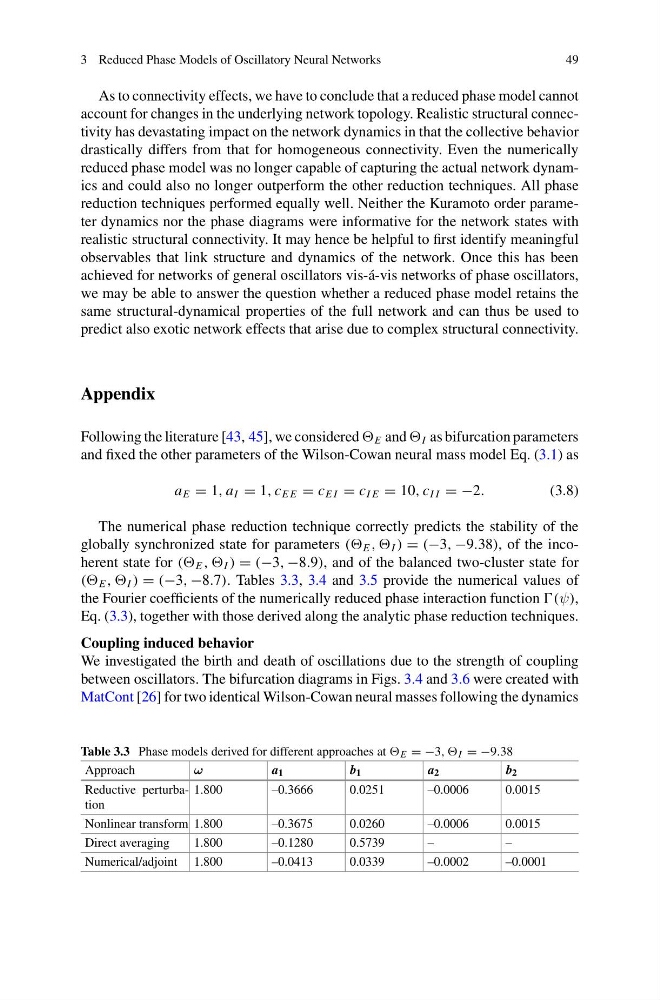
(( E , , I ) = (−3, −8.7). Tables 3.3, 3.4 and 3.5 provide the numerical values of
the Fourier coefficients of the numerically reduced phase interaction function (ψ),
Eq. (3.3), together with those derived along the analytic phase reduction techniques.
Coupling induced behavior
We investigated the birth and death of oscillations due to the strength of coupling
between oscillators. The bifurcation diagrams in Figs. 3.4 and 3.6 were created with
MatCont [26] for two identical Wilson-Cowan neural masses following the dynamics
Table 3.3 Phase models derived for different approaches at E = −3, , I = −9.38
Approach
ω
a 1
b 1
a 2
b 2
Reductive perturbation
1.800
–0.3666
0.0251
–0.0006
0.0015
Nonlinear transform 1.800
–0.3675
0.0260
–0.0006
0.0015
Direct averaging
1.800
–0.1280
0.5739
–
–
Numerical/adjoint 1.800
–0.0413
0.0339
–0.0002
–0.0001
49
As to connectivity effects, we have to conclude that a reduced phase model cannot
account for changes in the underlying network topology. Realistic structural connectivity has devastating impact on the network dynamics in that the collective behavior
drastically differs from that for homogeneous connectivity. Even the numerically
reduced phase model was no longer capable of capturing the actual network dynamics and could also no longer outperform the other reduction techniques. All phase
reduction techniques performed equally well. Neither the Kuramoto order parameter dynamics nor the phase diagrams were informative for the network states with
realistic structural connectivity. It may hence be helpful to first identify meaningful
observables that link structure and dynamics of the network. Once this has been
achieved for networks of general oscillators vis-á-vis networks of phase oscillators,
we may be able to answer the question whether a reduced phase model retains the
same structural-dynamical properties of the full network and can thus be used to
predict also exotic network effects that arise due to complex structural connectivity.
Appendix
Following the literature [43, 45], we considered E and I as bifurcation parameters
and fixed the other parameters of the Wilson-Cowan neural mass model Eq. (3.1) as
a E = 1, a I = 1, c E E = c E I = c I E = 10, c I I = −2.
(3.8)
The numerical phase reduction technique correctly predicts the stability of the
globally synchronized state for parameters (( E , , I ) = (−3, −9.38), of the incoherent state for (( E , , I ) = (−3, −8.9), and of the balanced two-cluster state for
(( E , , I ) = (−3, −8.7). Tables 3.3, 3.4 and 3.5 provide the numerical values of
the Fourier coefficients of the numerically reduced phase interaction function (ψ),
Eq. (3.3), together with those derived along the analytic phase reduction techniques.
Coupling induced behavior
We investigated the birth and death of oscillations due to the strength of coupling
between oscillators. The bifurcation diagrams in Figs. 3.4 and 3.6 were created with
MatCont [26] for two identical Wilson-Cowan neural masses following the dynamics
Table 3.3 Phase models derived for different approaches at E = −3, , I = −9.38
Approach
ω
a 1
b 1
a 2
b 2
Reductive perturbation
1.800
–0.3666
0.0251
–0.0006
0.0015
Nonlinear transform 1.800
–0.3675
0.0260
–0.0006
0.0015
Direct averaging
1.800
–0.1280
0.5739
–
–
Numerical/adjoint 1.800
–0.0413
0.0339
–0.0002
–0.0001