

26 Phase Coherence Between Cardiovascular Oscillations in Malaria …
407
26.3.2 Extracting the Instantaneous Heart Frequency
The instantaneous heart rate (IHR) was extracted from the data using both timefrequency and time domain analysis techniques [16]. The methods used included
nonlinear mode decomposition (NMD) [17], a technique that decomposes a signal
into a set of components, or modes. Using NMD, the instantaneous frequency of
the heart beat was extracted from the wavelet transform of the ECG, thus yielding
the IHR. The IHR was also derived from the LDF signals using the same technique.
Note that in the literature [15, 26] IHR is often referred to as HRV and, occasionally,
as IHF.
26.3.3 Wavelet Phase Coherence
While waves can be coherent in space, oscillations can be coherent in time. Quite
generally, correlation properties between physical quantities, whether at a single
or several oscillation frequencies, can be studied by investigating their coherence in
time. If we observe oscillations at the same frequency in two different time series and
find that the difference between their instantaneous phases φ 1k , n and φ 2k , n is constant,
then the oscillations are said to be coherent at that frequency [3, 5, 32]. A phenomenon
closely related to phase coherence is that of phase synchronization [13, 20, 28, 30].
While oscillations can be coherent without necessarily being directly coupled, the
existence of coupling is fundamental for synchronization [8]. For example, if we
have an n:m relationship between the frequencies of two signals, this implies that
there are n oscillation cycles in one time series per m cycles of the other time series:
1:1 phase synchronization may equally be considered as phase coherent oscillations.
Thus phase coherence can be used directly to investigate 1:1 synchronization between
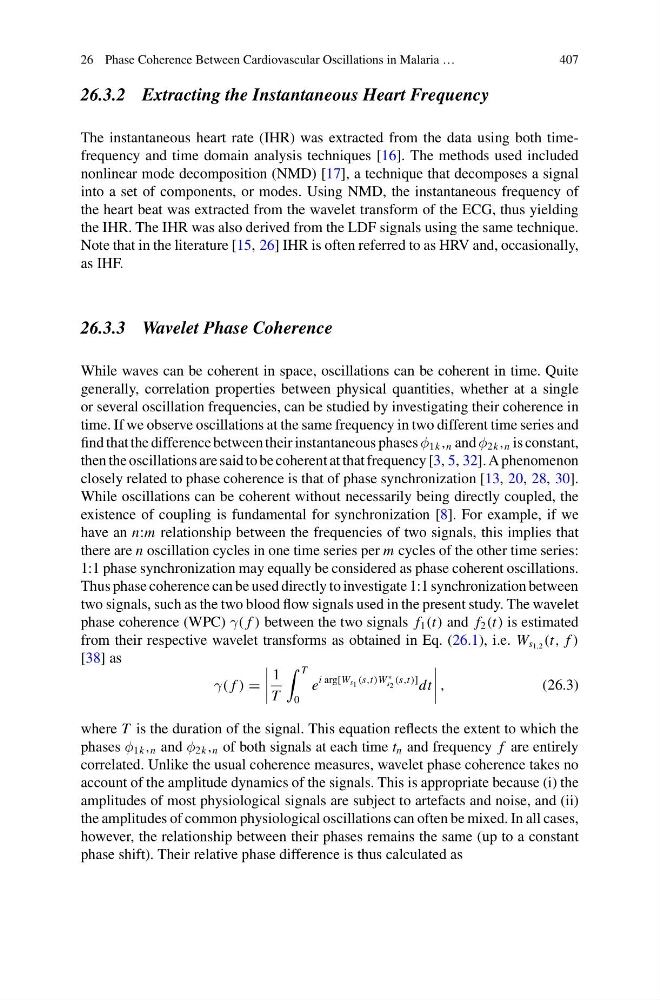
two signals, such as the two blood flow signals used in the present study. The wavelet
phase coherence (WPC) γ( f ) between the two signals f 1 (t) and f 2 (t) is estimated
from their respective wavelet transforms as obtained in Eq. (26.1), i.e. W s 1,2 (t, f )
[38] as
γ( f ) =
1
T
T
0
e
i arg[W s 1 (s,t)W
∗
s 2
(s,t)] dt
,
(26.3)
where T is the duration of the signal. This equation reflects the extent to which the
phases φ 1k , n and φ 2k , n of both signals at each time t n and frequency f are entirely
correlated. Unlike the usual coherence measures, wavelet phase coherence takes no
account of the amplitude dynamics of the signals. This is appropriate because (i) the
amplitudes of most physiological signals are subject to artefacts and noise, and (ii)
the amplitudes of common physiological oscillations can often be mixed. In all cases,
however, the relationship between their phases remains the same (up to a constant
phase shift). Their relative phase difference is thus calculated as
407
26.3.2 Extracting the Instantaneous Heart Frequency
The instantaneous heart rate (IHR) was extracted from the data using both timefrequency and time domain analysis techniques [16]. The methods used included
nonlinear mode decomposition (NMD) [17], a technique that decomposes a signal
into a set of components, or modes. Using NMD, the instantaneous frequency of
the heart beat was extracted from the wavelet transform of the ECG, thus yielding
the IHR. The IHR was also derived from the LDF signals using the same technique.
Note that in the literature [15, 26] IHR is often referred to as HRV and, occasionally,
as IHF.
26.3.3 Wavelet Phase Coherence
While waves can be coherent in space, oscillations can be coherent in time. Quite
generally, correlation properties between physical quantities, whether at a single
or several oscillation frequencies, can be studied by investigating their coherence in
time. If we observe oscillations at the same frequency in two different time series and
find that the difference between their instantaneous phases φ 1k , n and φ 2k , n is constant,
then the oscillations are said to be coherent at that frequency [3, 5, 32]. A phenomenon
closely related to phase coherence is that of phase synchronization [13, 20, 28, 30].
While oscillations can be coherent without necessarily being directly coupled, the
existence of coupling is fundamental for synchronization [8]. For example, if we
have an n:m relationship between the frequencies of two signals, this implies that
there are n oscillation cycles in one time series per m cycles of the other time series:
1:1 phase synchronization may equally be considered as phase coherent oscillations.
Thus phase coherence can be used directly to investigate 1:1 synchronization between
two signals, such as the two blood flow signals used in the present study. The wavelet
phase coherence (WPC) γ( f ) between the two signals f 1 (t) and f 2 (t) is estimated
from their respective wavelet transforms as obtained in Eq. (26.1), i.e. W s 1,2 (t, f )
[38] as
γ( f ) =
1
T
T
0
e
i arg[W s 1 (s,t)W
∗
s 2
(s,t)] dt
,
(26.3)
where T is the duration of the signal. This equation reflects the extent to which the
phases φ 1k , n and φ 2k , n of both signals at each time t n and frequency f are entirely
correlated. Unlike the usual coherence measures, wavelet phase coherence takes no
account of the amplitude dynamics of the signals. This is appropriate because (i) the
amplitudes of most physiological signals are subject to artefacts and noise, and (ii)
the amplitudes of common physiological oscillations can often be mixed. In all cases,
however, the relationship between their phases remains the same (up to a constant
phase shift). Their relative phase difference is thus calculated as