

24 Processed EEG as a Measure of Brain Activity During Anaesthesia
379
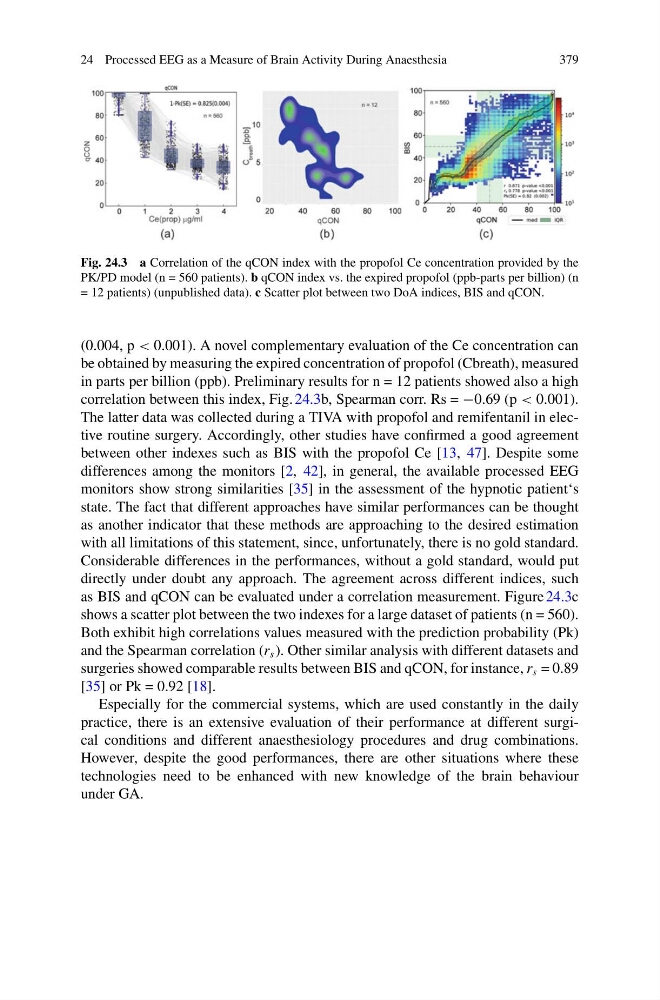
Fig. 24.3 a Correlation of the qCON index with the propofol Ce concentration provided by the
PK/PD model (n = 560 patients). b qCON index vs. the expired propofol (ppb-parts per billion) (n
= 12 patients) (unpublished data). c Scatter plot between two DoA indices, BIS and qCON.
(0.004, p < 0.001). A novel complementary evaluation of the Ce concentration can
be obtained by measuring the expired concentration of propofol (Cbreath), measured
in parts per billion (ppb). Preliminary results for n = 12 patients showed also a high
correlation between this index, Fig. 24.3b, Spearman corr. Rs = −0.69 (p < 0.001).
The latter data was collected during a TIVA with propofol and remifentanil in elective routine surgery. Accordingly, other studies have confirmed a good agreement
between other indexes such as BIS with the propofol Ce [13, 47]. Despite some
differences among the monitors [2, 42], in general, the available processed EEG
monitors show strong similarities [35] in the assessment of the hypnotic patient‘s
state. The fact that different approaches have similar performances can be thought
as another indicator that these methods are approaching to the desired estimation
with all limitations of this statement, since, unfortunately, there is no gold standard.
Considerable differences in the performances, without a gold standard, would put
directly under doubt any approach. The agreement across different indices, such
as BIS and qCON can be evaluated under a correlation measurement. Figure 24.3c
shows a scatter plot between the two indexes for a large dataset of patients (n = 560).
Both exhibit high correlations values measured with the prediction probability (Pk)
and the Spearman correlation (r s ). Other similar analysis with different datasets and
surgeries showed comparable results between BIS and qCON, for instance, r s = 0.89
[35] or Pk = 0.92 [18].
Especially for the commercial systems, which are used constantly in the daily
practice, there is an extensive evaluation of their performance at different surgical conditions and different anaesthesiology procedures and drug combinations.
However, despite the good performances, there are other situations where these
technologies need to be enhanced with new knowledge of the brain behaviour
under GA.
379
Fig. 24.3 a Correlation of the qCON index with the propofol Ce concentration provided by the
PK/PD model (n = 560 patients). b qCON index vs. the expired propofol (ppb-parts per billion) (n
= 12 patients) (unpublished data). c Scatter plot between two DoA indices, BIS and qCON.
(0.004, p < 0.001). A novel complementary evaluation of the Ce concentration can
be obtained by measuring the expired concentration of propofol (Cbreath), measured
in parts per billion (ppb). Preliminary results for n = 12 patients showed also a high
correlation between this index, Fig. 24.3b, Spearman corr. Rs = −0.69 (p < 0.001).
The latter data was collected during a TIVA with propofol and remifentanil in elective routine surgery. Accordingly, other studies have confirmed a good agreement
between other indexes such as BIS with the propofol Ce [13, 47]. Despite some
differences among the monitors [2, 42], in general, the available processed EEG
monitors show strong similarities [35] in the assessment of the hypnotic patient‘s
state. The fact that different approaches have similar performances can be thought
as another indicator that these methods are approaching to the desired estimation
with all limitations of this statement, since, unfortunately, there is no gold standard.
Considerable differences in the performances, without a gold standard, would put
directly under doubt any approach. The agreement across different indices, such
as BIS and qCON can be evaluated under a correlation measurement. Figure 24.3c
shows a scatter plot between the two indexes for a large dataset of patients (n = 560).
Both exhibit high correlations values measured with the prediction probability (Pk)
and the Spearman correlation (r s ). Other similar analysis with different datasets and
surgeries showed comparable results between BIS and qCON, for instance, r s = 0.89
[35] or Pk = 0.92 [18].
Especially for the commercial systems, which are used constantly in the daily
practice, there is an extensive evaluation of their performance at different surgical conditions and different anaesthesiology procedures and drug combinations.
However, despite the good performances, there are other situations where these
technologies need to be enhanced with new knowledge of the brain behaviour
under GA.