

220
L. F. Olsen and A. Lunding
x
y
x
y
y
x
S
S
S
a
b
c
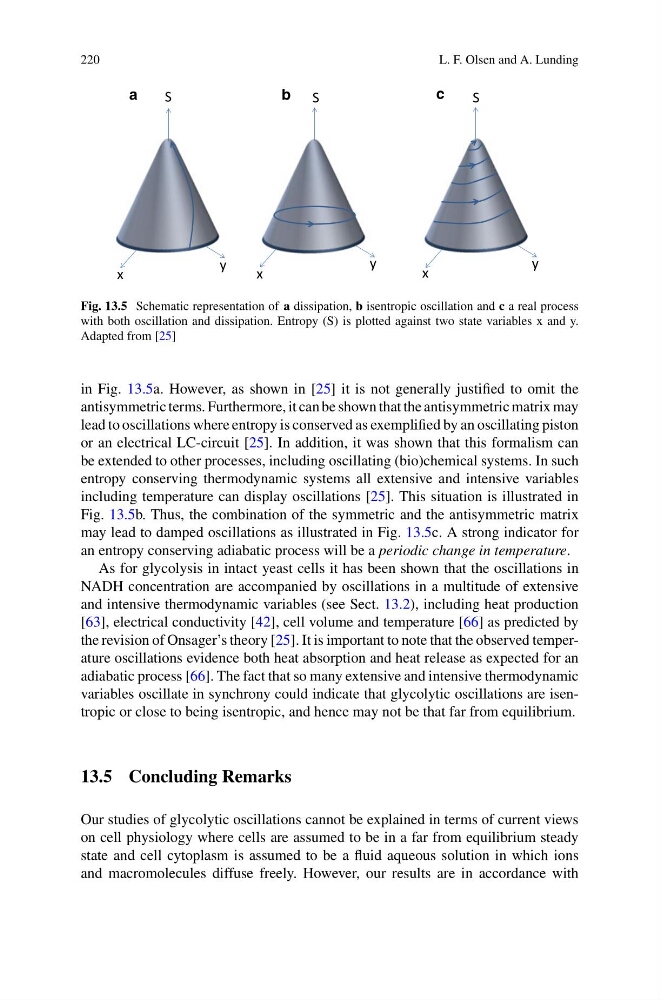
Fig. 13.5 Schematic representation of a dissipation, b isentropic oscillation and c a real process
with both oscillation and dissipation. Entropy (S) is plotted against two state variables x and y.
Adapted from [25]
in Fig. 13.5a. However, as shown in [25] it is not generally justified to omit the
antisymmetric terms. Furthermore, it can be shown that the antisymmetric matrix may
lead to oscillations where entropy is conserved as exemplified by an oscillating piston
or an electrical LC-circuit [25]. In addition, it was shown that this formalism can
be extended to other processes, including oscillating (bio)chemical systems. In such
entropy conserving thermodynamic systems all extensive and intensive variables
including temperature can display oscillations [25]. This situation is illustrated in
Fig. 13.5b. Thus, the combination of the symmetric and the antisymmetric matrix
may lead to damped oscillations as illustrated in Fig. 13.5c. A strong indicator for
an entropy conserving adiabatic process will be a periodic change in temperature.
As for glycolysis in intact yeast cells it has been shown that the oscillations in
NADH concentration are accompanied by oscillations in a multitude of extensive
and intensive thermodynamic variables (see Sect. 13.2), including heat production
[63], electrical conductivity [42], cell volume and temperature [66] as predicted by
the revision of Onsager’s theory [25]. It is important to note that the observed temperature oscillations evidence both heat absorption and heat release as expected for an
adiabatic process [66]. The fact that so many extensive and intensive thermodynamic
variables oscillate in synchrony could indicate that glycolytic oscillations are isentropic or close to being isentropic, and hence may not be that far from equilibrium.
13.5 Concluding Remarks
Our studies of glycolytic oscillations cannot be explained in terms of current views
on cell physiology where cells are assumed to be in a far from equilibrium steady
state and cell cytoplasm is assumed to be a fluid aqueous solution in which ions
and macromolecules diffuse freely. However, our results are in accordance with
L. F. Olsen and A. Lunding
x
y
x
y
y
x
S
S
S
a
b
c
Fig. 13.5 Schematic representation of a dissipation, b isentropic oscillation and c a real process
with both oscillation and dissipation. Entropy (S) is plotted against two state variables x and y.
Adapted from [25]
in Fig. 13.5a. However, as shown in [25] it is not generally justified to omit the
antisymmetric terms. Furthermore, it can be shown that the antisymmetric matrix may
lead to oscillations where entropy is conserved as exemplified by an oscillating piston
or an electrical LC-circuit [25]. In addition, it was shown that this formalism can
be extended to other processes, including oscillating (bio)chemical systems. In such
entropy conserving thermodynamic systems all extensive and intensive variables
including temperature can display oscillations [25]. This situation is illustrated in
Fig. 13.5b. Thus, the combination of the symmetric and the antisymmetric matrix
may lead to damped oscillations as illustrated in Fig. 13.5c. A strong indicator for
an entropy conserving adiabatic process will be a periodic change in temperature.
As for glycolysis in intact yeast cells it has been shown that the oscillations in
NADH concentration are accompanied by oscillations in a multitude of extensive
and intensive thermodynamic variables (see Sect. 13.2), including heat production
[63], electrical conductivity [42], cell volume and temperature [66] as predicted by
the revision of Onsager’s theory [25]. It is important to note that the observed temperature oscillations evidence both heat absorption and heat release as expected for an
adiabatic process [66]. The fact that so many extensive and intensive thermodynamic
variables oscillate in synchrony could indicate that glycolytic oscillations are isentropic or close to being isentropic, and hence may not be that far from equilibrium.
13.5 Concluding Remarks
Our studies of glycolytic oscillations cannot be explained in terms of current views
on cell physiology where cells are assumed to be in a far from equilibrium steady
state and cell cytoplasm is assumed to be a fluid aqueous solution in which ions
and macromolecules diffuse freely. However, our results are in accordance with