

218
L. F. Olsen and A. Lunding
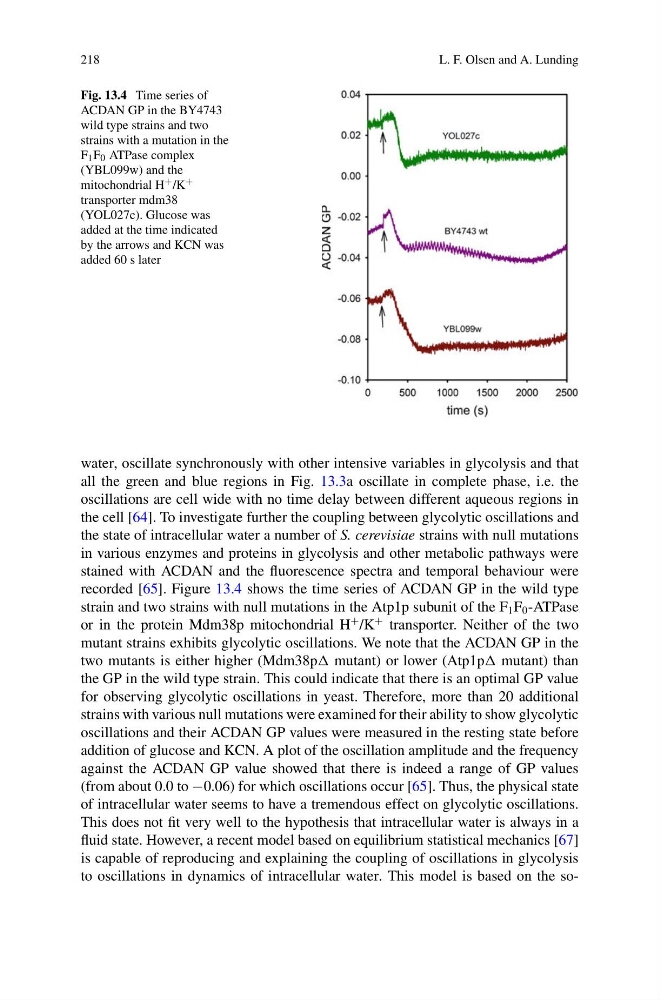
Fig. 13.4 Time series of
ACDAN GP in the BY4743
wild type strains and two
strains with a mutation in the
F 1 F 0 ATPase complex
(YBL099w) and the
mitochondrial H + /K +
transporter mdm38
(YOL027c). Glucose was
added at the time indicated
by the arrows and KCN was
added 60 s later
water, oscillate synchronously with other intensive variables in glycolysis and that
all the green and blue regions in Fig. 13.3a oscillate in complete phase, i.e. the
oscillations are cell wide with no time delay between different aqueous regions in
the cell [64]. To investigate further the coupling between glycolytic oscillations and
the state of intracellular water a number of S. cerevisiae strains with null mutations
in various enzymes and proteins in glycolysis and other metabolic pathways were
stained with ACDAN and the fluorescence spectra and temporal behaviour were
recorded [65]. Figure 13.4 shows the time series of ACDAN GP in the wild type
strain and two strains with null mutations in the Atp1p subunit of the F 1 F 0 -ATPase
or in the protein Mdm38p mitochondrial H
+ /K
+ transporter. Neither of the two
mutant strains exhibits glycolytic oscillations. We note that the ACDAN GP in the
two mutants is either higher (Mdm38p mutant) or lower (Atp1p mutant) than
the GP in the wild type strain. This could indicate that there is an optimal GP value
for observing glycolytic oscillations in yeast. Therefore, more than 20 additional
strains with various null mutations were examined for their ability to show glycolytic
oscillations and their ACDAN GP values were measured in the resting state before
addition of glucose and KCN. A plot of the oscillation amplitude and the frequency
against the ACDAN GP value showed that there is indeed a range of GP values
(from about 0.0 to −0.06) for which oscillations occur [65]. Thus, the physical state
of intracellular water seems to have a tremendous effect on glycolytic oscillations.
This does not fit very well to the hypothesis that intracellular water is always in a
fluid state. However, a recent model based on equilibrium statistical mechanics [67]
is capable of reproducing and explaining the coupling of oscillations in glycolysis
to oscillations in dynamics of intracellular water. This model is based on the so-
L. F. Olsen and A. Lunding
Fig. 13.4 Time series of
ACDAN GP in the BY4743
wild type strains and two
strains with a mutation in the
F 1 F 0 ATPase complex
(YBL099w) and the
mitochondrial H + /K +
transporter mdm38
(YOL027c). Glucose was
added at the time indicated
by the arrows and KCN was
added 60 s later
water, oscillate synchronously with other intensive variables in glycolysis and that
all the green and blue regions in Fig. 13.3a oscillate in complete phase, i.e. the
oscillations are cell wide with no time delay between different aqueous regions in
the cell [64]. To investigate further the coupling between glycolytic oscillations and
the state of intracellular water a number of S. cerevisiae strains with null mutations
in various enzymes and proteins in glycolysis and other metabolic pathways were
stained with ACDAN and the fluorescence spectra and temporal behaviour were
recorded [65]. Figure 13.4 shows the time series of ACDAN GP in the wild type
strain and two strains with null mutations in the Atp1p subunit of the F 1 F 0 -ATPase
or in the protein Mdm38p mitochondrial H
+ /K
+ transporter. Neither of the two
mutant strains exhibits glycolytic oscillations. We note that the ACDAN GP in the
two mutants is either higher (Mdm38p mutant) or lower (Atp1p mutant) than
the GP in the wild type strain. This could indicate that there is an optimal GP value
for observing glycolytic oscillations in yeast. Therefore, more than 20 additional
strains with various null mutations were examined for their ability to show glycolytic
oscillations and their ACDAN GP values were measured in the resting state before
addition of glucose and KCN. A plot of the oscillation amplitude and the frequency
against the ACDAN GP value showed that there is indeed a range of GP values
(from about 0.0 to −0.06) for which oscillations occur [65]. Thus, the physical state
of intracellular water seems to have a tremendous effect on glycolytic oscillations.
This does not fit very well to the hypothesis that intracellular water is always in a
fluid state. However, a recent model based on equilibrium statistical mechanics [67]
is capable of reproducing and explaining the coupling of oscillations in glycolysis
to oscillations in dynamics of intracellular water. This model is based on the so-