

194
E. Gengel and A. Pikovsky
-0.4
0
3
0
π
2π
-0.4
0
3
1005
1075
1145
X
2,3 (θ
0,10 ),X
2,3 (ϕ)
θ 1,10 ,ϕ
t
X
2,3 (t)
(a)
(b)
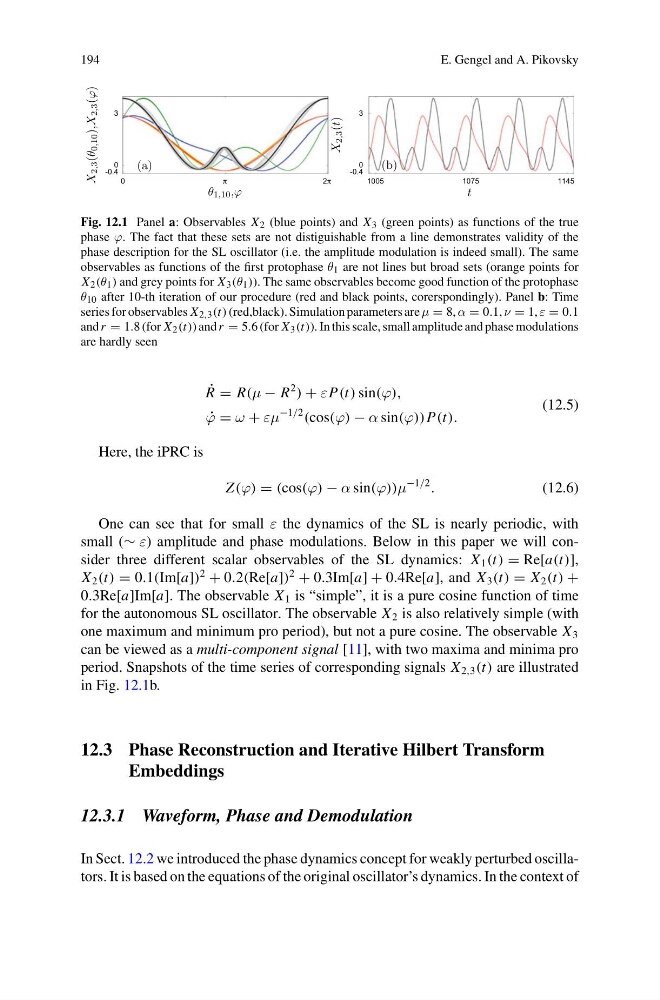
Fig. 12.1 Panel a: Observables X 2 (blue points) and X 3 (green points) as functions of the true
phase ϕ. The fact that these sets are not distiguishable from a line demonstrates validity of the
phase description for the SL oscillator (i.e. the amplitude modulation is indeed small). The same
observables as functions of the first protophase θ 1 are not lines but broad sets (orange points for
X 2 (θ 1 ) and grey points for X 3 (θ 1 )). The same observables become good function of the protophase
θ 10 after 10-th iteration of our procedure (red and black points, corerspondingly). Panel b: Time
series for observables X 2,3 (t) (red,black). Simulation parameters are μ = 8, α = 0.1, ν = 1, ε = 0.1
and r = 1.8 (for X 2 (t)) and r = 5.6 (for X 3 (t)). In this scale, small amplitude and phase modulations
are hardly seen
˙
R = R(μ − R
2
) + εP(t) sin(ϕ),
˙
ϕ = ω + εμ
−1/2
(cos(ϕ) − α sin(ϕ))P(t).
(12.5)
Here, the iPRC is
Z (ϕ) = (cos(ϕ) − α sin(ϕ))μ
−1/2
.
(12.6)
One can see that for small ε the dynamics of the SL is nearly periodic, with
small (∼ ε) amplitude and phase modulations. Below in this paper we will consider three different scalar observables of the SL dynamics: X 1 (t) = Re[a(t)],
X 2 (t) = 0.1(Im[a])
2
+ 0.2(Re[a])
2
+ 0.3Im[a] + 0.4Re[a], and X 3 (t) = X 2 (t) +
0.3Re[a]Im[a]. The observable X 1 is “simple”, it is a pure cosine function of time
for the autonomous SL oscillator. The observable X 2 is also relatively simple (with
one maximum and minimum pro period), but not a pure cosine. The observable X 3
can be viewed as a multi-component signal [11], with two maxima and minima pro
period. Snapshots of the time series of corresponding signals X 2,3 (t) are illustrated
in Fig. 12.1b.
12.3 Phase Reconstruction and Iterative Hilbert Transform
Embeddings
12.3.1 Waveform, Phase and Demodulation
In Sect. 12.2 we introduced the phase dynamics concept for weakly perturbed oscillators. It is based on the equations of the original oscillator’s dynamics. In the context of
E. Gengel and A. Pikovsky
-0.4
0
3
0
π
2π
-0.4
0
3
1005
1075
1145
X
2,3 (θ
0,10 ),X
2,3 (ϕ)
θ 1,10 ,ϕ
t
X
2,3 (t)
(a)
(b)
Fig. 12.1 Panel a: Observables X 2 (blue points) and X 3 (green points) as functions of the true
phase ϕ. The fact that these sets are not distiguishable from a line demonstrates validity of the
phase description for the SL oscillator (i.e. the amplitude modulation is indeed small). The same
observables as functions of the first protophase θ 1 are not lines but broad sets (orange points for
X 2 (θ 1 ) and grey points for X 3 (θ 1 )). The same observables become good function of the protophase
θ 10 after 10-th iteration of our procedure (red and black points, corerspondingly). Panel b: Time
series for observables X 2,3 (t) (red,black). Simulation parameters are μ = 8, α = 0.1, ν = 1, ε = 0.1
and r = 1.8 (for X 2 (t)) and r = 5.6 (for X 3 (t)). In this scale, small amplitude and phase modulations
are hardly seen
˙
R = R(μ − R
2
) + εP(t) sin(ϕ),
˙
ϕ = ω + εμ
−1/2
(cos(ϕ) − α sin(ϕ))P(t).
(12.5)
Here, the iPRC is
Z (ϕ) = (cos(ϕ) − α sin(ϕ))μ
−1/2
.
(12.6)
One can see that for small ε the dynamics of the SL is nearly periodic, with
small (∼ ε) amplitude and phase modulations. Below in this paper we will consider three different scalar observables of the SL dynamics: X 1 (t) = Re[a(t)],
X 2 (t) = 0.1(Im[a])
2
+ 0.2(Re[a])
2
+ 0.3Im[a] + 0.4Re[a], and X 3 (t) = X 2 (t) +
0.3Re[a]Im[a]. The observable X 1 is “simple”, it is a pure cosine function of time
for the autonomous SL oscillator. The observable X 2 is also relatively simple (with
one maximum and minimum pro period), but not a pure cosine. The observable X 3
can be viewed as a multi-component signal [11], with two maxima and minima pro
period. Snapshots of the time series of corresponding signals X 2,3 (t) are illustrated
in Fig. 12.1b.
12.3 Phase Reconstruction and Iterative Hilbert Transform
Embeddings
12.3.1 Waveform, Phase and Demodulation
In Sect. 12.2 we introduced the phase dynamics concept for weakly perturbed oscillators. It is based on the equations of the original oscillator’s dynamics. In the context of