

10 Useful Transformations from Non-autonomous to Autonomous Systems
169
Sym. (S M )
Parasym.
(C VN )
Heart
Period (T L )
B R (T L )
G(A q)
A
Lung
model
Vol. (V A )
R p
Airflow
(q)
To lung
model
Central respiratory drive
Stretch receptors
Baroreceptors
(a)
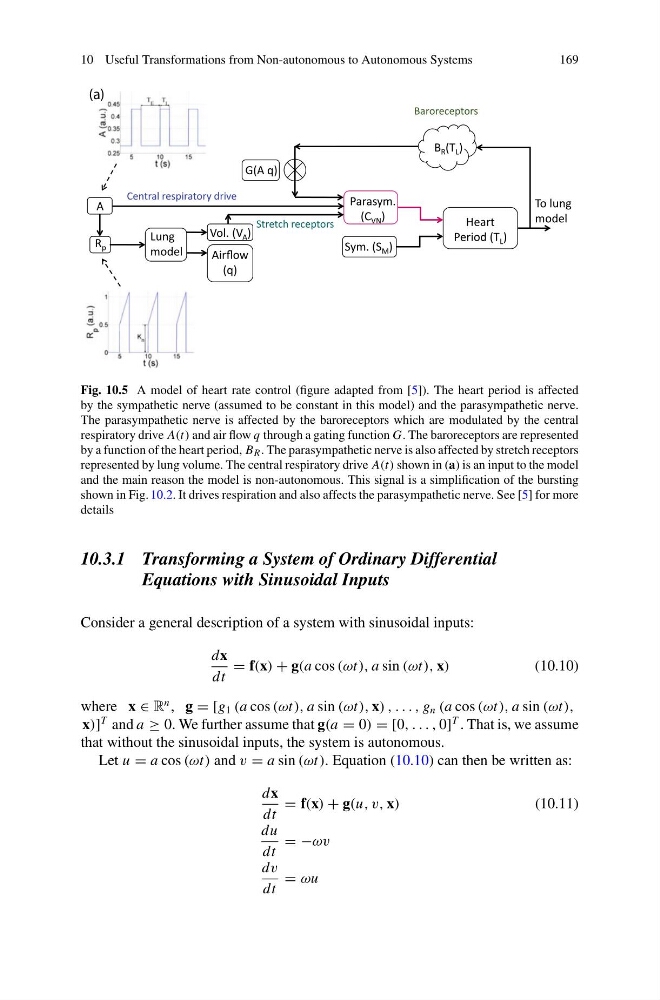
Fig. 10.5 A model of heart rate control (figure adapted from [5]). The heart period is affected
by the sympathetic nerve (assumed to be constant in this model) and the parasympathetic nerve.
The parasympathetic nerve is affected by the baroreceptors which are modulated by the central
respiratory drive A(t) and air flow q through a gating function G. The baroreceptors are represented
by a function of the heart period, B R . The parasympathetic nerve is also affected by stretch receptors
represented by lung volume. The central respiratory drive A(t) shown in (a) is an input to the model
and the main reason the model is non-autonomous. This signal is a simplification of the bursting
shown in Fig. 10.2. It drives respiration and also affects the parasympathetic nerve. See [5] for more
details
10.3.1 Transforming a System of Ordinary Differential
Equations with Sinusoidal Inputs
Consider a general description of a system with sinusoidal inputs:
dx
dt
= f(x) + g(a cos (ωt), a sin (ωt), x)
(10.10)
where x ∈ R
n , g = [g 1 (a cos (ωt), a sin (ωt), x) , . . . , g n (a cos (ωt), a sin (ωt),
x)]
T and a ≥ 0. We further assume that g(a = 0) = [0, . . . , 0]
T . That is, we assume
that without the sinusoidal inputs, the system is autonomous.
Let u = a cos (ωt) and v = a sin (ωt). Equation (10.10) can then be written as:
dx
dt
= f(x) + g(u, v, x)
(10.11)
du
dt
= −ωv
dv
dt
= ωu
169
Sym. (S M )
Parasym.
(C VN )
Heart
Period (T L )
B R (T L )
G(A q)
A
Lung
model
Vol. (V A )
R p
Airflow
(q)
To lung
model
Central respiratory drive
Stretch receptors
Baroreceptors
(a)
Fig. 10.5 A model of heart rate control (figure adapted from [5]). The heart period is affected
by the sympathetic nerve (assumed to be constant in this model) and the parasympathetic nerve.
The parasympathetic nerve is affected by the baroreceptors which are modulated by the central
respiratory drive A(t) and air flow q through a gating function G. The baroreceptors are represented
by a function of the heart period, B R . The parasympathetic nerve is also affected by stretch receptors
represented by lung volume. The central respiratory drive A(t) shown in (a) is an input to the model
and the main reason the model is non-autonomous. This signal is a simplification of the bursting
shown in Fig. 10.2. It drives respiration and also affects the parasympathetic nerve. See [5] for more
details
10.3.1 Transforming a System of Ordinary Differential
Equations with Sinusoidal Inputs
Consider a general description of a system with sinusoidal inputs:
dx
dt
= f(x) + g(a cos (ωt), a sin (ωt), x)
(10.10)
where x ∈ R
n , g = [g 1 (a cos (ωt), a sin (ωt), x) , . . . , g n (a cos (ωt), a sin (ωt),
x)]
T and a ≥ 0. We further assume that g(a = 0) = [0, . . . , 0]
T . That is, we assume
that without the sinusoidal inputs, the system is autonomous.
Let u = a cos (ωt) and v = a sin (ωt). Equation (10.10) can then be written as:
dx
dt
= f(x) + g(u, v, x)
(10.11)
du
dt
= −ωv
dv
dt
= ωu