

154
I. Kovacic et al.
discrete or continuous, with only few multi-degree-of-freedom models of branched
trees with discrete masses. In [5, 6], each structural element of a tree—the trunk and
branches—are treated as oscillating masses attached mutually via springs arranged
in parallel. The model is simple and potentially useful for biomimetic applications,
especially related to tuned mass-dampers [3]. However, its dynamic behaviour has not
been explored deeply. This work contributes to this shortcoming from the viewpoint
of the appearance of localised modes, when only a part of the structure oscillates,
but the main mass, i.e. the trunk stays at rest.
9.2 Model with First-Order Branches
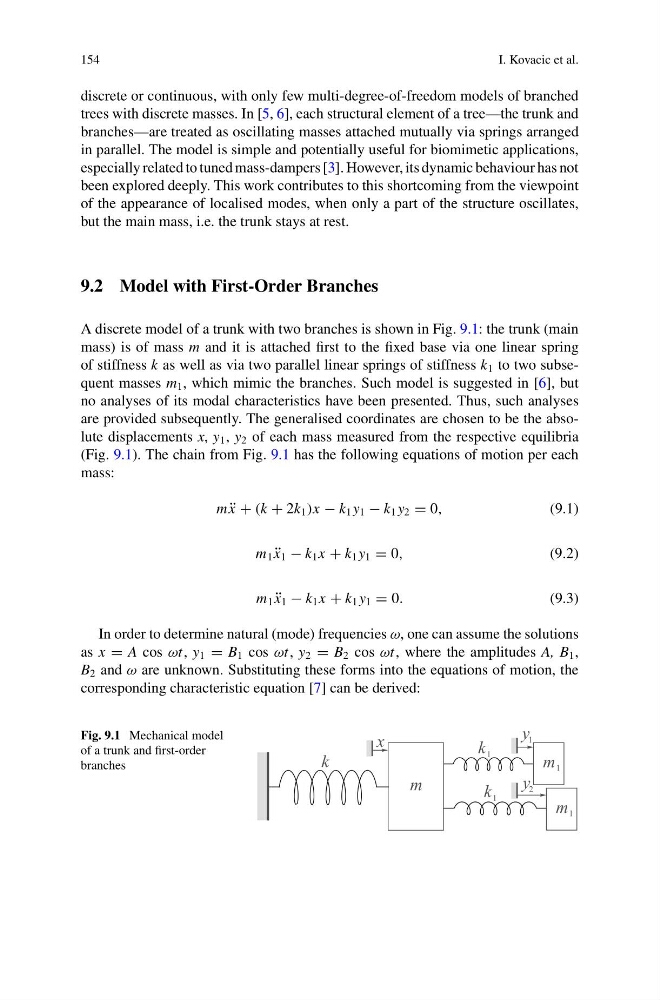
A discrete model of a trunk with two branches is shown in Fig. 9.1: the trunk (main
mass) is of mass m and it is attached first to the fixed base via one linear spring
of stiffness k as well as via two parallel linear springs of stiffness k 1 to two subsequent masses m 1 , which mimic the branches. Such model is suggested in [6], but
no analyses of its modal characteristics have been presented. Thus, such analyses
are provided subsequently. The generalised coordinates are chosen to be the absolute displacements x, y 1 , y 2 of each mass measured from the respective equilibria
(Fig. 9.1). The chain from Fig. 9.1 has the following equations of motion per each
mass:
m ¨
x + (k + 2k 1 )x − k 1 y 1 − k 1 y 2 = 0,
(9.1)
m 1 ¨
x 1 − k 1 x + k 1 y 1 = 0,
(9.2)
m 1 ¨
x 1 − k 1 x + k 1 y 1 = 0.
(9.3)
In order to determine natural (mode) frequencies ω, one can assume the solutions
as x = A cos ωt, y 1 = B 1 cos ωt, y 2 = B 2 cos ωt, where the amplitudes A, B 1 ,
B 2 and ω are unknown. Substituting these forms into the equations of motion, the
corresponding characteristic equation [7] can be derived:
Fig. 9.1 Mechanical model
of a trunk and first-order
branches
I. Kovacic et al.
discrete or continuous, with only few multi-degree-of-freedom models of branched
trees with discrete masses. In [5, 6], each structural element of a tree—the trunk and
branches—are treated as oscillating masses attached mutually via springs arranged
in parallel. The model is simple and potentially useful for biomimetic applications,
especially related to tuned mass-dampers [3]. However, its dynamic behaviour has not
been explored deeply. This work contributes to this shortcoming from the viewpoint
of the appearance of localised modes, when only a part of the structure oscillates,
but the main mass, i.e. the trunk stays at rest.
9.2 Model with First-Order Branches
A discrete model of a trunk with two branches is shown in Fig. 9.1: the trunk (main
mass) is of mass m and it is attached first to the fixed base via one linear spring
of stiffness k as well as via two parallel linear springs of stiffness k 1 to two subsequent masses m 1 , which mimic the branches. Such model is suggested in [6], but
no analyses of its modal characteristics have been presented. Thus, such analyses
are provided subsequently. The generalised coordinates are chosen to be the absolute displacements x, y 1 , y 2 of each mass measured from the respective equilibria
(Fig. 9.1). The chain from Fig. 9.1 has the following equations of motion per each
mass:
m ¨
x + (k + 2k 1 )x − k 1 y 1 − k 1 y 2 = 0,
(9.1)
m 1 ¨
x 1 − k 1 x + k 1 y 1 = 0,
(9.2)
m 1 ¨
x 1 − k 1 x + k 1 y 1 = 0.
(9.3)
In order to determine natural (mode) frequencies ω, one can assume the solutions
as x = A cos ωt, y 1 = B 1 cos ωt, y 2 = B 2 cos ωt, where the amplitudes A, B 1 ,
B 2 and ω are unknown. Substituting these forms into the equations of motion, the
corresponding characteristic equation [7] can be derived:
Fig. 9.1 Mechanical model
of a trunk and first-order
branches