

7 Non-asymptotic-time Dynamics
121
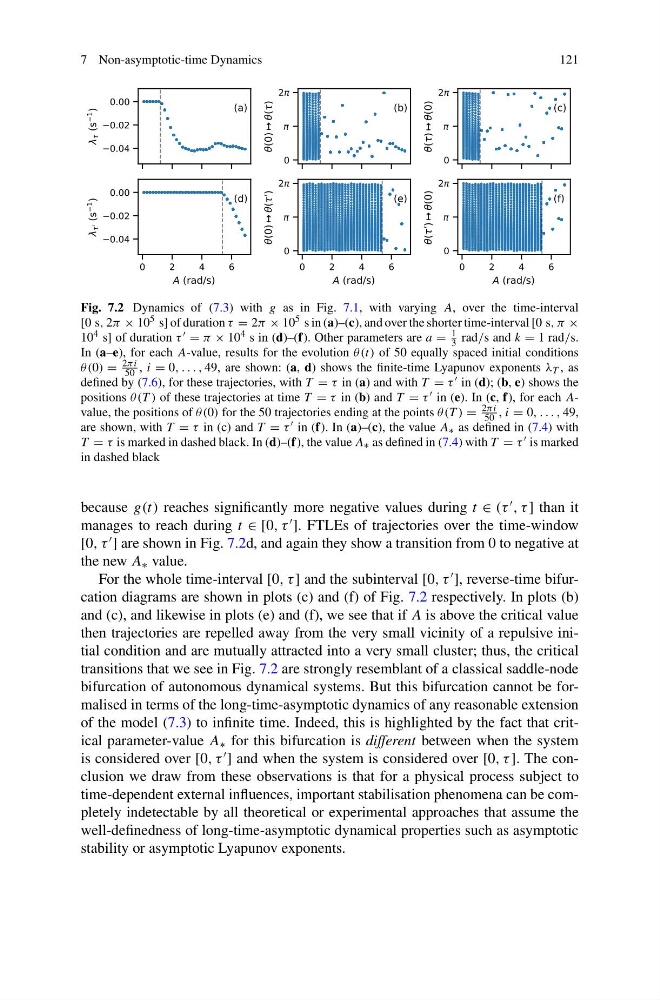
Fig. 7.2 Dynamics of (7.3) with g as in Fig. 7.1, with varying A, over the time-interval
[0 s, 2π × 10 5 s] of duration τ = 2π × 10 5 s in (a)–(c), and over the shorter time-interval [0 s, π ×
10 4 s] of duration τ = π × 10 4 s in (d)–(f). Other parameters are a =
1
3 rad/s and k = 1 rad/s.
In (a–e), for each A-value, results for the evolution θ(t) of 50 equally spaced initial conditions
θ(0) =
2πi
50 , i = 0, . . . , 49, are shown: (a, d) shows the finite-time Lyapunov exponents λ T , as
defined by (7.6), for these trajectories, with T = τ in (a) and with T = τ in (d); (b, e) shows the
positions θ(T ) of these trajectories at time T = τ in (b) and T = τ in (e). In (c, f), for each Avalue, the positions of θ(0) for the 50 trajectories ending at the points θ(T ) =
2πi
50 , i = 0, . . . , 49,
are shown, with T = τ in (c) and T = τ in (f). In (a)–(c), the value A ∗ as defined in (7.4) with
T = τ is marked in dashed black. In (d)–(f), the value A ∗ as defined in (7.4) with T = τ is marked
in dashed black
because g(t) reaches significantly more negative values during t ∈ (τ
, τ ] than it
manages to reach during t ∈ [0, τ
]. FTLEs of trajectories over the time-window
[0, τ
] are shown in Fig. 7.2d, and again they show a transition from 0 to negative at
the new A ∗ value.
For the whole time-interval [0, τ ] and the subinterval [0, τ
], reverse-time bifurcation diagrams are shown in plots (c) and (f) of Fig. 7.2 respectively. In plots (b)
and (c), and likewise in plots (e) and (f), we see that if A is above the critical value
then trajectories are repelled away from the very small vicinity of a repulsive initial condition and are mutually attracted into a very small cluster; thus, the critical
transitions that we see in Fig. 7.2 are strongly resemblant of a classical saddle-node
bifurcation of autonomous dynamical systems. But this bifurcation cannot be formalised in terms of the long-time-asymptotic dynamics of any reasonable extension
of the model (7.3) to infinite time. Indeed, this is highlighted by the fact that critical parameter-value A ∗ for this bifurcation is different between when the system
is considered over [0, τ
] and when the system is considered over [0, τ ]. The conclusion we draw from these observations is that for a physical process subject to
time-dependent external influences, important stabilisation phenomena can be completely indetectable by all theoretical or experimental approaches that assume the
well-definedness of long-time-asymptotic dynamical properties such as asymptotic
stability or asymptotic Lyapunov exponents.
121
Fig. 7.2 Dynamics of (7.3) with g as in Fig. 7.1, with varying A, over the time-interval
[0 s, 2π × 10 5 s] of duration τ = 2π × 10 5 s in (a)–(c), and over the shorter time-interval [0 s, π ×
10 4 s] of duration τ = π × 10 4 s in (d)–(f). Other parameters are a =
1
3 rad/s and k = 1 rad/s.
In (a–e), for each A-value, results for the evolution θ(t) of 50 equally spaced initial conditions
θ(0) =
2πi
50 , i = 0, . . . , 49, are shown: (a, d) shows the finite-time Lyapunov exponents λ T , as
defined by (7.6), for these trajectories, with T = τ in (a) and with T = τ in (d); (b, e) shows the
positions θ(T ) of these trajectories at time T = τ in (b) and T = τ in (e). In (c, f), for each Avalue, the positions of θ(0) for the 50 trajectories ending at the points θ(T ) =
2πi
50 , i = 0, . . . , 49,
are shown, with T = τ in (c) and T = τ in (f). In (a)–(c), the value A ∗ as defined in (7.4) with
T = τ is marked in dashed black. In (d)–(f), the value A ∗ as defined in (7.4) with T = τ is marked
in dashed black
because g(t) reaches significantly more negative values during t ∈ (τ
, τ ] than it
manages to reach during t ∈ [0, τ
]. FTLEs of trajectories over the time-window
[0, τ
] are shown in Fig. 7.2d, and again they show a transition from 0 to negative at
the new A ∗ value.
For the whole time-interval [0, τ ] and the subinterval [0, τ
], reverse-time bifurcation diagrams are shown in plots (c) and (f) of Fig. 7.2 respectively. In plots (b)
and (c), and likewise in plots (e) and (f), we see that if A is above the critical value
then trajectories are repelled away from the very small vicinity of a repulsive initial condition and are mutually attracted into a very small cluster; thus, the critical
transitions that we see in Fig. 7.2 are strongly resemblant of a classical saddle-node
bifurcation of autonomous dynamical systems. But this bifurcation cannot be formalised in terms of the long-time-asymptotic dynamics of any reasonable extension
of the model (7.3) to infinite time. Indeed, this is highlighted by the fact that critical parameter-value A ∗ for this bifurcation is different between when the system
is considered over [0, τ
] and when the system is considered over [0, τ ]. The conclusion we draw from these observations is that for a physical process subject to
time-dependent external influences, important stabilisation phenomena can be completely indetectable by all theoretical or experimental approaches that assume the
well-definedness of long-time-asymptotic dynamical properties such as asymptotic
stability or asymptotic Lyapunov exponents.