

6 Synchronisation and Non-autonomicity
107
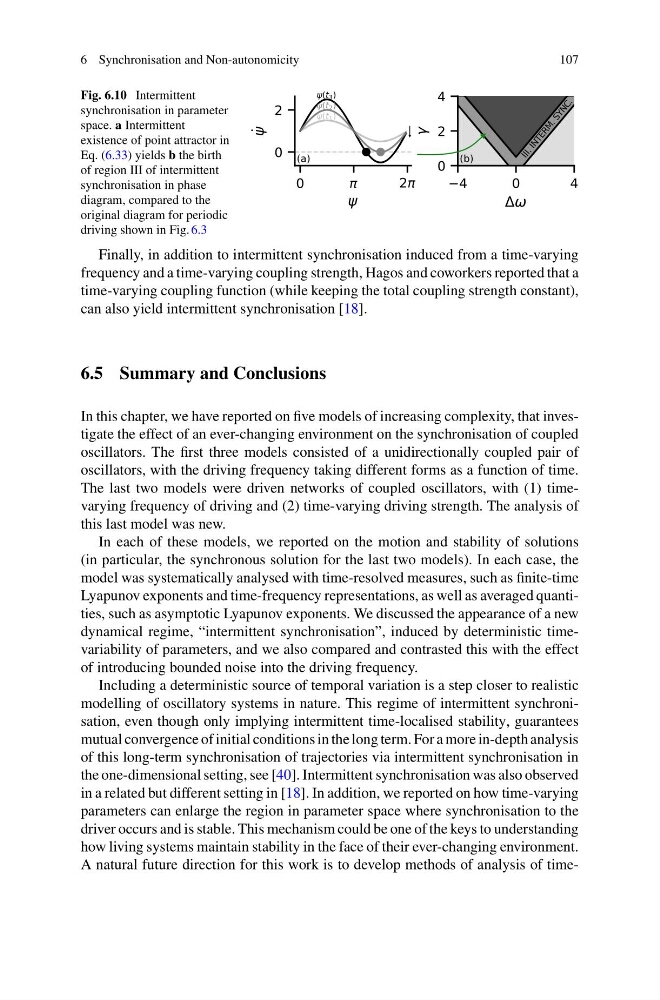
Fig. 6.10 Intermittent
synchronisation in parameter
space. a Intermittent
existence of point attractor in
Eq. (6.33) yields b the birth
of region III of intermittent
synchronisation in phase
diagram, compared to the
original diagram for periodic
driving shown in Fig. 6.3
Finally, in addition to intermittent synchronisation induced from a time-varying
frequency and a time-varying coupling strength, Hagos and coworkers reported that a
time-varying coupling function (while keeping the total coupling strength constant),
can also yield intermittent synchronisation [18].
6.5 Summary and Conclusions
In this chapter, we have reported on five models of increasing complexity, that investigate the effect of an ever-changing environment on the synchronisation of coupled
oscillators. The first three models consisted of a unidirectionally coupled pair of
oscillators, with the driving frequency taking different forms as a function of time.
The last two models were driven networks of coupled oscillators, with (1) timevarying frequency of driving and (2) time-varying driving strength. The analysis of
this last model was new.
In each of these models, we reported on the motion and stability of solutions
(in particular, the synchronous solution for the last two models). In each case, the
model was systematically analysed with time-resolved measures, such as finite-time
Lyapunov exponents and time-frequency representations, as well as averaged quantities, such as asymptotic Lyapunov exponents. We discussed the appearance of a new
dynamical regime, “intermittent synchronisation”, induced by deterministic timevariability of parameters, and we also compared and contrasted this with the effect
of introducing bounded noise into the driving frequency.
Including a deterministic source of temporal variation is a step closer to realistic
modelling of oscillatory systems in nature. This regime of intermittent synchronisation, even though only implying intermittent time-localised stability, guarantees
mutual convergence of initial conditions in the long term. For a more in-depth analysis
of this long-term synchronisation of trajectories via intermittent synchronisation in
the one-dimensional setting, see [40]. Intermittent synchronisation was also observed
in a related but different setting in [18]. In addition, we reported on how time-varying
parameters can enlarge the region in parameter space where synchronisation to the
driver occurs and is stable. This mechanism could be one of the keys to understanding
how living systems maintain stability in the face of their ever-changing environment.
A natural future direction for this work is to develop methods of analysis of time-
107
Fig. 6.10 Intermittent
synchronisation in parameter
space. a Intermittent
existence of point attractor in
Eq. (6.33) yields b the birth
of region III of intermittent
synchronisation in phase
diagram, compared to the
original diagram for periodic
driving shown in Fig. 6.3
Finally, in addition to intermittent synchronisation induced from a time-varying
frequency and a time-varying coupling strength, Hagos and coworkers reported that a
time-varying coupling function (while keeping the total coupling strength constant),
can also yield intermittent synchronisation [18].
6.5 Summary and Conclusions
In this chapter, we have reported on five models of increasing complexity, that investigate the effect of an ever-changing environment on the synchronisation of coupled
oscillators. The first three models consisted of a unidirectionally coupled pair of
oscillators, with the driving frequency taking different forms as a function of time.
The last two models were driven networks of coupled oscillators, with (1) timevarying frequency of driving and (2) time-varying driving strength. The analysis of
this last model was new.
In each of these models, we reported on the motion and stability of solutions
(in particular, the synchronous solution for the last two models). In each case, the
model was systematically analysed with time-resolved measures, such as finite-time
Lyapunov exponents and time-frequency representations, as well as averaged quantities, such as asymptotic Lyapunov exponents. We discussed the appearance of a new
dynamical regime, “intermittent synchronisation”, induced by deterministic timevariability of parameters, and we also compared and contrasted this with the effect
of introducing bounded noise into the driving frequency.
Including a deterministic source of temporal variation is a step closer to realistic
modelling of oscillatory systems in nature. This regime of intermittent synchronisation, even though only implying intermittent time-localised stability, guarantees
mutual convergence of initial conditions in the long term. For a more in-depth analysis
of this long-term synchronisation of trajectories via intermittent synchronisation in
the one-dimensional setting, see [40]. Intermittent synchronisation was also observed
in a related but different setting in [18]. In addition, we reported on how time-varying
parameters can enlarge the region in parameter space where synchronisation to the
driver occurs and is stable. This mechanism could be one of the keys to understanding
how living systems maintain stability in the face of their ever-changing environment.
A natural future direction for this work is to develop methods of analysis of time-