

102
M. Lucas et al.
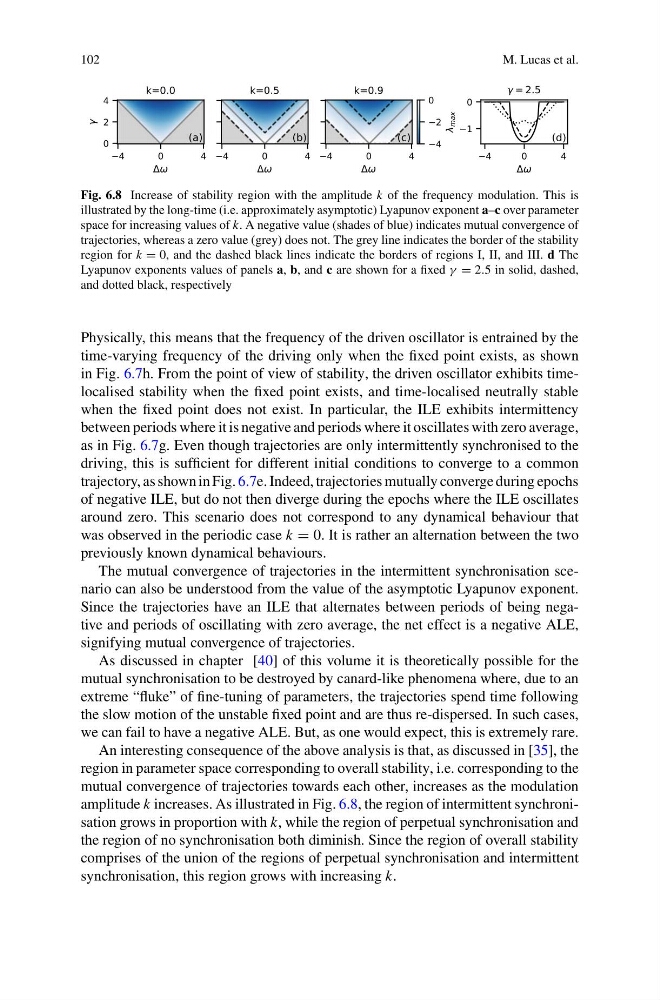
Fig. 6.8 Increase of stability region with the amplitude k of the frequency modulation. This is
illustrated by the long-time (i.e. approximately asymptotic) Lyapunov exponent a–c over parameter
space for increasing values of k. A negative value (shades of blue) indicates mutual convergence of
trajectories, whereas a zero value (grey) does not. The grey line indicates the border of the stability
region for k = 0, and the dashed black lines indicate the borders of regions I, II, and III. d The
Lyapunov exponents values of panels a, b, and c are shown for a fixed γ = 2.5 in solid, dashed,
and dotted black, respectively
Physically, this means that the frequency of the driven oscillator is entrained by the
time-varying frequency of the driving only when the fixed point exists, as shown
in Fig. 6.7h. From the point of view of stability, the driven oscillator exhibits timelocalised stability when the fixed point exists, and time-localised neutrally stable
when the fixed point does not exist. In particular, the ILE exhibits intermittency
between periods where it is negative and periods where it oscillates with zero average,
as in Fig. 6.7g. Even though trajectories are only intermittently synchronised to the
driving, this is sufficient for different initial conditions to converge to a common
trajectory, as shown in Fig. 6.7e. Indeed, trajectories mutually converge during epochs
of negative ILE, but do not then diverge during the epochs where the ILE oscillates
around zero. This scenario does not correspond to any dynamical behaviour that
was observed in the periodic case k = 0. It is rather an alternation between the two
previously known dynamical behaviours.
The mutual convergence of trajectories in the intermittent synchronisation scenario can also be understood from the value of the asymptotic Lyapunov exponent.
Since the trajectories have an ILE that alternates between periods of being negative and periods of oscillating with zero average, the net effect is a negative ALE,
signifying mutual convergence of trajectories.
As discussed in chapter [40] of this volume it is theoretically possible for the
mutual synchronisation to be destroyed by canard-like phenomena where, due to an
extreme “fluke” of fine-tuning of parameters, the trajectories spend time following
the slow motion of the unstable fixed point and are thus re-dispersed. In such cases,
we can fail to have a negative ALE. But, as one would expect, this is extremely rare.
An interesting consequence of the above analysis is that, as discussed in [35], the
region in parameter space corresponding to overall stability, i.e. corresponding to the
mutual convergence of trajectories towards each other, increases as the modulation
amplitude k increases. As illustrated in Fig. 6.8, the region of intermittent synchronisation grows in proportion with k, while the region of perpetual synchronisation and
the region of no synchronisation both diminish. Since the region of overall stability
comprises of the union of the regions of perpetual synchronisation and intermittent
synchronisation, this region grows with increasing k.
M. Lucas et al.
Fig. 6.8 Increase of stability region with the amplitude k of the frequency modulation. This is
illustrated by the long-time (i.e. approximately asymptotic) Lyapunov exponent a–c over parameter
space for increasing values of k. A negative value (shades of blue) indicates mutual convergence of
trajectories, whereas a zero value (grey) does not. The grey line indicates the border of the stability
region for k = 0, and the dashed black lines indicate the borders of regions I, II, and III. d The
Lyapunov exponents values of panels a, b, and c are shown for a fixed γ = 2.5 in solid, dashed,
and dotted black, respectively
Physically, this means that the frequency of the driven oscillator is entrained by the
time-varying frequency of the driving only when the fixed point exists, as shown
in Fig. 6.7h. From the point of view of stability, the driven oscillator exhibits timelocalised stability when the fixed point exists, and time-localised neutrally stable
when the fixed point does not exist. In particular, the ILE exhibits intermittency
between periods where it is negative and periods where it oscillates with zero average,
as in Fig. 6.7g. Even though trajectories are only intermittently synchronised to the
driving, this is sufficient for different initial conditions to converge to a common
trajectory, as shown in Fig. 6.7e. Indeed, trajectories mutually converge during epochs
of negative ILE, but do not then diverge during the epochs where the ILE oscillates
around zero. This scenario does not correspond to any dynamical behaviour that
was observed in the periodic case k = 0. It is rather an alternation between the two
previously known dynamical behaviours.
The mutual convergence of trajectories in the intermittent synchronisation scenario can also be understood from the value of the asymptotic Lyapunov exponent.
Since the trajectories have an ILE that alternates between periods of being negative and periods of oscillating with zero average, the net effect is a negative ALE,
signifying mutual convergence of trajectories.
As discussed in chapter [40] of this volume it is theoretically possible for the
mutual synchronisation to be destroyed by canard-like phenomena where, due to an
extreme “fluke” of fine-tuning of parameters, the trajectories spend time following
the slow motion of the unstable fixed point and are thus re-dispersed. In such cases,
we can fail to have a negative ALE. But, as one would expect, this is extremely rare.
An interesting consequence of the above analysis is that, as discussed in [35], the
region in parameter space corresponding to overall stability, i.e. corresponding to the
mutual convergence of trajectories towards each other, increases as the modulation
amplitude k increases. As illustrated in Fig. 6.8, the region of intermittent synchronisation grows in proportion with k, while the region of perpetual synchronisation and
the region of no synchronisation both diminish. Since the region of overall stability
comprises of the union of the regions of perpetual synchronisation and intermittent
synchronisation, this region grows with increasing k.