

88
M. Lucas et al.
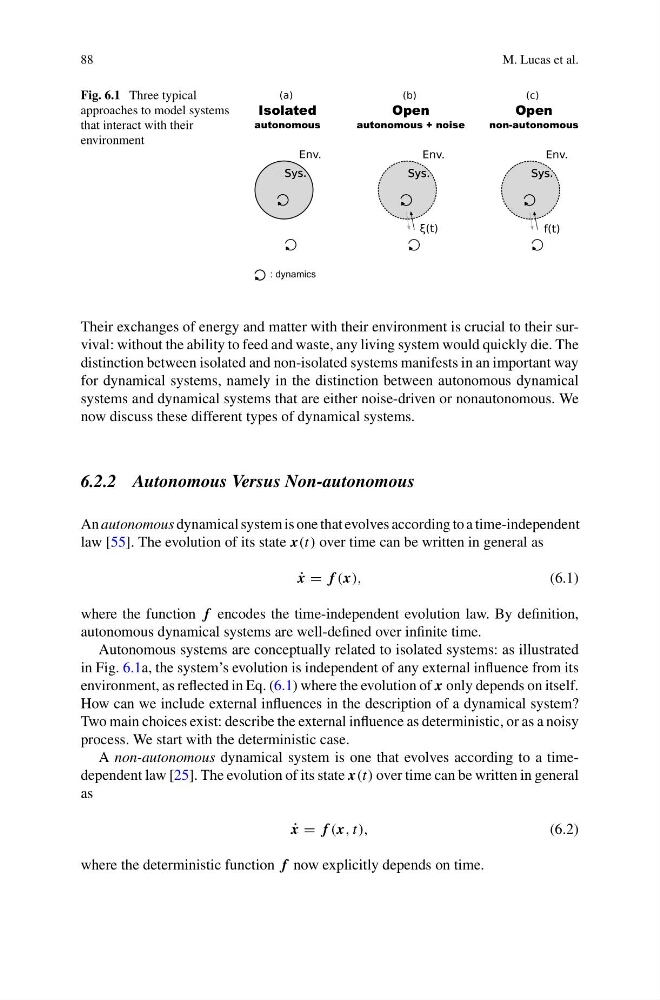
Fig. 6.1 Three typical
approaches to model systems
that interact with their
environment
Open
non-autonomous
Open
autonomous + noise
Isolated
autonomous
: dynamics
Their exchanges of energy and matter with their environment is crucial to their survival: without the ability to feed and waste, any living system would quickly die. The
distinction between isolated and non-isolated systems manifests in an important way
for dynamical systems, namely in the distinction between autonomous dynamical
systems and dynamical systems that are either noise-driven or nonautonomous. We
now discuss these different types of dynamical systems.
6.2.2 Autonomous Versus Non-autonomous
An autonomous dynamical system is one that evolves according to a time-independent
law [55]. The evolution of its state x(t) over time can be written in general as
˙
x = f (x),
(6.1)
where the function f encodes the time-independent evolution law. By definition,
autonomous dynamical systems are well-defined over infinite time.
Autonomous systems are conceptually related to isolated systems: as illustrated
in Fig. 6.1a, the system’s evolution is independent of any external influence from its
environment, as reflected in Eq. (6.1) where the evolution of x only depends on itself.
How can we include external influences in the description of a dynamical system?
Two main choices exist: describe the external influence as deterministic, or as a noisy
process. We start with the deterministic case.
A non-autonomous dynamical system is one that evolves according to a timedependent law [25]. The evolution of its state x(t) over time can be written in general
as
˙
x = f (x, t),
(6.2)
where the deterministic function f now explicitly depends on time.
M. Lucas et al.
Fig. 6.1 Three typical
approaches to model systems
that interact with their
environment
Open
non-autonomous
Open
autonomous + noise
Isolated
autonomous
: dynamics
Their exchanges of energy and matter with their environment is crucial to their survival: without the ability to feed and waste, any living system would quickly die. The
distinction between isolated and non-isolated systems manifests in an important way
for dynamical systems, namely in the distinction between autonomous dynamical
systems and dynamical systems that are either noise-driven or nonautonomous. We
now discuss these different types of dynamical systems.
6.2.2 Autonomous Versus Non-autonomous
An autonomous dynamical system is one that evolves according to a time-independent
law [55]. The evolution of its state x(t) over time can be written in general as
˙
x = f (x),
(6.1)
where the function f encodes the time-independent evolution law. By definition,
autonomous dynamical systems are well-defined over infinite time.
Autonomous systems are conceptually related to isolated systems: as illustrated
in Fig. 6.1a, the system’s evolution is independent of any external influence from its
environment, as reflected in Eq. (6.1) where the evolution of x only depends on itself.
How can we include external influences in the description of a dynamical system?
Two main choices exist: describe the external influence as deterministic, or as a noisy
process. We start with the deterministic case.
A non-autonomous dynamical system is one that evolves according to a timedependent law [25]. The evolution of its state x(t) over time can be written in general
as
˙
x = f (x, t),
(6.2)
where the deterministic function f now explicitly depends on time.