

(Gassiot et al. 2014). The oldest phase of use was identified when a hearth was
found in the place where the inner space connects with the small entrance passage.
A pine charcoal fragment from this hearth, which was more or less circular in shape
and a little over half a metre in diameter, was dated to 7001–6574 cal BC, over
3000 years before the Neolithic occupation.
A small quartz flake with thermal domes was found inside the hearth. Outside, in
the layer that identified the occupation level, a further three chipped lithic fragments
were found; together with the charcoal these form the only remains corresponding
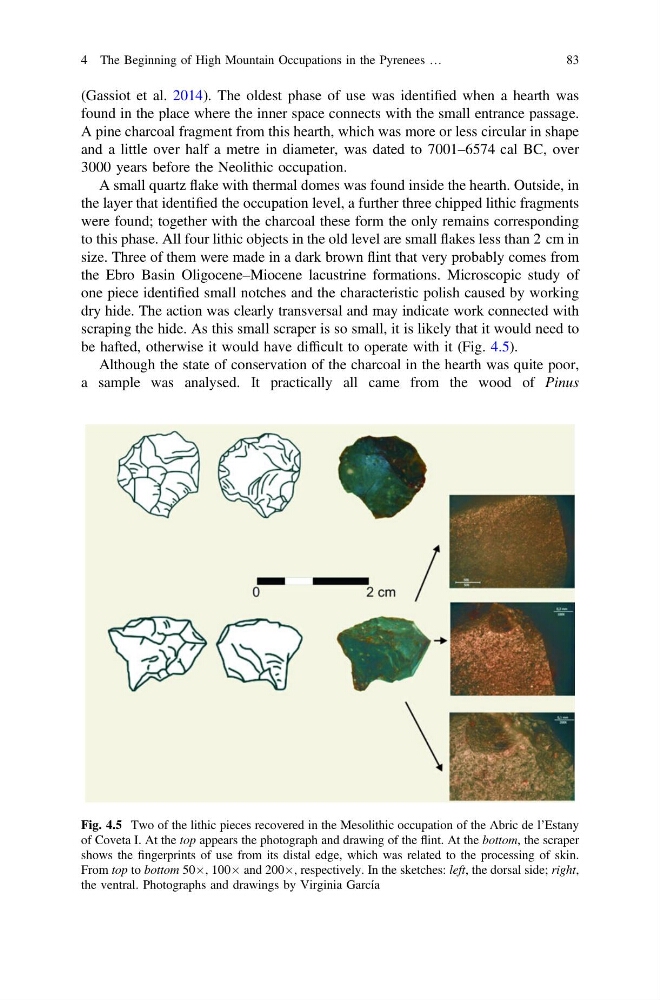
to this phase. All four lithic objects in the old level are small flakes less than 2 cm in
size. Three of them were made in a dark brown flint that very probably comes from
the Ebro Basin Oligocene–Miocene lacustrine formations. Microscopic study of
one piece identified small notches and the characteristic polish caused by working
dry hide. The action was clearly transversal and may indicate work connected with
scraping the hide. As this small scraper is so small, it is likely that it would need to
be hafted, otherwise it would have difficult to operate with it (Fig. 4.5).
Although the state of conservation of the charcoal in the hearth was quite poor,
a sample was analysed. It practically all came from the wood of Pinus
Fig. 4.5 Two of the lithic pieces recovered in the Mesolithic occupation of the Abric de l’Estany
of Coveta I. At the top appears the photograph and drawing of the flint. At the bottom, the scraper
shows the fingerprints of use from its distal edge, which was related to the processing of skin.
From top to bottom 50Â, 100Â and 200Â, respectively. In the sketches: left, the dorsal side; right,
the ventral. Photographs and drawings by Virginia García
4 The Beginning of High Mountain Occupations in the Pyrenees …
83
found in the place where the inner space connects with the small entrance passage.
A pine charcoal fragment from this hearth, which was more or less circular in shape
and a little over half a metre in diameter, was dated to 7001–6574 cal BC, over
3000 years before the Neolithic occupation.
A small quartz flake with thermal domes was found inside the hearth. Outside, in
the layer that identified the occupation level, a further three chipped lithic fragments
were found; together with the charcoal these form the only remains corresponding
to this phase. All four lithic objects in the old level are small flakes less than 2 cm in
size. Three of them were made in a dark brown flint that very probably comes from
the Ebro Basin Oligocene–Miocene lacustrine formations. Microscopic study of
one piece identified small notches and the characteristic polish caused by working
dry hide. The action was clearly transversal and may indicate work connected with
scraping the hide. As this small scraper is so small, it is likely that it would need to
be hafted, otherwise it would have difficult to operate with it (Fig. 4.5).
Although the state of conservation of the charcoal in the hearth was quite poor,
a sample was analysed. It practically all came from the wood of Pinus
Fig. 4.5 Two of the lithic pieces recovered in the Mesolithic occupation of the Abric de l’Estany
of Coveta I. At the top appears the photograph and drawing of the flint. At the bottom, the scraper
shows the fingerprints of use from its distal edge, which was related to the processing of skin.
From top to bottom 50Â, 100Â and 200Â, respectively. In the sketches: left, the dorsal side; right,
the ventral. Photographs and drawings by Virginia García
4 The Beginning of High Mountain Occupations in the Pyrenees …
83