

the walls visible on the surface, several occupation levels contained prehistoric
remains. The lowest layer, Level 107, yielded flakes in local metamorphic rocks.
This level was dated to 8764–8532 and 8517–8478 cal BC. The strata above it
demonstrated the re-occupation of the site in later prehistoric periods. Lithic
materials associated with this occupation are preliminarily classifiable as Notches
and Denticulates Mesolithic (Orengo et al. 2014).
The third site with remains older than the Neolithisation process in the Pyrenees
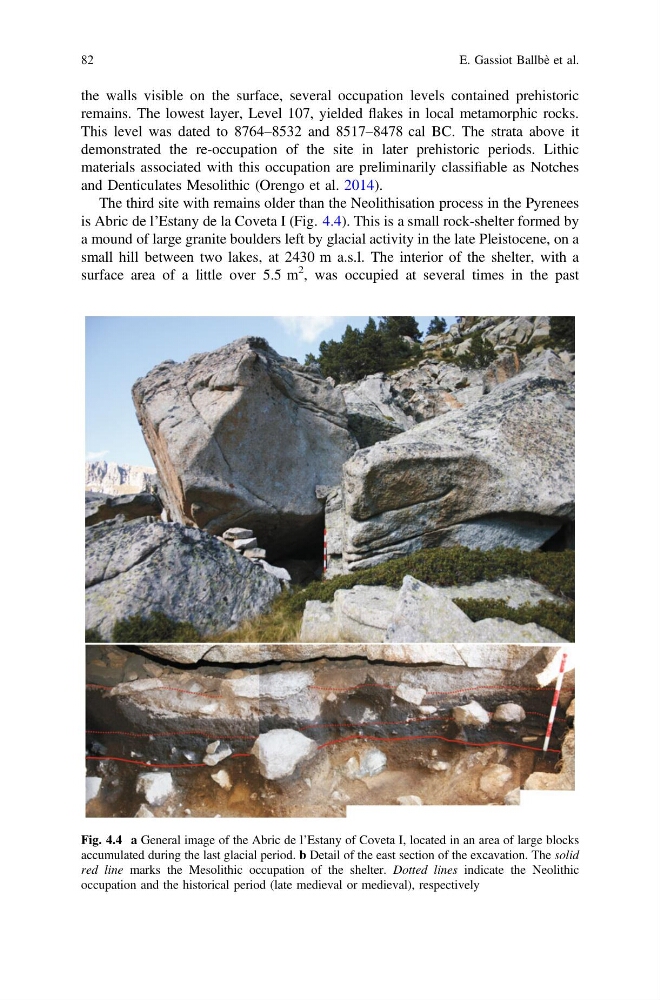
is Abric de l’Estany de la Coveta I (Fig. 4.4). This is a small rock-shelter formed by
a mound of large granite boulders left by glacial activity in the late Pleistocene, on a
small hill between two lakes, at 2430 m a.s.l. The interior of the shelter, with a
surface area of a little over 5.5 m
2 , was occupied at several times in the past
Fig. 4.4 a General image of the Abric de l’Estany of Coveta I, located in an area of large blocks
accumulated during the last glacial period. b Detail of the east section of the excavation. The solid
red line marks the Mesolithic occupation of the shelter. Dotted lines indicate the Neolithic
occupation and the historical period (late medieval or medieval), respectively
82
E. Gassiot Ballbè et al.
remains. The lowest layer, Level 107, yielded flakes in local metamorphic rocks.
This level was dated to 8764–8532 and 8517–8478 cal BC. The strata above it
demonstrated the re-occupation of the site in later prehistoric periods. Lithic
materials associated with this occupation are preliminarily classifiable as Notches
and Denticulates Mesolithic (Orengo et al. 2014).
The third site with remains older than the Neolithisation process in the Pyrenees
is Abric de l’Estany de la Coveta I (Fig. 4.4). This is a small rock-shelter formed by
a mound of large granite boulders left by glacial activity in the late Pleistocene, on a
small hill between two lakes, at 2430 m a.s.l. The interior of the shelter, with a
surface area of a little over 5.5 m
2 , was occupied at several times in the past
Fig. 4.4 a General image of the Abric de l’Estany of Coveta I, located in an area of large blocks
accumulated during the last glacial period. b Detail of the east section of the excavation. The solid
red line marks the Mesolithic occupation of the shelter. Dotted lines indicate the Neolithic
occupation and the historical period (late medieval or medieval), respectively
82
E. Gassiot Ballbè et al.