

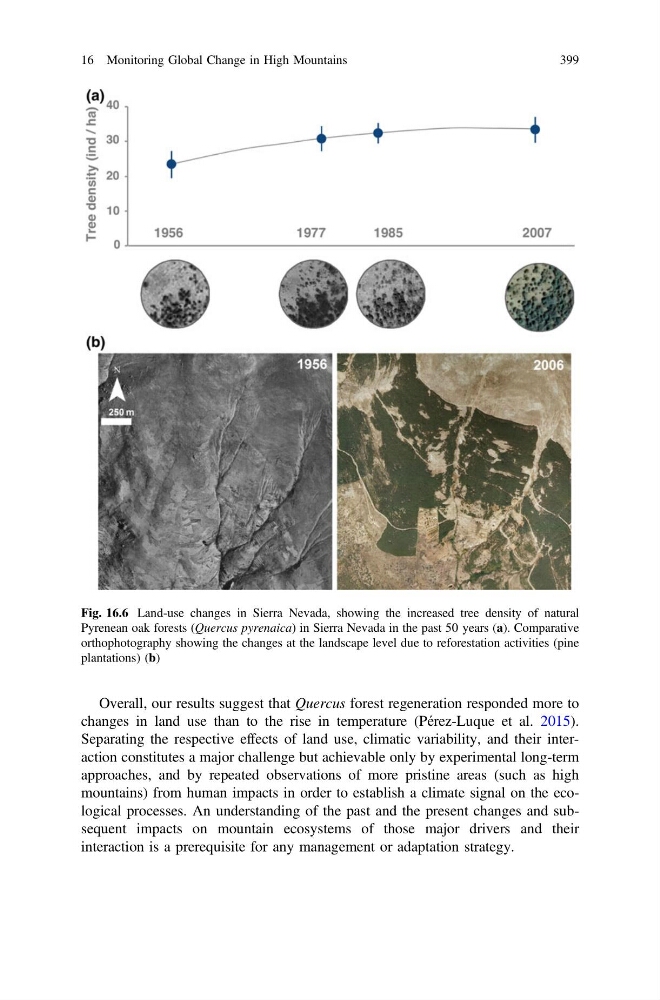
Overall, our results suggest that Quercus forest regeneration responded more to
changes in land use than to the rise in temperature (Pérez-Luque et al. 2015).
Separating the respective effects of land use, climatic variability, and their interaction constitutes a major challenge but achievable only by experimental long-term
approaches, and by repeated observations of more pristine areas (such as high
mountains) from human impacts in order to establish a climate signal on the ecological processes. An understanding of the past and the present changes and subsequent impacts on mountain ecosystems of those major drivers and their
interaction is a prerequisite for any management or adaptation strategy.
Fig. 16.6 Land-use changes in Sierra Nevada, showing the increased tree density of natural
Pyrenean oak forests (Quercus pyrenaica) in Sierra Nevada in the past 50 years (a). Comparative
orthophotography showing the changes at the landscape level due to reforestation activities (pine
plantations) (b)
16 Monitoring Global Change in High Mountains
399
changes in land use than to the rise in temperature (Pérez-Luque et al. 2015).
Separating the respective effects of land use, climatic variability, and their interaction constitutes a major challenge but achievable only by experimental long-term
approaches, and by repeated observations of more pristine areas (such as high
mountains) from human impacts in order to establish a climate signal on the ecological processes. An understanding of the past and the present changes and subsequent impacts on mountain ecosystems of those major drivers and their
interaction is a prerequisite for any management or adaptation strategy.
Fig. 16.6 Land-use changes in Sierra Nevada, showing the increased tree density of natural
Pyrenean oak forests (Quercus pyrenaica) in Sierra Nevada in the past 50 years (a). Comparative
orthophotography showing the changes at the landscape level due to reforestation activities (pine
plantations) (b)
16 Monitoring Global Change in High Mountains
399