

and managers and technical teams of the Sierra Nevada National Park is through
joint work in the thematic areas we have defined as systems of indicators
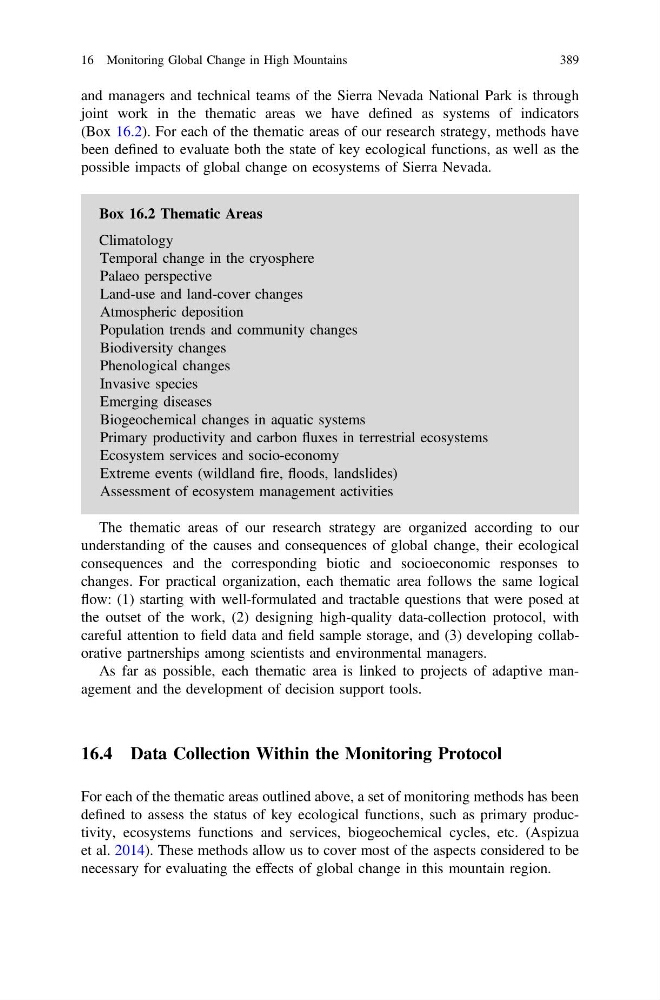
(Box 16.2). For each of the thematic areas of our research strategy, methods have
been defined to evaluate both the state of key ecological functions, as well as the
possible impacts of global change on ecosystems of Sierra Nevada.
Box 16.2 Thematic Areas
Climatology
Temporal change in the cryosphere
Palaeo perspective
Land-use and land-cover changes
Atmospheric deposition
Population trends and community changes
Biodiversity changes
Phenological changes
Invasive species
Emerging diseases
Biogeochemical changes in aquatic systems
Primary productivity and carbon fluxes in terrestrial ecosystems
Ecosystem services and socio-economy
Extreme events (wildland fire, floods, landslides)
Assessment of ecosystem management activities
The thematic areas of our research strategy are organized according to our
understanding of the causes and consequences of global change, their ecological
consequences and the corresponding biotic and socioeconomic responses to
changes. For practical organization, each thematic area follows the same logical
flow: (1) starting with well-formulated and tractable questions that were posed at
the outset of the work, (2) designing high-quality data-collection protocol, with
careful attention to field data and field sample storage, and (3) developing collaborative partnerships among scientists and environmental managers.
As far as possible, each thematic area is linked to projects of adaptive management and the development of decision support tools.
16.4 Data Collection Within the Monitoring Protocol
For each of the thematic areas outlined above, a set of monitoring methods has been
defined to assess the status of key ecological functions, such as primary productivity, ecosystems functions and services, biogeochemical cycles, etc. (Aspizua
et al. 2014). These methods allow us to cover most of the aspects considered to be
necessary for evaluating the effects of global change in this mountain region.
16 Monitoring Global Change in High Mountains
389
joint work in the thematic areas we have defined as systems of indicators
(Box 16.2). For each of the thematic areas of our research strategy, methods have
been defined to evaluate both the state of key ecological functions, as well as the
possible impacts of global change on ecosystems of Sierra Nevada.
Box 16.2 Thematic Areas
Climatology
Temporal change in the cryosphere
Palaeo perspective
Land-use and land-cover changes
Atmospheric deposition
Population trends and community changes
Biodiversity changes
Phenological changes
Invasive species
Emerging diseases
Biogeochemical changes in aquatic systems
Primary productivity and carbon fluxes in terrestrial ecosystems
Ecosystem services and socio-economy
Extreme events (wildland fire, floods, landslides)
Assessment of ecosystem management activities
The thematic areas of our research strategy are organized according to our
understanding of the causes and consequences of global change, their ecological
consequences and the corresponding biotic and socioeconomic responses to
changes. For practical organization, each thematic area follows the same logical
flow: (1) starting with well-formulated and tractable questions that were posed at
the outset of the work, (2) designing high-quality data-collection protocol, with
careful attention to field data and field sample storage, and (3) developing collaborative partnerships among scientists and environmental managers.
As far as possible, each thematic area is linked to projects of adaptive management and the development of decision support tools.
16.4 Data Collection Within the Monitoring Protocol
For each of the thematic areas outlined above, a set of monitoring methods has been
defined to assess the status of key ecological functions, such as primary productivity, ecosystems functions and services, biogeochemical cycles, etc. (Aspizua
et al. 2014). These methods allow us to cover most of the aspects considered to be
necessary for evaluating the effects of global change in this mountain region.
16 Monitoring Global Change in High Mountains
389