

and/or (2) natural selection progressively eliminates low-quality individuals
(Tavecchia et al. 2001). Even when the underlying mechanisms may be of great
interest in understanding the evolution of life histories, it is tough to correctly
separate one mechanism from another (Tavecchia et al. 2001; Sanz et al. 2008). All
in all, consequences for population dynamics are similar: population growth rates
among long-lived species are expected to be highly sensitive to changes in adult
survival (Real and Mañosa 1997; Oro et al. 2008; Ortega et al. 2009;
Hernández-Matías et al. 2013; Margalida et al. 2015), so natural selection might
have minimised variation in this parameter to ensure population stability (Saether
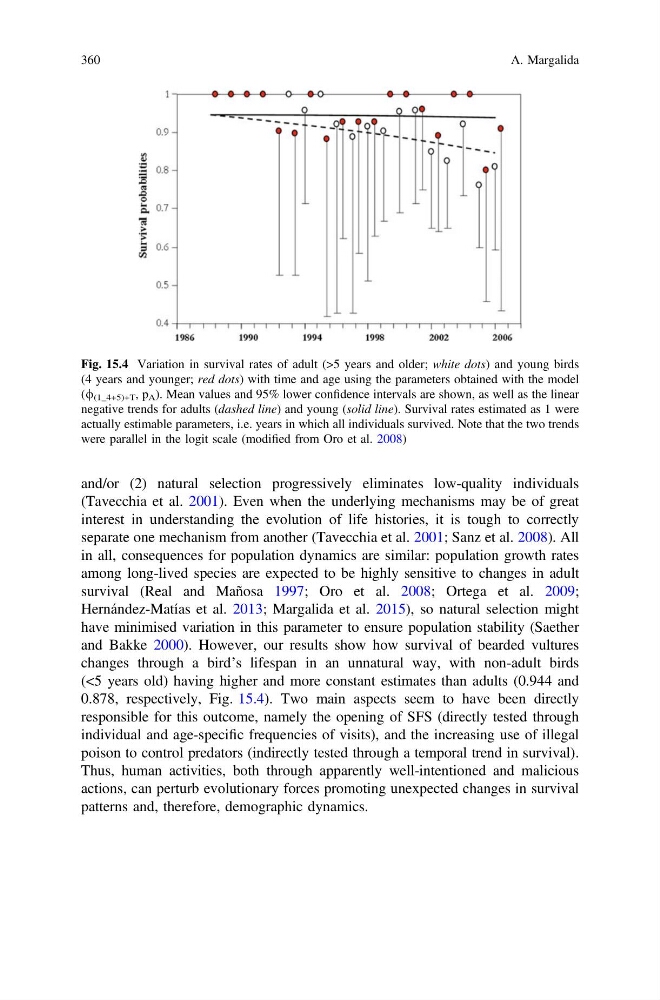
and Bakke 2000). However, our results show how survival of bearded vultures
changes through a bird’s lifespan in an unnatural way, with non-adult birds
(<5 years old) having higher and more constant estimates than adults (0.944 and
0.878, respectively, Fig. 15.4). Two main aspects seem to have been directly
responsible for this outcome, namely the opening of SFS (directly tested through
individual and age-specific frequencies of visits), and the increasing use of illegal
poison to control predators (indirectly tested through a temporal trend in survival).
Thus, human activities, both through apparently well-intentioned and malicious
actions, can perturb evolutionary forces promoting unexpected changes in survival
patterns and, therefore, demographic dynamics.
Fig. 15.4 Variation in survival rates of adult (>5 years and older; white dots) and young birds
(4 years and younger; red dots) with time and age using the parameters obtained with the model
(/ (1_4+5)+T , p A ). Mean values and 95% lower confidence intervals are shown, as well as the linear
negative trends for adults (dashed line) and young (solid line). Survival rates estimated as 1 were
actually estimable parameters, i.e. years in which all individuals survived. Note that the two trends
were parallel in the logit scale (modified from Oro et al. 2008)
360
A. Margalida
(Tavecchia et al. 2001). Even when the underlying mechanisms may be of great
interest in understanding the evolution of life histories, it is tough to correctly
separate one mechanism from another (Tavecchia et al. 2001; Sanz et al. 2008). All
in all, consequences for population dynamics are similar: population growth rates
among long-lived species are expected to be highly sensitive to changes in adult
survival (Real and Mañosa 1997; Oro et al. 2008; Ortega et al. 2009;
Hernández-Matías et al. 2013; Margalida et al. 2015), so natural selection might
have minimised variation in this parameter to ensure population stability (Saether
and Bakke 2000). However, our results show how survival of bearded vultures
changes through a bird’s lifespan in an unnatural way, with non-adult birds
(<5 years old) having higher and more constant estimates than adults (0.944 and
0.878, respectively, Fig. 15.4). Two main aspects seem to have been directly
responsible for this outcome, namely the opening of SFS (directly tested through
individual and age-specific frequencies of visits), and the increasing use of illegal
poison to control predators (indirectly tested through a temporal trend in survival).
Thus, human activities, both through apparently well-intentioned and malicious
actions, can perturb evolutionary forces promoting unexpected changes in survival
patterns and, therefore, demographic dynamics.
Fig. 15.4 Variation in survival rates of adult (>5 years and older; white dots) and young birds
(4 years and younger; red dots) with time and age using the parameters obtained with the model
(/ (1_4+5)+T , p A ). Mean values and 95% lower confidence intervals are shown, as well as the linear
negative trends for adults (dashed line) and young (solid line). Survival rates estimated as 1 were
actually estimable parameters, i.e. years in which all individuals survived. Note that the two trends
were parallel in the logit scale (modified from Oro et al. 2008)
360
A. Margalida