

variation, lead, zinc and nickel show a significant decreasing trend between 2004 and
2013, in good agreement with the reduction in the emissions to the atmosphere
recorded in Europe during the same period (EEA 2013).
Is the abatement of emissions the end of the story about trace elements pollution? Possibly not. Besides lake sediments, soils are another matrix where trace
elements have accumulated during centuries of contamination. The amount of
polluting trace elements in high mountain soils (averaged taking into account bare
rock areas) in the Pyrenees (Bacardit et al. 2012) can be quantified in milligrams per
square metre (mg m
−2 ; Pb and Zn * 1000, Ni and Cu * 200, Cd * 10), whereas
yearly atmospheric deposition is measured as micrograms per square metre
(µg m
−2 ; Zn * 10,000, Pb and Cu * 1000, Ni * 250, Cd * 25). That is, soils
hold (on a per unit area) an anthropogenic trace elements burden that is about three
orders of magnitude larger than the current yearly deposition, even larger if natural
(i.e. coming from the rocks) trace elements are included. So, what is the fate of this
pollution legacy? May it be released from soils and contaminate the water courses,
for instance? There is evidence for certain elements that this is indeed the case
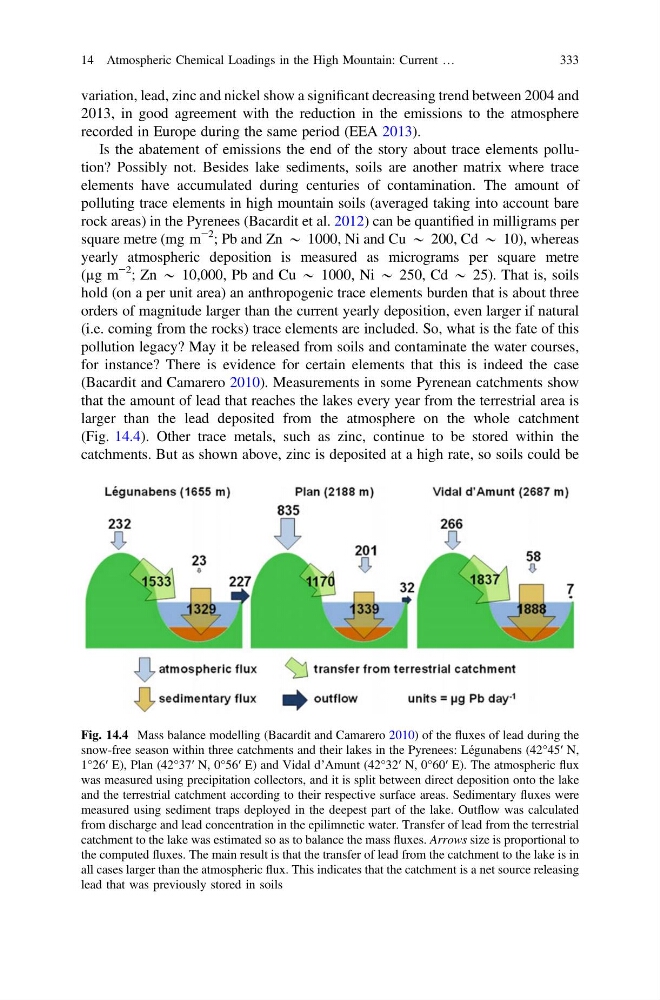
(Bacardit and Camarero 2010). Measurements in some Pyrenean catchments show
that the amount of lead that reaches the lakes every year from the terrestrial area is
larger than the lead deposited from the atmosphere on the whole catchment
(Fig. 14.4). Other trace metals, such as zinc, continue to be stored within the
catchments. But as shown above, zinc is deposited at a high rate, so soils could be
Fig. 14.4 Mass balance modelling (Bacardit and Camarero 2010) of the fluxes of lead during the
snow-free season within three catchments and their lakes in the Pyrenees: Légunabens (42°45′ N,
1°26′ E), Plan (42°37′ N, 0°56′ E) and Vidal d’Amunt (42°32′ N, 0°60′ E). The atmospheric flux
was measured using precipitation collectors, and it is split between direct deposition onto the lake
and the terrestrial catchment according to their respective surface areas. Sedimentary fluxes were
measured using sediment traps deployed in the deepest part of the lake. Outflow was calculated
from discharge and lead concentration in the epilimnetic water. Transfer of lead from the terrestrial
catchment to the lake was estimated so as to balance the mass fluxes. Arrows size is proportional to
the computed fluxes. The main result is that the transfer of lead from the catchment to the lake is in
all cases larger than the atmospheric flux. This indicates that the catchment is a net source releasing
lead that was previously stored in soils
14 Atmospheric Chemical Loadings in the High Mountain: Current …
333
2013, in good agreement with the reduction in the emissions to the atmosphere
recorded in Europe during the same period (EEA 2013).
Is the abatement of emissions the end of the story about trace elements pollution? Possibly not. Besides lake sediments, soils are another matrix where trace
elements have accumulated during centuries of contamination. The amount of
polluting trace elements in high mountain soils (averaged taking into account bare
rock areas) in the Pyrenees (Bacardit et al. 2012) can be quantified in milligrams per
square metre (mg m
−2 ; Pb and Zn * 1000, Ni and Cu * 200, Cd * 10), whereas
yearly atmospheric deposition is measured as micrograms per square metre
(µg m
−2 ; Zn * 10,000, Pb and Cu * 1000, Ni * 250, Cd * 25). That is, soils
hold (on a per unit area) an anthropogenic trace elements burden that is about three
orders of magnitude larger than the current yearly deposition, even larger if natural
(i.e. coming from the rocks) trace elements are included. So, what is the fate of this
pollution legacy? May it be released from soils and contaminate the water courses,
for instance? There is evidence for certain elements that this is indeed the case
(Bacardit and Camarero 2010). Measurements in some Pyrenean catchments show
that the amount of lead that reaches the lakes every year from the terrestrial area is
larger than the lead deposited from the atmosphere on the whole catchment
(Fig. 14.4). Other trace metals, such as zinc, continue to be stored within the
catchments. But as shown above, zinc is deposited at a high rate, so soils could be
Fig. 14.4 Mass balance modelling (Bacardit and Camarero 2010) of the fluxes of lead during the
snow-free season within three catchments and their lakes in the Pyrenees: Légunabens (42°45′ N,
1°26′ E), Plan (42°37′ N, 0°56′ E) and Vidal d’Amunt (42°32′ N, 0°60′ E). The atmospheric flux
was measured using precipitation collectors, and it is split between direct deposition onto the lake
and the terrestrial catchment according to their respective surface areas. Sedimentary fluxes were
measured using sediment traps deployed in the deepest part of the lake. Outflow was calculated
from discharge and lead concentration in the epilimnetic water. Transfer of lead from the terrestrial
catchment to the lake was estimated so as to balance the mass fluxes. Arrows size is proportional to
the computed fluxes. The main result is that the transfer of lead from the catchment to the lake is in
all cases larger than the atmospheric flux. This indicates that the catchment is a net source releasing
lead that was previously stored in soils
14 Atmospheric Chemical Loadings in the High Mountain: Current …
333