

sediments, and that lakes in the Central and Eastern Pyrenees were more frequently
enriched than lakes in the Western side (Camarero 2003). This difference could be
hypothetically due to a higher deposition of dust from southern locations carrying
those metals adsorbed onto the particles (see below) in the Centre and East.
The concentration of some trace elements in the surface sediments of a number
of lakes is surprisingly high for such relatively remote sites where pollutants arrive
exclusively through atmospheric deposition (Fig. 14.3). The concentration found in
those lakes is comparable to the levels found in sites with intense pollution, such as
areas directly affected by urban and industrial sewage discharge or within harbours
(Camarero et al. 2009). Some factors likely contribute to these high levels: first,
lake sediments are the final sink of many elements deposited in the whole catchment and transported from there to the lake, so it may take place a “focussing” of
pollutants towards the sediments; second, sediments of Pyrenean lakes tend to be
very organic and have therefore a great affinity and ability to bound metal and
metalloid cations; and finally, sedimentary rates in these non-productive lakes are
often very low, so the effect of “dilution” of pollutants within the bulk sediment is
minimised. As a consequence, a large proportion of the lakes presents concentrations of trace elements in sediments that are above the boundary where the first
toxic effects on biota are detected, or even above the level in which severe effects
occur.
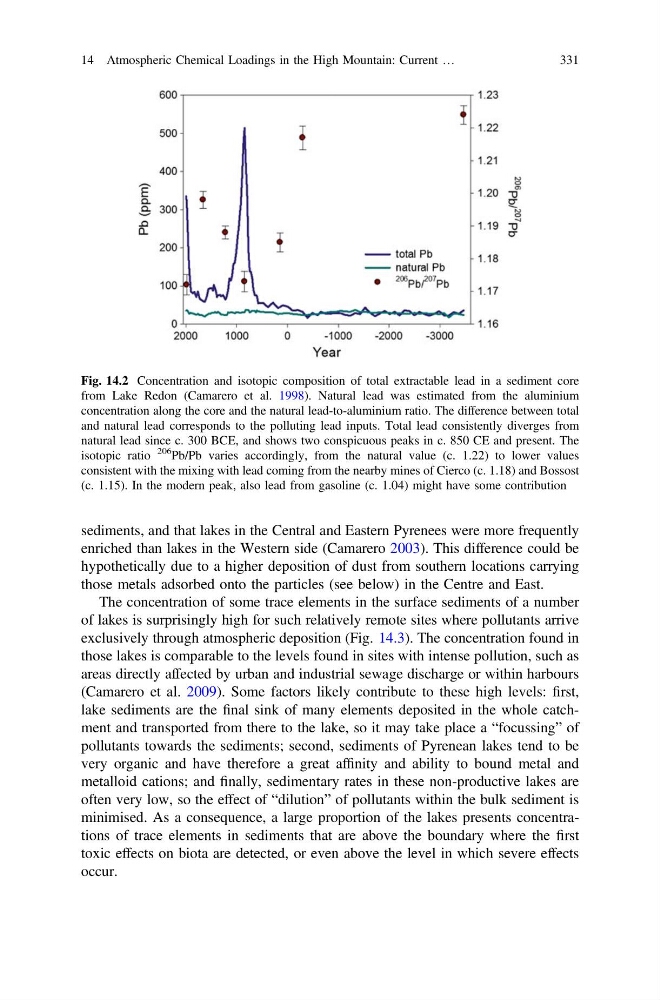
Fig. 14.2 Concentration and isotopic composition of total extractable lead in a sediment core
from Lake Redon (Camarero et al. 1998). Natural lead was estimated from the aluminium
concentration along the core and the natural lead-to-aluminium ratio. The difference between total
and natural lead corresponds to the polluting lead inputs. Total lead consistently diverges from
natural lead since c. 300 BCE, and shows two conspicuous peaks in c. 850 CE and present. The
isotopic ratio
206
Pb/Pb varies accordingly, from the natural value (c. 1.22) to lower values
consistent with the mixing with lead coming from the nearby mines of Cierco (c. 1.18) and Bossost
(c. 1.15). In the modern peak, also lead from gasoline (c. 1.04) might have some contribution
14 Atmospheric Chemical Loadings in the High Mountain: Current …
331
enriched than lakes in the Western side (Camarero 2003). This difference could be
hypothetically due to a higher deposition of dust from southern locations carrying
those metals adsorbed onto the particles (see below) in the Centre and East.
The concentration of some trace elements in the surface sediments of a number
of lakes is surprisingly high for such relatively remote sites where pollutants arrive
exclusively through atmospheric deposition (Fig. 14.3). The concentration found in
those lakes is comparable to the levels found in sites with intense pollution, such as
areas directly affected by urban and industrial sewage discharge or within harbours
(Camarero et al. 2009). Some factors likely contribute to these high levels: first,
lake sediments are the final sink of many elements deposited in the whole catchment and transported from there to the lake, so it may take place a “focussing” of
pollutants towards the sediments; second, sediments of Pyrenean lakes tend to be
very organic and have therefore a great affinity and ability to bound metal and
metalloid cations; and finally, sedimentary rates in these non-productive lakes are
often very low, so the effect of “dilution” of pollutants within the bulk sediment is
minimised. As a consequence, a large proportion of the lakes presents concentrations of trace elements in sediments that are above the boundary where the first
toxic effects on biota are detected, or even above the level in which severe effects
occur.
Fig. 14.2 Concentration and isotopic composition of total extractable lead in a sediment core
from Lake Redon (Camarero et al. 1998). Natural lead was estimated from the aluminium
concentration along the core and the natural lead-to-aluminium ratio. The difference between total
and natural lead corresponds to the polluting lead inputs. Total lead consistently diverges from
natural lead since c. 300 BCE, and shows two conspicuous peaks in c. 850 CE and present. The
isotopic ratio
206
Pb/Pb varies accordingly, from the natural value (c. 1.22) to lower values
consistent with the mixing with lead coming from the nearby mines of Cierco (c. 1.18) and Bossost
(c. 1.15). In the modern peak, also lead from gasoline (c. 1.04) might have some contribution
14 Atmospheric Chemical Loadings in the High Mountain: Current …
331