

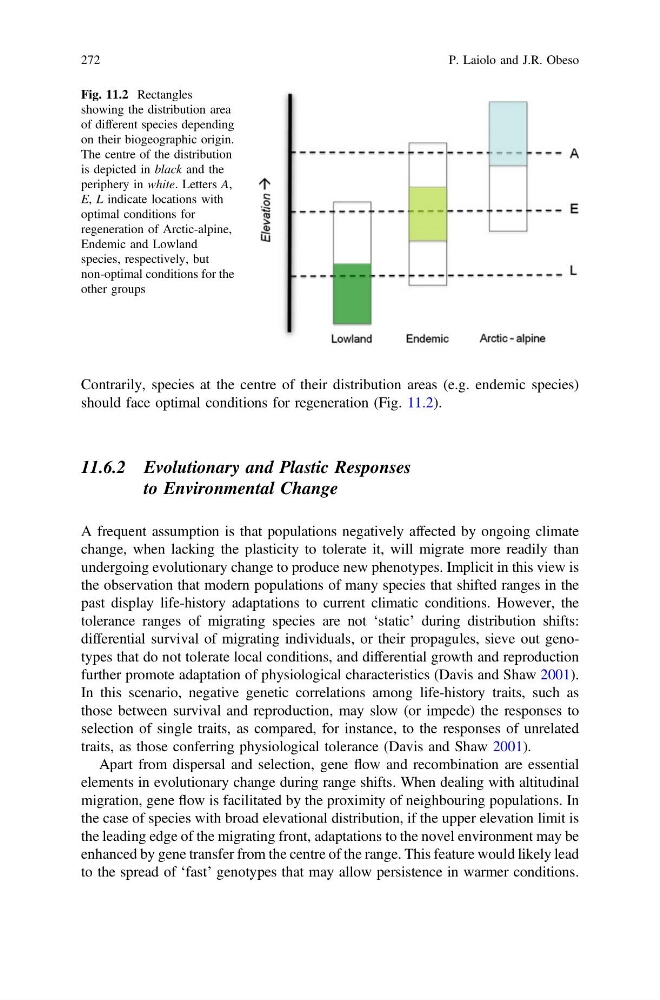
Contrarily, species at the centre of their distribution areas (e.g. endemic species)
should face optimal conditions for regeneration (Fig. 11.2).
11.6.2 Evolutionary and Plastic Responses
to Environmental Change
A frequent assumption is that populations negatively affected by ongoing climate
change, when lacking the plasticity to tolerate it, will migrate more readily than
undergoing evolutionary change to produce new phenotypes. Implicit in this view is
the observation that modern populations of many species that shifted ranges in the
past display life-history adaptations to current climatic conditions. However, the
tolerance ranges of migrating species are not ‘static’ during distribution shifts:
differential survival of migrating individuals, or their propagules, sieve out genotypes that do not tolerate local conditions, and differential growth and reproduction
further promote adaptation of physiological characteristics (Davis and Shaw 2001).
In this scenario, negative genetic correlations among life-history traits, such as
those between survival and reproduction, may slow (or impede) the responses to
selection of single traits, as compared, for instance, to the responses of unrelated
traits, as those conferring physiological tolerance (Davis and Shaw 2001).
Apart from dispersal and selection, gene flow and recombination are essential
elements in evolutionary change during range shifts. When dealing with altitudinal
migration, gene flow is facilitated by the proximity of neighbouring populations. In
the case of species with broad elevational distribution, if the upper elevation limit is
the leading edge of the migrating front, adaptations to the novel environment may be
enhanced by gene transfer from the centre of the range. This feature would likely lead
to the spread of ‘fast’ genotypes that may allow persistence in warmer conditions.
Fig. 11.2 Rectangles
showing the distribution area
of different species depending
on their biogeographic origin.
The centre of the distribution
is depicted in black and the
periphery in white. Letters A,
E, L indicate locations with
optimal conditions for
regeneration of Arctic-alpine,
Endemic and Lowland
species, respectively, but
non-optimal conditions for the
other groups
272
P. Laiolo and J.R. Obeso
should face optimal conditions for regeneration (Fig. 11.2).
11.6.2 Evolutionary and Plastic Responses
to Environmental Change
A frequent assumption is that populations negatively affected by ongoing climate
change, when lacking the plasticity to tolerate it, will migrate more readily than
undergoing evolutionary change to produce new phenotypes. Implicit in this view is
the observation that modern populations of many species that shifted ranges in the
past display life-history adaptations to current climatic conditions. However, the
tolerance ranges of migrating species are not ‘static’ during distribution shifts:
differential survival of migrating individuals, or their propagules, sieve out genotypes that do not tolerate local conditions, and differential growth and reproduction
further promote adaptation of physiological characteristics (Davis and Shaw 2001).
In this scenario, negative genetic correlations among life-history traits, such as
those between survival and reproduction, may slow (or impede) the responses to
selection of single traits, as compared, for instance, to the responses of unrelated
traits, as those conferring physiological tolerance (Davis and Shaw 2001).
Apart from dispersal and selection, gene flow and recombination are essential
elements in evolutionary change during range shifts. When dealing with altitudinal
migration, gene flow is facilitated by the proximity of neighbouring populations. In
the case of species with broad elevational distribution, if the upper elevation limit is
the leading edge of the migrating front, adaptations to the novel environment may be
enhanced by gene transfer from the centre of the range. This feature would likely lead
to the spread of ‘fast’ genotypes that may allow persistence in warmer conditions.
Fig. 11.2 Rectangles
showing the distribution area
of different species depending
on their biogeographic origin.
The centre of the distribution
is depicted in black and the
periphery in white. Letters A,
E, L indicate locations with
optimal conditions for
regeneration of Arctic-alpine,
Endemic and Lowland
species, respectively, but
non-optimal conditions for the
other groups
272
P. Laiolo and J.R. Obeso