

a fact that suggests that gene flow and repeated seedling recruitment during succession might be more frequent than commonly thought (Diggle et al. 1998; Pluess
and Stöcklin 2004; Reisch et al. 2007).
11.6 Discussion
11.6.1 Current Patterns
This review shows that much of life-history variation in elevation is the result of
direct physiological sensitivity to temperature and nutrient supply, which is then
modified secondarily by evolutionary responses that refine the relationship with the
environment. Generally, organisms as diverse as animal ectotherms, endotherms
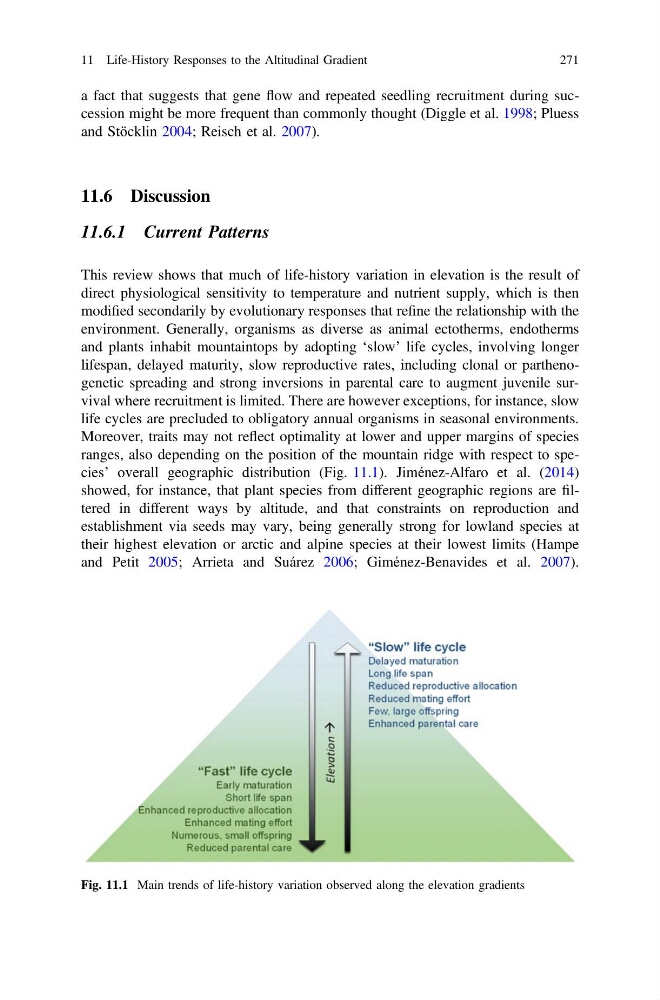
and plants inhabit mountaintops by adopting ‘slow’ life cycles, involving longer
lifespan, delayed maturity, slow reproductive rates, including clonal or parthenogenetic spreading and strong inversions in parental care to augment juvenile survival where recruitment is limited. There are however exceptions, for instance, slow
life cycles are precluded to obligatory annual organisms in seasonal environments.
Moreover, traits may not reflect optimality at lower and upper margins of species
ranges, also depending on the position of the mountain ridge with respect to species’ overall geographic distribution (Fig. 11.1). Jiménez-Alfaro et al. (2014)
showed, for instance, that plant species from different geographic regions are filtered in different ways by altitude, and that constraints on reproduction and
establishment via seeds may vary, being generally strong for lowland species at
their highest elevation or arctic and alpine species at their lowest limits (Hampe
and Petit 2005; Arrieta and Suárez 2006; Giménez-Benavides et al. 2007).
Fig. 11.1 Main trends of life-history variation observed along the elevation gradients
11 Life-History Responses to the Altitudinal Gradient
271
and Stöcklin 2004; Reisch et al. 2007).
11.6 Discussion
11.6.1 Current Patterns
This review shows that much of life-history variation in elevation is the result of
direct physiological sensitivity to temperature and nutrient supply, which is then
modified secondarily by evolutionary responses that refine the relationship with the
environment. Generally, organisms as diverse as animal ectotherms, endotherms
and plants inhabit mountaintops by adopting ‘slow’ life cycles, involving longer
lifespan, delayed maturity, slow reproductive rates, including clonal or parthenogenetic spreading and strong inversions in parental care to augment juvenile survival where recruitment is limited. There are however exceptions, for instance, slow
life cycles are precluded to obligatory annual organisms in seasonal environments.
Moreover, traits may not reflect optimality at lower and upper margins of species
ranges, also depending on the position of the mountain ridge with respect to species’ overall geographic distribution (Fig. 11.1). Jiménez-Alfaro et al. (2014)
showed, for instance, that plant species from different geographic regions are filtered in different ways by altitude, and that constraints on reproduction and
establishment via seeds may vary, being generally strong for lowland species at
their highest elevation or arctic and alpine species at their lowest limits (Hampe
and Petit 2005; Arrieta and Suárez 2006; Giménez-Benavides et al. 2007).
Fig. 11.1 Main trends of life-history variation observed along the elevation gradients
11 Life-History Responses to the Altitudinal Gradient
271