

11.4 Empirical Evidence in Animals
11.4.1 Insects and Other Arthropods
Two major obstacles are faced by ectotherms in uplands or with broad altitudinal
distribution: low or decreasing ambient temperature and short or decreasing
growing/breeding seasons. Insect growth, development, reproduction, dormancy
and diapause are timed in relation to these constraints through alternative strategies.
The most common are the reduction of the length of the larval stage and the
acceleration of growth. Insects from collembolans to orthopterans have been shown
to reduce the number of instars (i.e. the number of moults to achieve the adult stage)
or the timing of diapause to complete their annual cycle earlier in uplands (Tanaka
and Brookes 1983; Zettel 2000). This response is typically associated with thermal
conditions close to a species’ tolerance range at either low or high extremes (Esperk
et al. 2007). Growing faster at high elevations is a widespread alternative (Dingle
et al. 1990; Berner et al. 2004; Laiolo and Obeso 2015), and represents one of the
best examples of countergradient genotypic variation opposing physiological
responses to temperature.
The reduction of instar number or development time lead to smaller adult body
sizes, a pattern commonly observed in upland insect populations and species
(Laiolo et al. 2013). Body size constrains fecundity, thus these strategies may carry
direct fecundity costs (Hönek 1993). These costs are obviated when prolonging
development or generation time over the years rather than restraining them within a
single year. This strategy has been described in alpine populations of both holo- and
hemimetabolous insects (Hodkinson 2005) and is more commonly associated with
seasonal but non-resource-limited environments. Meanwhile, resource limitation
together with high seasonality tends to favour fast growth at the expense of body
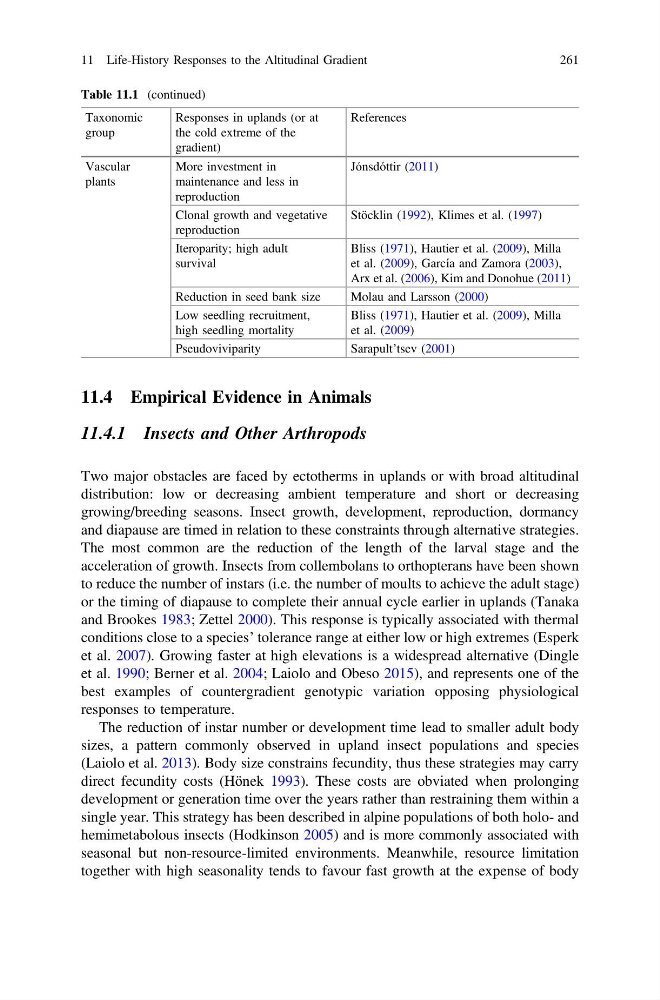
Table 11.1 (continued)
Taxonomic
group
Responses in uplands (or at
the cold extreme of the
gradient)
References
Vascular
plants
More investment in
maintenance and less in
reproduction
Jónsdóttir (2011)
Clonal growth and vegetative
reproduction
Stöcklin (1992), Klimes et al. (1997)
Iteroparity; high adult
survival
Bliss (1971), Hautier et al. (2009), Milla
et al. (2009), García and Zamora (2003),
Arx et al. (2006), Kim and Donohue (2011)
Reduction in seed bank size
Molau and Larsson (2000)
Low seedling recruitment,
high seedling mortality
Bliss (1971), Hautier et al. (2009), Milla
et al. (2009)
Pseudoviviparity
Sarapult’tsev (2001)
11 Life-History Responses to the Altitudinal Gradient
261
11.4.1 Insects and Other Arthropods
Two major obstacles are faced by ectotherms in uplands or with broad altitudinal
distribution: low or decreasing ambient temperature and short or decreasing
growing/breeding seasons. Insect growth, development, reproduction, dormancy
and diapause are timed in relation to these constraints through alternative strategies.
The most common are the reduction of the length of the larval stage and the
acceleration of growth. Insects from collembolans to orthopterans have been shown
to reduce the number of instars (i.e. the number of moults to achieve the adult stage)
or the timing of diapause to complete their annual cycle earlier in uplands (Tanaka
and Brookes 1983; Zettel 2000). This response is typically associated with thermal
conditions close to a species’ tolerance range at either low or high extremes (Esperk
et al. 2007). Growing faster at high elevations is a widespread alternative (Dingle
et al. 1990; Berner et al. 2004; Laiolo and Obeso 2015), and represents one of the
best examples of countergradient genotypic variation opposing physiological
responses to temperature.
The reduction of instar number or development time lead to smaller adult body
sizes, a pattern commonly observed in upland insect populations and species
(Laiolo et al. 2013). Body size constrains fecundity, thus these strategies may carry
direct fecundity costs (Hönek 1993). These costs are obviated when prolonging
development or generation time over the years rather than restraining them within a
single year. This strategy has been described in alpine populations of both holo- and
hemimetabolous insects (Hodkinson 2005) and is more commonly associated with
seasonal but non-resource-limited environments. Meanwhile, resource limitation
together with high seasonality tends to favour fast growth at the expense of body
Table 11.1 (continued)
Taxonomic
group
Responses in uplands (or at
the cold extreme of the
gradient)
References
Vascular
plants
More investment in
maintenance and less in
reproduction
Jónsdóttir (2011)
Clonal growth and vegetative
reproduction
Stöcklin (1992), Klimes et al. (1997)
Iteroparity; high adult
survival
Bliss (1971), Hautier et al. (2009), Milla
et al. (2009), García and Zamora (2003),
Arx et al. (2006), Kim and Donohue (2011)
Reduction in seed bank size
Molau and Larsson (2000)
Low seedling recruitment,
high seedling mortality
Bliss (1971), Hautier et al. (2009), Milla
et al. (2009)
Pseudoviviparity
Sarapult’tsev (2001)
11 Life-History Responses to the Altitudinal Gradient
261