

emergence of new values and interests. As a consequence, traditional and sustainable multifunctional activities were abandoned and replaced by more purely
production-oriented ones. Pastures located on steep slopes and at higher altitudes,
requiring intensive labour, were abandoned while, at the same time, agriculture and
livestock raising in accessible fertile lowland fields and productive mountain
grasslands has intensified (Tasser and Tappeiner 2002; Bartolomé et al. 2005;
Hopkins and Holz 2006). Changes in traditional farming practices have been
observed across the European mountains (MacDonald et al. 2000). In the Pyrenees,
traditional pastoral systems were characterised by an extensive management of the
herd and the local transhumance to the communal alpine pastures in summer. Also,
herds of sheep moved each year from the Ebro basin to summer mountain grasslands (Montserrat and Fillat 1994). In the last decades, in the Pyrenees, but also in
most of the temperate European mountains, the redirection of the labour force to
other employments, mainly related to the tertiary sector, caused changes in the
farming management practices. As a consequence, some farms were abandoned
while other intensified the management to accommodate socio-economic changes
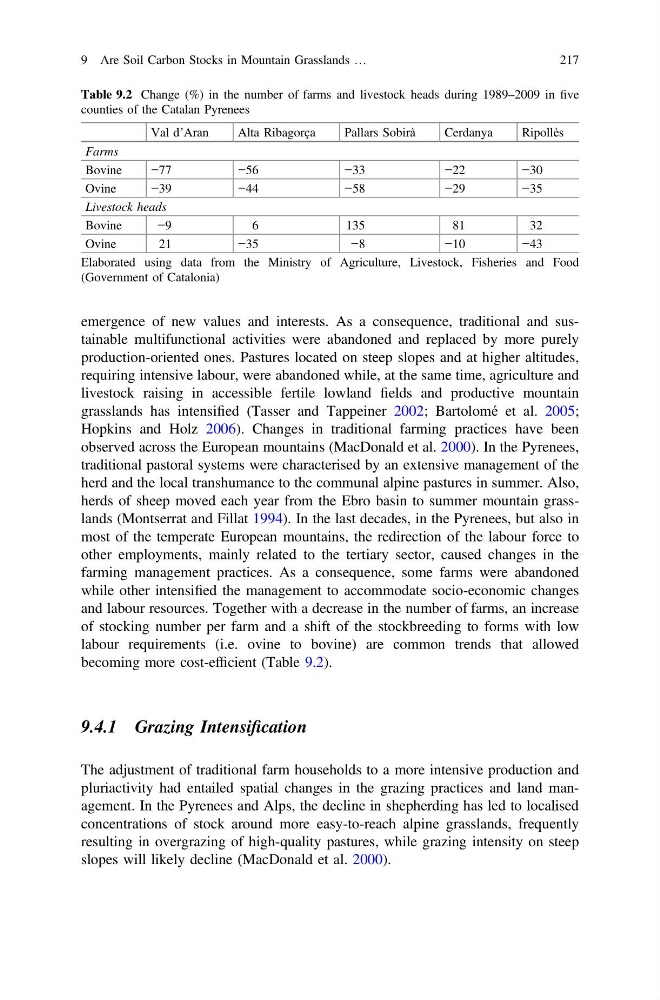
and labour resources. Together with a decrease in the number of farms, an increase
of stocking number per farm and a shift of the stockbreeding to forms with low
labour requirements (i.e. ovine to bovine) are common trends that allowed
becoming more cost-efficient (Table 9.2).
9.4.1 Grazing Intensification
The adjustment of traditional farm households to a more intensive production and
pluriactivity had entailed spatial changes in the grazing practices and land management. In the Pyrenees and Alps, the decline in shepherding has led to localised
concentrations of stock around more easy-to-reach alpine grasslands, frequently
resulting in overgrazing of high-quality pastures, while grazing intensity on steep
slopes will likely decline (MacDonald et al. 2000).
Table 9.2 Change (%) in the number of farms and livestock heads during 1989–2009 in five
counties of the Catalan Pyrenees
Val d’Aran
Alta Ribagorça
Pallars Sobirà
Cerdanya
Ripollès
Farms
Bovine
−77
−56
−33
−22
−30
Ovine
−39
−44
−58
−29
−35
Livestock heads
Bovine
−9
6
135
81
32
Ovine
21
−35
−8
−10
−43
Elaborated using data from the Ministry of Agriculture, Livestock, Fisheries and Food
(Government of Catalonia)
9 Are Soil Carbon Stocks in Mountain Grasslands …
217
production-oriented ones. Pastures located on steep slopes and at higher altitudes,
requiring intensive labour, were abandoned while, at the same time, agriculture and
livestock raising in accessible fertile lowland fields and productive mountain
grasslands has intensified (Tasser and Tappeiner 2002; Bartolomé et al. 2005;
Hopkins and Holz 2006). Changes in traditional farming practices have been
observed across the European mountains (MacDonald et al. 2000). In the Pyrenees,
traditional pastoral systems were characterised by an extensive management of the
herd and the local transhumance to the communal alpine pastures in summer. Also,
herds of sheep moved each year from the Ebro basin to summer mountain grasslands (Montserrat and Fillat 1994). In the last decades, in the Pyrenees, but also in
most of the temperate European mountains, the redirection of the labour force to
other employments, mainly related to the tertiary sector, caused changes in the
farming management practices. As a consequence, some farms were abandoned
while other intensified the management to accommodate socio-economic changes
and labour resources. Together with a decrease in the number of farms, an increase
of stocking number per farm and a shift of the stockbreeding to forms with low
labour requirements (i.e. ovine to bovine) are common trends that allowed
becoming more cost-efficient (Table 9.2).
9.4.1 Grazing Intensification
The adjustment of traditional farm households to a more intensive production and
pluriactivity had entailed spatial changes in the grazing practices and land management. In the Pyrenees and Alps, the decline in shepherding has led to localised
concentrations of stock around more easy-to-reach alpine grasslands, frequently
resulting in overgrazing of high-quality pastures, while grazing intensity on steep
slopes will likely decline (MacDonald et al. 2000).
Table 9.2 Change (%) in the number of farms and livestock heads during 1989–2009 in five
counties of the Catalan Pyrenees
Val d’Aran
Alta Ribagorça
Pallars Sobirà
Cerdanya
Ripollès
Farms
Bovine
−77
−56
−33
−22
−30
Ovine
−39
−44
−58
−29
−35
Livestock heads
Bovine
−9
6
135
81
32
Ovine
21
−35
−8
−10
−43
Elaborated using data from the Ministry of Agriculture, Livestock, Fisheries and Food
(Government of Catalonia)
9 Are Soil Carbon Stocks in Mountain Grasslands …
217