

9.4 Effects of Land-Use and Management Changes on Soil
C Dynamics and Stocks
Although at the global scale remote areas still exist in mountain regions, in temperate European mountains the diversity of habitats resulting from the complex
topography and multiple microclimates has been shaped, similarly to the lowland,
by the human activities for centuries (Montserrat and Fillat 1994; Gassiot Ballbè
et al. 2017 in the present book). Over the past centuries, low-intensity agriculture,
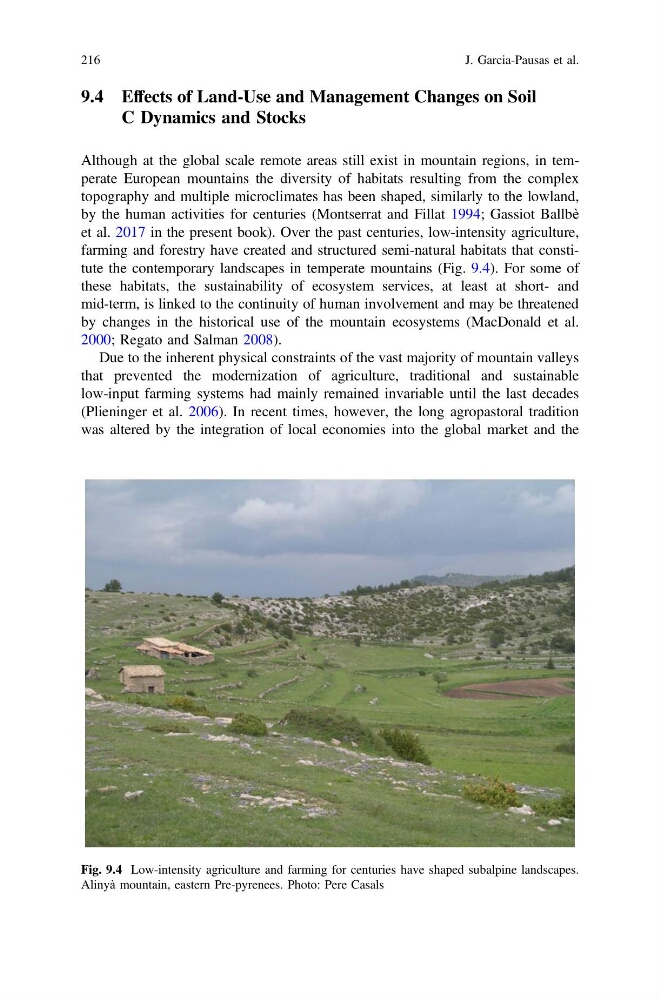
farming and forestry have created and structured semi-natural habitats that constitute the contemporary landscapes in temperate mountains (Fig. 9.4). For some of
these habitats, the sustainability of ecosystem services, at least at short- and
mid-term, is linked to the continuity of human involvement and may be threatened
by changes in the historical use of the mountain ecosystems (MacDonald et al.
2000; Regato and Salman 2008).
Due to the inherent physical constraints of the vast majority of mountain valleys
that prevented the modernization of agriculture, traditional and sustainable
low-input farming systems had mainly remained invariable until the last decades
(Plieninger et al. 2006). In recent times, however, the long agropastoral tradition
was altered by the integration of local economies into the global market and the
Fig. 9.4 Low-intensity agriculture and farming for centuries have shaped subalpine landscapes.
Alinyà mountain, eastern Pre-pyrenees. Photo: Pere Casals
216
J. Garcia-Pausas et al.
C Dynamics and Stocks
Although at the global scale remote areas still exist in mountain regions, in temperate European mountains the diversity of habitats resulting from the complex
topography and multiple microclimates has been shaped, similarly to the lowland,
by the human activities for centuries (Montserrat and Fillat 1994; Gassiot Ballbè
et al. 2017 in the present book). Over the past centuries, low-intensity agriculture,
farming and forestry have created and structured semi-natural habitats that constitute the contemporary landscapes in temperate mountains (Fig. 9.4). For some of
these habitats, the sustainability of ecosystem services, at least at short- and
mid-term, is linked to the continuity of human involvement and may be threatened
by changes in the historical use of the mountain ecosystems (MacDonald et al.
2000; Regato and Salman 2008).
Due to the inherent physical constraints of the vast majority of mountain valleys
that prevented the modernization of agriculture, traditional and sustainable
low-input farming systems had mainly remained invariable until the last decades
(Plieninger et al. 2006). In recent times, however, the long agropastoral tradition
was altered by the integration of local economies into the global market and the
Fig. 9.4 Low-intensity agriculture and farming for centuries have shaped subalpine landscapes.
Alinyà mountain, eastern Pre-pyrenees. Photo: Pere Casals
216
J. Garcia-Pausas et al.