

The introduction of fish might also affect the conservation status of some species
at the metapopulation level depending on their preference for lakes over ponds
(Denoël et al. 2016). Most animal groups inhabiting alpine lakes have species better
adapted to colonise lakes rather than ponds or vice versa, for example, because
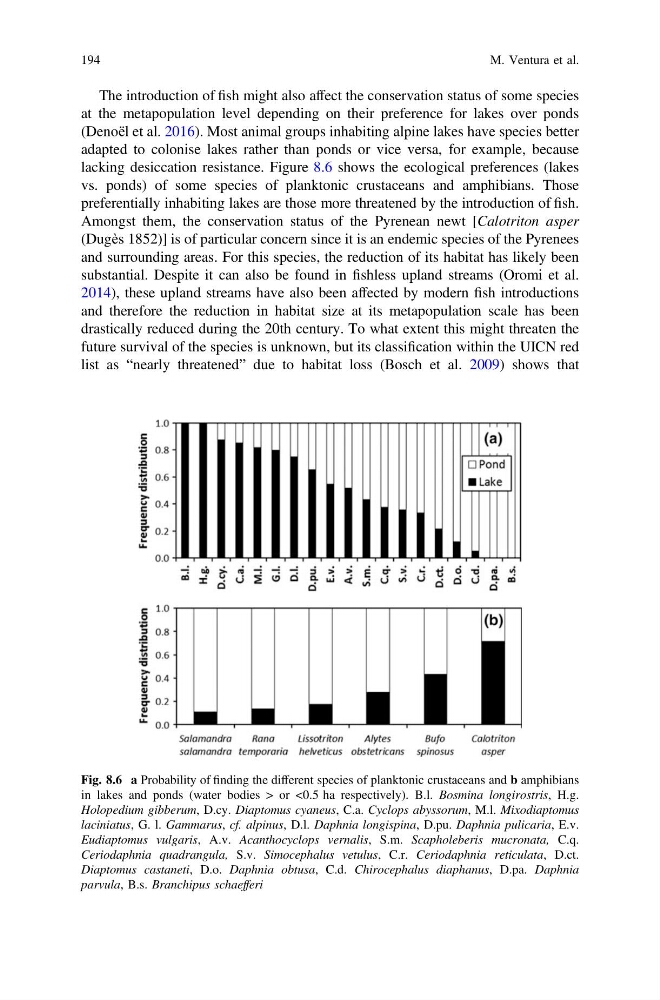
lacking desiccation resistance. Figure 8.6 shows the ecological preferences (lakes
vs. ponds) of some species of planktonic crustaceans and amphibians. Those
preferentially inhabiting lakes are those more threatened by the introduction of fish.
Amongst them, the conservation status of the Pyrenean newt [Calotriton asper
(Dugès 1852)] is of particular concern since it is an endemic species of the Pyrenees
and surrounding areas. For this species, the reduction of its habitat has likely been
substantial. Despite it can also be found in fishless upland streams (Oromi et al.
2014), these upland streams have also been affected by modern fish introductions
and therefore the reduction in habitat size at its metapopulation scale has been
drastically reduced during the 20th century. To what extent this might threaten the
future survival of the species is unknown, but its classification within the UICN red
list as “nearly threatened” due to habitat loss (Bosch et al. 2009) shows that
Fig. 8.6 a Probability of finding the different species of planktonic crustaceans and b amphibians
in lakes and ponds (water bodies > or <0.5 ha respectively). B.l. Bosmina longirostris, H.g.
Holopedium gibberum, D.cy. Diaptomus cyaneus, C.a. Cyclops abyssorum, M.l. Mixodiaptomus
laciniatus, G. l. Gammarus, cf. alpinus, D.l. Daphnia longispina, D.pu. Daphnia pulicaria, E.v.
Eudiaptomus vulgaris, A.v. Acanthocyclops vernalis, S.m. Scapholeberis mucronata, C.q.
Ceriodaphnia quadrangula, S.v. Simocephalus vetulus, C.r. Ceriodaphnia reticulata, D.ct.
Diaptomus castaneti, D.o. Daphnia obtusa, C.d. Chirocephalus diaphanus, D.pa. Daphnia
parvula, B.s. Branchipus schaefferi
194
M. Ventura et al.
at the metapopulation level depending on their preference for lakes over ponds
(Denoël et al. 2016). Most animal groups inhabiting alpine lakes have species better
adapted to colonise lakes rather than ponds or vice versa, for example, because
lacking desiccation resistance. Figure 8.6 shows the ecological preferences (lakes
vs. ponds) of some species of planktonic crustaceans and amphibians. Those
preferentially inhabiting lakes are those more threatened by the introduction of fish.
Amongst them, the conservation status of the Pyrenean newt [Calotriton asper
(Dugès 1852)] is of particular concern since it is an endemic species of the Pyrenees
and surrounding areas. For this species, the reduction of its habitat has likely been
substantial. Despite it can also be found in fishless upland streams (Oromi et al.
2014), these upland streams have also been affected by modern fish introductions
and therefore the reduction in habitat size at its metapopulation scale has been
drastically reduced during the 20th century. To what extent this might threaten the
future survival of the species is unknown, but its classification within the UICN red
list as “nearly threatened” due to habitat loss (Bosch et al. 2009) shows that
Fig. 8.6 a Probability of finding the different species of planktonic crustaceans and b amphibians
in lakes and ponds (water bodies > or <0.5 ha respectively). B.l. Bosmina longirostris, H.g.
Holopedium gibberum, D.cy. Diaptomus cyaneus, C.a. Cyclops abyssorum, M.l. Mixodiaptomus
laciniatus, G. l. Gammarus, cf. alpinus, D.l. Daphnia longispina, D.pu. Daphnia pulicaria, E.v.
Eudiaptomus vulgaris, A.v. Acanthocyclops vernalis, S.m. Scapholeberis mucronata, C.q.
Ceriodaphnia quadrangula, S.v. Simocephalus vetulus, C.r. Ceriodaphnia reticulata, D.ct.
Diaptomus castaneti, D.o. Daphnia obtusa, C.d. Chirocephalus diaphanus, D.pa. Daphnia
parvula, B.s. Branchipus schaefferi
194
M. Ventura et al.