

8.5 A Serious Problem for Conservation
The effects of fish introductions on high mountain lake ecosystems summarised
above and at Fig. 8.4 demonstrate unambiguously that there are substantial effects
at the lake scale, but it is also a problem at a regional and biogeographic scale,
either affecting some particular lakes or individual species.
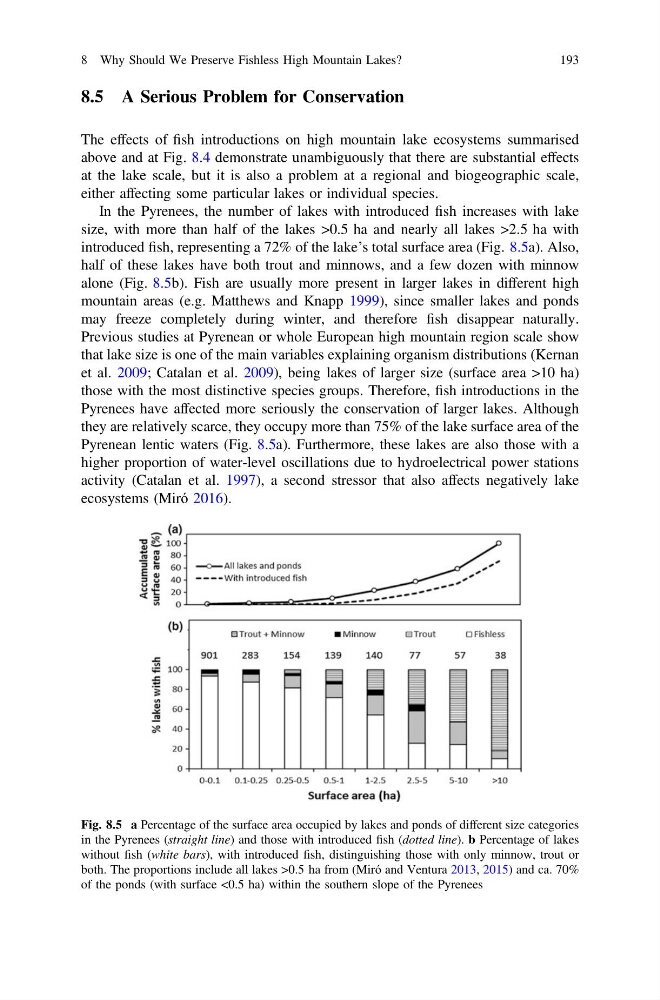
In the Pyrenees, the number of lakes with introduced fish increases with lake
size, with more than half of the lakes >0.5 ha and nearly all lakes >2.5 ha with
introduced fish, representing a 72% of the lake’s total surface area (Fig. 8.5a). Also,
half of these lakes have both trout and minnows, and a few dozen with minnow
alone (Fig. 8.5b). Fish are usually more present in larger lakes in different high
mountain areas (e.g. Matthews and Knapp 1999), since smaller lakes and ponds
may freeze completely during winter, and therefore fish disappear naturally.
Previous studies at Pyrenean or whole European high mountain region scale show
that lake size is one of the main variables explaining organism distributions (Kernan
et al. 2009; Catalan et al. 2009), being lakes of larger size (surface area >10 ha)
those with the most distinctive species groups. Therefore, fish introductions in the
Pyrenees have affected more seriously the conservation of larger lakes. Although
they are relatively scarce, they occupy more than 75% of the lake surface area of the
Pyrenean lentic waters (Fig. 8.5a). Furthermore, these lakes are also those with a
higher proportion of water-level oscillations due to hydroelectrical power stations
activity (Catalan et al. 1997), a second stressor that also affects negatively lake
ecosystems (Miró 2016).
Fig. 8.5 a Percentage of the surface area occupied by lakes and ponds of different size categories
in the Pyrenees (straight line) and those with introduced fish (dotted line). b Percentage of lakes
without fish (white bars), with introduced fish, distinguishing those with only minnow, trout or
both. The proportions include all lakes >0.5 ha from (Miró and Ventura 2013, 2015) and ca. 70%
of the ponds (with surface <0.5 ha) within the southern slope of the Pyrenees
8 Why Should We Preserve Fishless High Mountain Lakes?
193
The effects of fish introductions on high mountain lake ecosystems summarised
above and at Fig. 8.4 demonstrate unambiguously that there are substantial effects
at the lake scale, but it is also a problem at a regional and biogeographic scale,
either affecting some particular lakes or individual species.
In the Pyrenees, the number of lakes with introduced fish increases with lake
size, with more than half of the lakes >0.5 ha and nearly all lakes >2.5 ha with
introduced fish, representing a 72% of the lake’s total surface area (Fig. 8.5a). Also,
half of these lakes have both trout and minnows, and a few dozen with minnow
alone (Fig. 8.5b). Fish are usually more present in larger lakes in different high
mountain areas (e.g. Matthews and Knapp 1999), since smaller lakes and ponds
may freeze completely during winter, and therefore fish disappear naturally.
Previous studies at Pyrenean or whole European high mountain region scale show
that lake size is one of the main variables explaining organism distributions (Kernan
et al. 2009; Catalan et al. 2009), being lakes of larger size (surface area >10 ha)
those with the most distinctive species groups. Therefore, fish introductions in the
Pyrenees have affected more seriously the conservation of larger lakes. Although
they are relatively scarce, they occupy more than 75% of the lake surface area of the
Pyrenean lentic waters (Fig. 8.5a). Furthermore, these lakes are also those with a
higher proportion of water-level oscillations due to hydroelectrical power stations
activity (Catalan et al. 1997), a second stressor that also affects negatively lake
ecosystems (Miró 2016).
Fig. 8.5 a Percentage of the surface area occupied by lakes and ponds of different size categories
in the Pyrenees (straight line) and those with introduced fish (dotted line). b Percentage of lakes
without fish (white bars), with introduced fish, distinguishing those with only minnow, trout or
both. The proportions include all lakes >0.5 ha from (Miró and Ventura 2013, 2015) and ca. 70%
of the ponds (with surface <0.5 ha) within the southern slope of the Pyrenees
8 Why Should We Preserve Fishless High Mountain Lakes?
193