

biomass (Schabetsberger et al. 1995), that might result in a strong trophic cascade,
as has been described for other lakes such as those from the north-temperate area
(Carpenter et al. 2011).
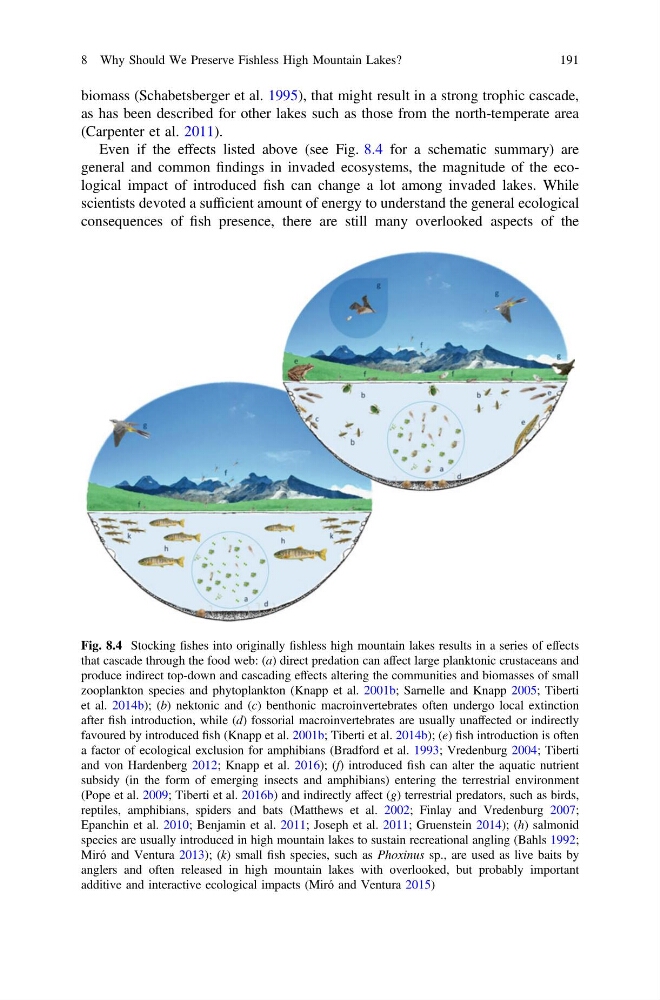
Even if the effects listed above (see Fig. 8.4 for a schematic summary) are
general and common findings in invaded ecosystems, the magnitude of the ecological impact of introduced fish can change a lot among invaded lakes. While
scientists devoted a sufficient amount of energy to understand the general ecological
consequences of fish presence, there are still many overlooked aspects of the
Fig. 8.4 Stocking fishes into originally fishless high mountain lakes results in a series of effects
that cascade through the food web: (a) direct predation can affect large planktonic crustaceans and
produce indirect top-down and cascading effects altering the communities and biomasses of small
zooplankton species and phytoplankton (Knapp et al. 2001b; Sarnelle and Knapp 2005; Tiberti
et al. 2014b); (b) nektonic and (c) benthonic macroinvertebrates often undergo local extinction
after fish introduction, while (d) fossorial macroinvertebrates are usually unaffected or indirectly
favoured by introduced fish (Knapp et al. 2001b; Tiberti et al. 2014b); (e) fish introduction is often
a factor of ecological exclusion for amphibians (Bradford et al. 1993; Vredenburg 2004; Tiberti
and von Hardenberg 2012; Knapp et al. 2016); (f) introduced fish can alter the aquatic nutrient
subsidy (in the form of emerging insects and amphibians) entering the terrestrial environment
(Pope et al. 2009; Tiberti et al. 2016b) and indirectly affect (g) terrestrial predators, such as birds,
reptiles, amphibians, spiders and bats (Matthews et al. 2002; Finlay and Vredenburg 2007;
Epanchin et al. 2010; Benjamin et al. 2011; Joseph et al. 2011; Gruenstein 2014); (h) salmonid
species are usually introduced in high mountain lakes to sustain recreational angling (Bahls 1992;
Miró and Ventura 2013); (k) small fish species, such as Phoxinus sp., are used as live baits by
anglers and often released in high mountain lakes with overlooked, but probably important
additive and interactive ecological impacts (Miró and Ventura 2015)
8 Why Should We Preserve Fishless High Mountain Lakes?
191
as has been described for other lakes such as those from the north-temperate area
(Carpenter et al. 2011).
Even if the effects listed above (see Fig. 8.4 for a schematic summary) are
general and common findings in invaded ecosystems, the magnitude of the ecological impact of introduced fish can change a lot among invaded lakes. While
scientists devoted a sufficient amount of energy to understand the general ecological
consequences of fish presence, there are still many overlooked aspects of the
Fig. 8.4 Stocking fishes into originally fishless high mountain lakes results in a series of effects
that cascade through the food web: (a) direct predation can affect large planktonic crustaceans and
produce indirect top-down and cascading effects altering the communities and biomasses of small
zooplankton species and phytoplankton (Knapp et al. 2001b; Sarnelle and Knapp 2005; Tiberti
et al. 2014b); (b) nektonic and (c) benthonic macroinvertebrates often undergo local extinction
after fish introduction, while (d) fossorial macroinvertebrates are usually unaffected or indirectly
favoured by introduced fish (Knapp et al. 2001b; Tiberti et al. 2014b); (e) fish introduction is often
a factor of ecological exclusion for amphibians (Bradford et al. 1993; Vredenburg 2004; Tiberti
and von Hardenberg 2012; Knapp et al. 2016); (f) introduced fish can alter the aquatic nutrient
subsidy (in the form of emerging insects and amphibians) entering the terrestrial environment
(Pope et al. 2009; Tiberti et al. 2016b) and indirectly affect (g) terrestrial predators, such as birds,
reptiles, amphibians, spiders and bats (Matthews et al. 2002; Finlay and Vredenburg 2007;
Epanchin et al. 2010; Benjamin et al. 2011; Joseph et al. 2011; Gruenstein 2014); (h) salmonid
species are usually introduced in high mountain lakes to sustain recreational angling (Bahls 1992;
Miró and Ventura 2013); (k) small fish species, such as Phoxinus sp., are used as live baits by
anglers and often released in high mountain lakes with overlooked, but probably important
additive and interactive ecological impacts (Miró and Ventura 2015)
8 Why Should We Preserve Fishless High Mountain Lakes?
191