

heterogeneous landscape. High mountain lakes are therefore natural laboratories of
great interest to improve the current knowledge of archaeal biology and ecology,
but perturbations in the trophic status and dissolved organic matter content may
induce substantial changes in the archaeal community composition (Auguet and
Casamayor 2013). Field experimentation should confirm whether or not warming
and eutrophication are major threats for such idiosyncratic assemblages.
7.3.3 Protists and Fungi
Microeukaryotes are essential components of microbial food webs, and morphological criteria have been traditionally used to tell apart the different species and to
successfully study the biology and ecology of the different taxa (e.g. diatoms,
cryptophytes, chrysophytes, among others). Inconspicuous forms usually of the
smallest sizes are however abundant and difficult to study because the cells lack
morphological features for identification. Microscopic eukaryotes constitute much
of the genetic diversity within the domain Eukarya and the development of genetic
approaches mostly based on the 18S rRNA gene sequencing have revealed new
previously undescribed clades and large diversity than expected present in nearly all
the Eukarya lineages. As it occurs with their prokaryotic counterparts, most of them
are uncultivable, but new molecular approaches combined with high-throughput
sequencing technologies and bioinformatics analyses provide for the first time the
possibility for detailed species inventories, although not free of limitations and
biases (e.g. Stoeck et al. 2014; Triadó-Margarit and Casamayor 2012). More
accurate preliminary estimations on how many different eukaryotic species exist, on
their functions, and on the environments with high and low microbial eukaryotic
Pyrenean
lakes
Marine
water column
Soil
0
2
4
6
8
10
PD
16S rRNA
amoA
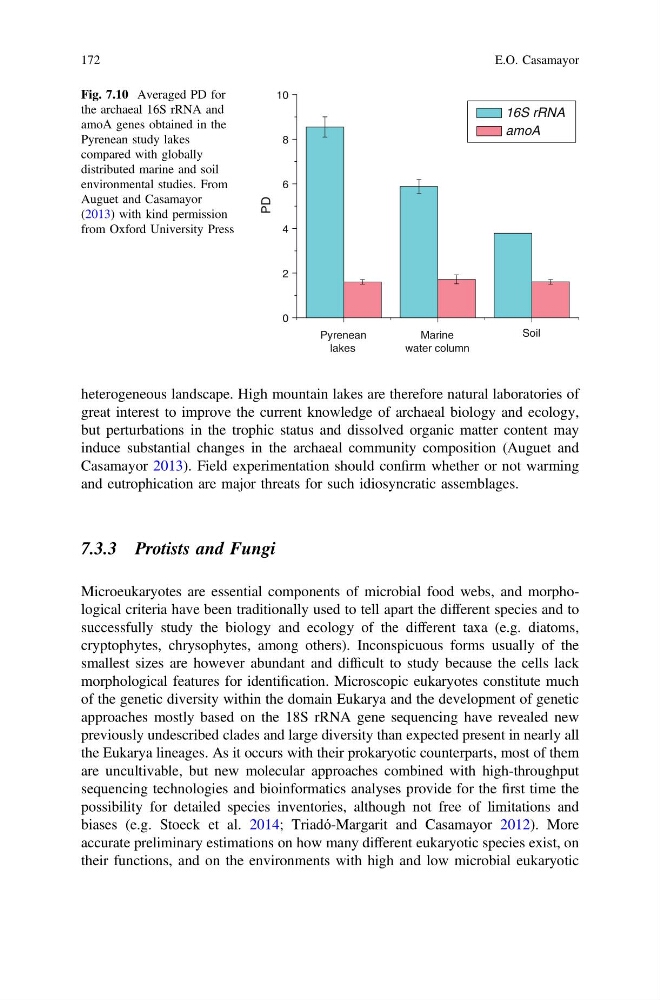
Fig. 7.10 Averaged PD for
the archaeal 16S rRNA and
amoA genes obtained in the
Pyrenean study lakes
compared with globally
distributed marine and soil
environmental studies. From
Auguet and Casamayor
(2013) with kind permission
from Oxford University Press
172
E.O. Casamayor
great interest to improve the current knowledge of archaeal biology and ecology,
but perturbations in the trophic status and dissolved organic matter content may
induce substantial changes in the archaeal community composition (Auguet and
Casamayor 2013). Field experimentation should confirm whether or not warming
and eutrophication are major threats for such idiosyncratic assemblages.
7.3.3 Protists and Fungi
Microeukaryotes are essential components of microbial food webs, and morphological criteria have been traditionally used to tell apart the different species and to
successfully study the biology and ecology of the different taxa (e.g. diatoms,
cryptophytes, chrysophytes, among others). Inconspicuous forms usually of the
smallest sizes are however abundant and difficult to study because the cells lack
morphological features for identification. Microscopic eukaryotes constitute much
of the genetic diversity within the domain Eukarya and the development of genetic
approaches mostly based on the 18S rRNA gene sequencing have revealed new
previously undescribed clades and large diversity than expected present in nearly all
the Eukarya lineages. As it occurs with their prokaryotic counterparts, most of them
are uncultivable, but new molecular approaches combined with high-throughput
sequencing technologies and bioinformatics analyses provide for the first time the
possibility for detailed species inventories, although not free of limitations and
biases (e.g. Stoeck et al. 2014; Triadó-Margarit and Casamayor 2012). More
accurate preliminary estimations on how many different eukaryotic species exist, on
their functions, and on the environments with high and low microbial eukaryotic
Pyrenean
lakes
Marine
water column
Soil
0
2
4
6
8
10
PD
16S rRNA
amoA
Fig. 7.10 Averaged PD for
the archaeal 16S rRNA and
amoA genes obtained in the
Pyrenean study lakes
compared with globally
distributed marine and soil
environmental studies. From
Auguet and Casamayor
(2013) with kind permission
from Oxford University Press
172
E.O. Casamayor