

content, being most of the lakes ultraoligotrophic or oligotrophic. Again, the higher
than expected habitat richness provides a rich background for diverse planktonic
bacterial communities.
Bacteria are also highly abundant and diverse in the epilithic biofilms of streams
and lakes, although no consistent global elevational patterns in biodiversity for
stream bacteria exist (Wang et al. 2017). These biofilms play, however, a relevant
and specific biogeochemical role in mountain lakes (Vila-Costa et al. 2014).
Bacteroidetes and Cyanobacteria are the most common groups found in the epilithon, whereas Actinobacteria were not detected and Betaproteobacteria were present in low abundances (Bartrons et al. 2012). Interestingly, most of the epilithic
Bacteroidetes form distinct phylogenetic clusters and may represent particular
poorly known ecotypes with a potentially major role in the organic matter cycling.
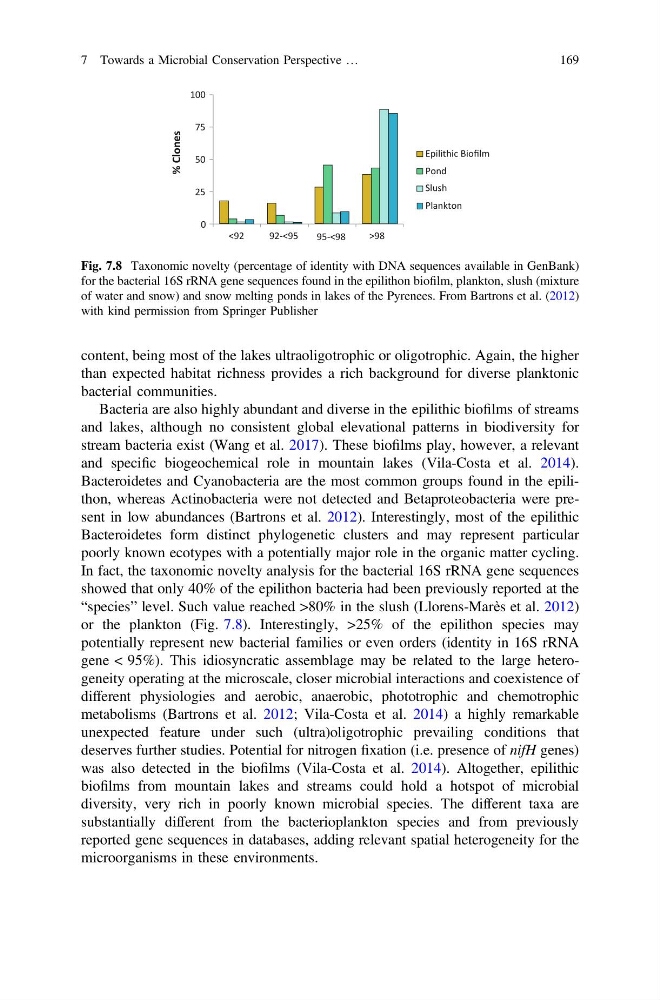
In fact, the taxonomic novelty analysis for the bacterial 16S rRNA gene sequences
showed that only 40% of the epilithon bacteria had been previously reported at the
“species” level. Such value reached >80% in the slush (Llorens-Marès et al. 2012)
or the plankton (Fig. 7.8). Interestingly, >25% of the epilithon species may
potentially represent new bacterial families or even orders (identity in 16S rRNA
gene < 95%). This idiosyncratic assemblage may be related to the large heterogeneity operating at the microscale, closer microbial interactions and coexistence of
different physiologies and aerobic, anaerobic, phototrophic and chemotrophic
metabolisms (Bartrons et al. 2012; Vila-Costa et al. 2014) a highly remarkable
unexpected feature under such (ultra)oligotrophic prevailing conditions that
deserves further studies. Potential for nitrogen fixation (i.e. presence of nifH genes)
was also detected in the biofilms (Vila-Costa et al. 2014). Altogether, epilithic
biofilms from mountain lakes and streams could hold a hotspot of microbial
diversity, very rich in poorly known microbial species. The different taxa are
substantially different from the bacterioplankton species and from previously
reported gene sequences in databases, adding relevant spatial heterogeneity for the
microorganisms in these environments.
0
25
50
75
100
<92
92-<95
>98
% Clones
95-<98
Epilithic Biofilm
Pond
Slush
Plankton
Fig. 7.8 Taxonomic novelty (percentage of identity with DNA sequences available in GenBank)
for the bacterial 16S rRNA gene sequences found in the epilithon biofilm, plankton, slush (mixture
of water and snow) and snow melting ponds in lakes of the Pyrenees. From Bartrons et al. (2012)
with kind permission from Springer Publisher
7 Towards a Microbial Conservation Perspective …
169
than expected habitat richness provides a rich background for diverse planktonic
bacterial communities.
Bacteria are also highly abundant and diverse in the epilithic biofilms of streams
and lakes, although no consistent global elevational patterns in biodiversity for
stream bacteria exist (Wang et al. 2017). These biofilms play, however, a relevant
and specific biogeochemical role in mountain lakes (Vila-Costa et al. 2014).
Bacteroidetes and Cyanobacteria are the most common groups found in the epilithon, whereas Actinobacteria were not detected and Betaproteobacteria were present in low abundances (Bartrons et al. 2012). Interestingly, most of the epilithic
Bacteroidetes form distinct phylogenetic clusters and may represent particular
poorly known ecotypes with a potentially major role in the organic matter cycling.
In fact, the taxonomic novelty analysis for the bacterial 16S rRNA gene sequences
showed that only 40% of the epilithon bacteria had been previously reported at the
“species” level. Such value reached >80% in the slush (Llorens-Marès et al. 2012)
or the plankton (Fig. 7.8). Interestingly, >25% of the epilithon species may
potentially represent new bacterial families or even orders (identity in 16S rRNA
gene < 95%). This idiosyncratic assemblage may be related to the large heterogeneity operating at the microscale, closer microbial interactions and coexistence of
different physiologies and aerobic, anaerobic, phototrophic and chemotrophic
metabolisms (Bartrons et al. 2012; Vila-Costa et al. 2014) a highly remarkable
unexpected feature under such (ultra)oligotrophic prevailing conditions that
deserves further studies. Potential for nitrogen fixation (i.e. presence of nifH genes)
was also detected in the biofilms (Vila-Costa et al. 2014). Altogether, epilithic
biofilms from mountain lakes and streams could hold a hotspot of microbial
diversity, very rich in poorly known microbial species. The different taxa are
substantially different from the bacterioplankton species and from previously
reported gene sequences in databases, adding relevant spatial heterogeneity for the
microorganisms in these environments.
0
25
50
75
100
<92
92-<95
>98
% Clones
95-<98
Epilithic Biofilm
Pond
Slush
Plankton
Fig. 7.8 Taxonomic novelty (percentage of identity with DNA sequences available in GenBank)
for the bacterial 16S rRNA gene sequences found in the epilithon biofilm, plankton, slush (mixture
of water and snow) and snow melting ponds in lakes of the Pyrenees. From Bartrons et al. (2012)
with kind permission from Springer Publisher
7 Towards a Microbial Conservation Perspective …
169