

need of any particular taxonomic level using the phylogenetic dispersion of communities, through the phylogenetic diversity index (PD) (Barberán and Casamayor
2014). High or low levels of PD did not necessarily match those Pyrenean lakes
with the highest or lowest OTUs richness, respectively, adding relevant information
for stakeholders and managers and showing where most of the biological diversity
accumulates (see Supporting information in Barberán and Casamayor 2014).
Higher PD might result in higher functional diversity and versatility of the bacterial
assemblages, but this assumption remains to be tested. This integrative tool also
provides proper interbiome comparison. Interestingly, when the Pyrenean dataset is
compared with a similar study of the plankton from surface waters in different seas
and oceans (first 5 m sampled), and after correcting for unequal number of
sequences between the studies, it arises that freshwater bacterial communities
accumulated higher genetic dispersion than the very surface marine assemblages
(Fig. 7.4). This result nicely contextualises any bacterial community circumventing
culturing and species definitions limitations and agrees with the highest environmental heterogeneity present in the Pyrenean dataset analysed (see below). It also
indicates that microbial diversity is a direct reflection of habitat diversity.
0
20
40
60
80
100
Lakes
Pyrenean
lakes
Marine
Gammaproteobacteria
Betaproteobacteria
Alphaproteobacteria
Deltaproteobacteria
Cyanobacteria
Bacteroidetes
Verrucomicrobia
Planctomycetes
Actinobacteria
Firmicutes
Others
%
**
*
**
**
**
**
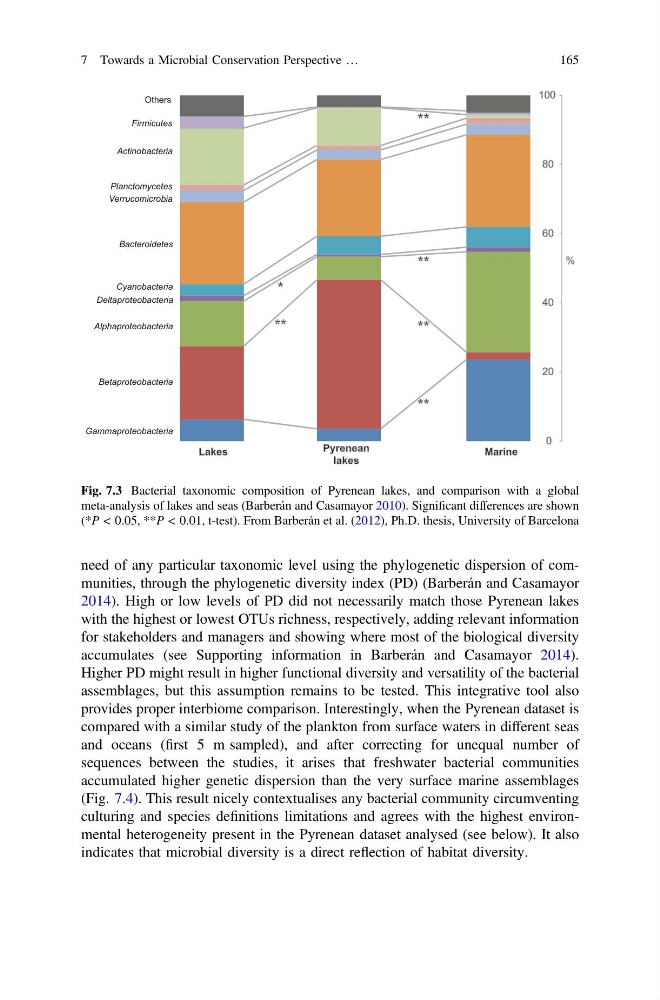
Fig. 7.3 Bacterial taxonomic composition of Pyrenean lakes, and comparison with a global
meta-analysis of lakes and seas (Barberán and Casamayor 2010). Significant differences are shown
(*P < 0.05, **P < 0.01, t-test). From Barberán et al. (2012), Ph.D. thesis, University of Barcelona
7 Towards a Microbial Conservation Perspective …
165
2014). High or low levels of PD did not necessarily match those Pyrenean lakes
with the highest or lowest OTUs richness, respectively, adding relevant information
for stakeholders and managers and showing where most of the biological diversity
accumulates (see Supporting information in Barberán and Casamayor 2014).
Higher PD might result in higher functional diversity and versatility of the bacterial
assemblages, but this assumption remains to be tested. This integrative tool also
provides proper interbiome comparison. Interestingly, when the Pyrenean dataset is
compared with a similar study of the plankton from surface waters in different seas
and oceans (first 5 m sampled), and after correcting for unequal number of
sequences between the studies, it arises that freshwater bacterial communities
accumulated higher genetic dispersion than the very surface marine assemblages
(Fig. 7.4). This result nicely contextualises any bacterial community circumventing
culturing and species definitions limitations and agrees with the highest environmental heterogeneity present in the Pyrenean dataset analysed (see below). It also
indicates that microbial diversity is a direct reflection of habitat diversity.
0
20
40
60
80
100
Lakes
Pyrenean
lakes
Marine
Gammaproteobacteria
Betaproteobacteria
Alphaproteobacteria
Deltaproteobacteria
Cyanobacteria
Bacteroidetes
Verrucomicrobia
Planctomycetes
Actinobacteria
Firmicutes
Others
%
**
*
**
**
**
**
Fig. 7.3 Bacterial taxonomic composition of Pyrenean lakes, and comparison with a global
meta-analysis of lakes and seas (Barberán and Casamayor 2010). Significant differences are shown
(*P < 0.05, **P < 0.01, t-test). From Barberán et al. (2012), Ph.D. thesis, University of Barcelona
7 Towards a Microbial Conservation Perspective …
165