

that tree dbh and growth along the cambial age of a tree were consistently lower in
declining than in non-declining sites (Fig. 6.4). Other factors may explain why
logging increases the sensitivity of silver fir to drought stress. For instance, there
may be a boost in resources after logging, usually expressed as a growth release,
which favours the acquisition of hydraulic traits (e.g. tracheids with wider lumen
area) that increase hydraulic conductivity but also make trees more prone to drought
damage. Logging is also related to the presence of root-rot fungi, but their abundance was not greater in declining than in non-declining Pyrenean sites (Oliva and
Colinas 2007; Sangüesa–Barreda et al. 2015). Lastly, mistletoe infestation and
insects whose outbreaks cause punctual silver-fir defoliation (e.g. Epinotia subsequana) have been identified in some affected forests, but they are not considered the
primary drivers of silver-fir dieback but secondary factors contributing to tree death
(Camarero et al. 2002, 2003, 2011).
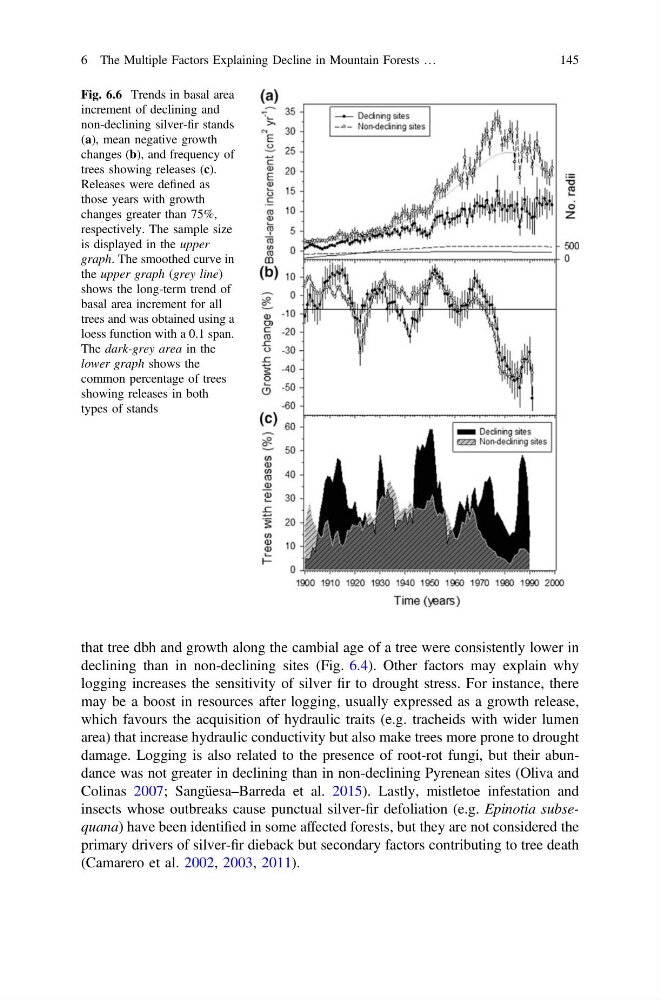
Fig. 6.6 Trends in basal area
increment of declining and
non-declining silver-fir stands
(a), mean negative growth
changes (b), and frequency of
trees showing releases (c).
Releases were defined as
those years with growth
changes greater than 75%,
respectively. The sample size
is displayed in the upper
graph. The smoothed curve in
the upper graph (grey line)
shows the long-term trend of
basal area increment for all
trees and was obtained using a
loess function with a 0.1 span.
The dark-grey area in the
lower graph shows the
common percentage of trees
showing releases in both
types of stands
6 The Multiple Factors Explaining Decline in Mountain Forests …
145
declining than in non-declining sites (Fig. 6.4). Other factors may explain why
logging increases the sensitivity of silver fir to drought stress. For instance, there
may be a boost in resources after logging, usually expressed as a growth release,
which favours the acquisition of hydraulic traits (e.g. tracheids with wider lumen
area) that increase hydraulic conductivity but also make trees more prone to drought
damage. Logging is also related to the presence of root-rot fungi, but their abundance was not greater in declining than in non-declining Pyrenean sites (Oliva and
Colinas 2007; Sangüesa–Barreda et al. 2015). Lastly, mistletoe infestation and
insects whose outbreaks cause punctual silver-fir defoliation (e.g. Epinotia subsequana) have been identified in some affected forests, but they are not considered the
primary drivers of silver-fir dieback but secondary factors contributing to tree death
(Camarero et al. 2002, 2003, 2011).
Fig. 6.6 Trends in basal area
increment of declining and
non-declining silver-fir stands
(a), mean negative growth
changes (b), and frequency of
trees showing releases (c).
Releases were defined as
those years with growth
changes greater than 75%,
respectively. The sample size
is displayed in the upper
graph. The smoothed curve in
the upper graph (grey line)
shows the long-term trend of
basal area increment for all
trees and was obtained using a
loess function with a 0.1 span.
The dark-grey area in the
lower graph shows the
common percentage of trees
showing releases in both
types of stands
6 The Multiple Factors Explaining Decline in Mountain Forests …
145