

Cova del Sardo, contains two successive phases. This number contrasts with the
single site dated in the previous phase of the Neolithic. The situation is similar in
other high zones of the mountain range where systematic archaeological surveying
has been carried out. In the Madriu-Perafita-Claror valley, six different sites are
known for the period from 3300 to 2000 cal BC (Orengo et al. 2014). In the Enveig
Mountains, in eastern Cerdanya, the three oldest occupations, all in the area of La
Pradilla, are dated between 3500 and 2000 cal BC. Second, this increase in the
number of sites is also seen in their altitude. They are all above 2000 m a.s.l.,
except for three in Aigüestortes i Estany de Sant Maurici National Park, which are
at between 1780 and 1980 m. It, therefore, seems that this phenomenon can be
extrapolated to at least the eastern half of the mountains.
In the Aigüestortes—Sant Maurici area, this increase in the number of occupations and their altitude takes place after 3400–3300 cal BC and becomes more
noticeable after 3000 cal BC (Gassiot et al. 2014). The excavation at Abric de
l’Estany de la Coveta I succeeded in documenting an occupation phase after the
Mesolithic, in which a large hearth with abundant burnt pine wood was documented. Additionally, small soundings performed during surveying and surface
archaeological documentation has identified the occupation of other rock-shelters
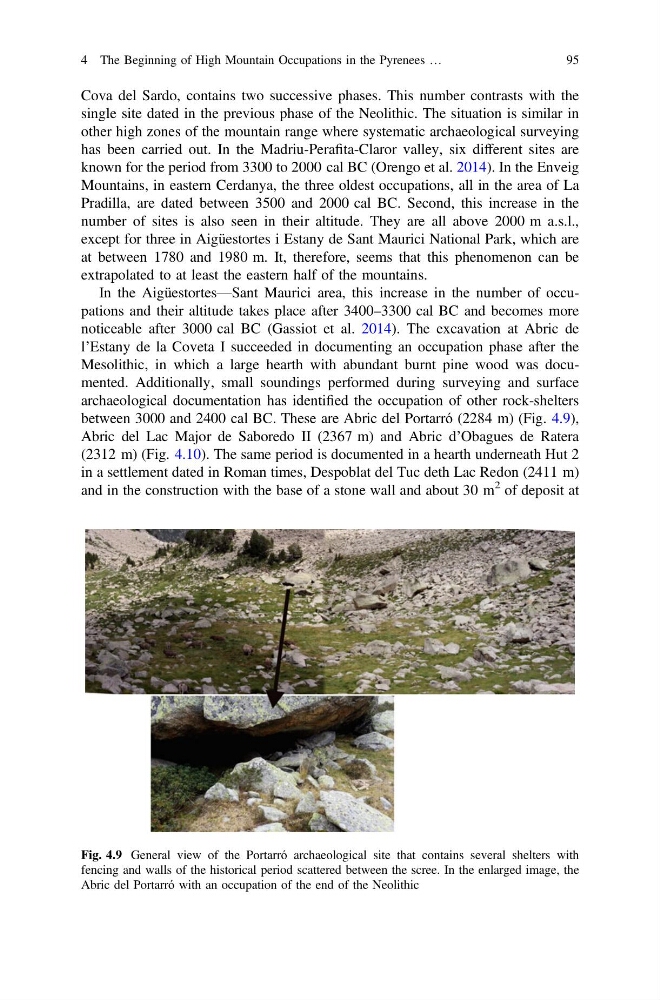
between 3000 and 2400 cal BC. These are Abric del Portarró (2284 m) (Fig. 4.9),
Abric del Lac Major de Saboredo II (2367 m) and Abric d’Obagues de Ratera
(2312 m) (Fig. 4.10). The same period is documented in a hearth underneath Hut 2
in a settlement dated in Roman times, Despoblat del Tuc deth Lac Redon (2411 m)
and in the construction with the base of a stone wall and about 30 m
2 of deposit at
Fig. 4.9 General view of the Portarró archaeological site that contains several shelters with
fencing and walls of the historical period scattered between the scree. In the enlarged image, the
Abric del Portarró with an occupation of the end of the Neolithic
4 The Beginning of High Mountain Occupations in the Pyrenees …
95
single site dated in the previous phase of the Neolithic. The situation is similar in
other high zones of the mountain range where systematic archaeological surveying
has been carried out. In the Madriu-Perafita-Claror valley, six different sites are
known for the period from 3300 to 2000 cal BC (Orengo et al. 2014). In the Enveig
Mountains, in eastern Cerdanya, the three oldest occupations, all in the area of La
Pradilla, are dated between 3500 and 2000 cal BC. Second, this increase in the
number of sites is also seen in their altitude. They are all above 2000 m a.s.l.,
except for three in Aigüestortes i Estany de Sant Maurici National Park, which are
at between 1780 and 1980 m. It, therefore, seems that this phenomenon can be
extrapolated to at least the eastern half of the mountains.
In the Aigüestortes—Sant Maurici area, this increase in the number of occupations and their altitude takes place after 3400–3300 cal BC and becomes more
noticeable after 3000 cal BC (Gassiot et al. 2014). The excavation at Abric de
l’Estany de la Coveta I succeeded in documenting an occupation phase after the
Mesolithic, in which a large hearth with abundant burnt pine wood was documented. Additionally, small soundings performed during surveying and surface
archaeological documentation has identified the occupation of other rock-shelters
between 3000 and 2400 cal BC. These are Abric del Portarró (2284 m) (Fig. 4.9),
Abric del Lac Major de Saboredo II (2367 m) and Abric d’Obagues de Ratera
(2312 m) (Fig. 4.10). The same period is documented in a hearth underneath Hut 2
in a settlement dated in Roman times, Despoblat del Tuc deth Lac Redon (2411 m)
and in the construction with the base of a stone wall and about 30 m
2 of deposit at
Fig. 4.9 General view of the Portarró archaeological site that contains several shelters with
fencing and walls of the historical period scattered between the scree. In the enlarged image, the
Abric del Portarró with an occupation of the end of the Neolithic
4 The Beginning of High Mountain Occupations in the Pyrenees …
95