

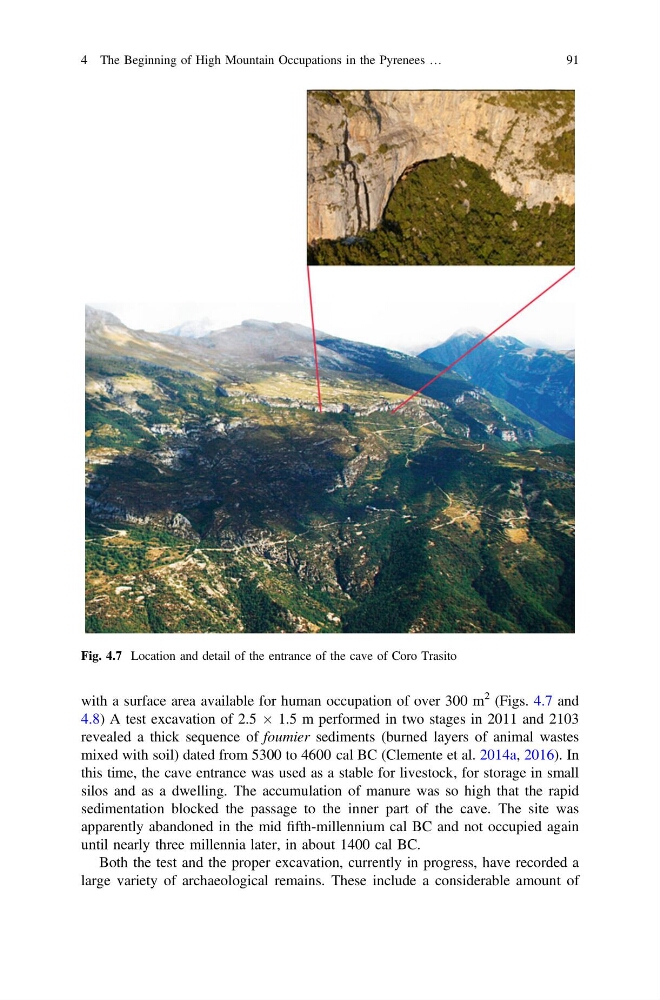
with a surface area available for human occupation of over 300 m
2 (Figs. 4.7 and
4.8) A test excavation of 2.5 Â 1.5 m performed in two stages in 2011 and 2103
revealed a thick sequence of foumier sediments (burned layers of animal wastes
mixed with soil) dated from 5300 to 4600 cal BC (Clemente et al. 2014a, 2016). In
this time, the cave entrance was used as a stable for livestock, for storage in small
silos and as a dwelling. The accumulation of manure was so high that the rapid
sedimentation blocked the passage to the inner part of the cave. The site was
apparently abandoned in the mid fifth-millennium cal BC and not occupied again
until nearly three millennia later, in about 1400 cal BC.
Both the test and the proper excavation, currently in progress, have recorded a
large variety of archaeological remains. These include a considerable amount of
Fig. 4.7 Location and detail of the entrance of the cave of Coro Trasito
4 The Beginning of High Mountain Occupations in the Pyrenees …
91
2 (Figs. 4.7 and
4.8) A test excavation of 2.5 Â 1.5 m performed in two stages in 2011 and 2103
revealed a thick sequence of foumier sediments (burned layers of animal wastes
mixed with soil) dated from 5300 to 4600 cal BC (Clemente et al. 2014a, 2016). In
this time, the cave entrance was used as a stable for livestock, for storage in small
silos and as a dwelling. The accumulation of manure was so high that the rapid
sedimentation blocked the passage to the inner part of the cave. The site was
apparently abandoned in the mid fifth-millennium cal BC and not occupied again
until nearly three millennia later, in about 1400 cal BC.
Both the test and the proper excavation, currently in progress, have recorded a
large variety of archaeological remains. These include a considerable amount of
Fig. 4.7 Location and detail of the entrance of the cave of Coro Trasito
4 The Beginning of High Mountain Occupations in the Pyrenees …
91