

60
S. J. Blundell
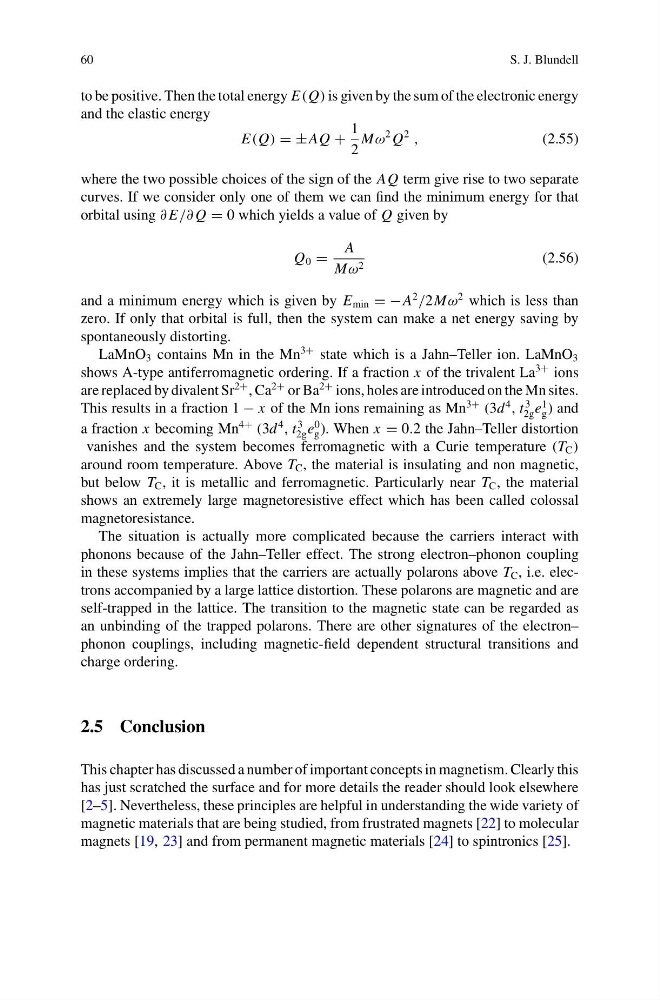
to be positive. Then the total energy E(Q) is given by the sum of the electronic energy
and the elastic energy
E(Q) = ±AQ +
1
2
Mω
2 Q
2
,
(2.55)
where the two possible choices of the sign of the AQ term give rise to two separate
curves. If we consider only one of them we can find the minimum energy for that
orbital using ∂ E/∂ Q = 0 which yields a value of Q given by
Q 0 =
A
Mω 2
(2.56)
and a minimum energy which is given by E min = −A
2
/2Mω
2 which is less than
zero. If only that orbital is full, then the system can make a net energy saving by
spontaneously distorting.
LaMnO 3 contains Mn in the Mn
3+ state which is a Jahn–Teller ion. LaMnO 3
shows A-type antiferromagnetic ordering. If a fraction x of the trivalent La
3+ ions
are replaced by divalent Sr
2+ , Ca
2+ or Ba
2+ ions, holes are introduced on the Mn sites.
This results in a fraction 1 − x of the Mn ions remaining as Mn
3+ (3d
4 , t
3
2g e
1
g ) and
a fraction x becoming Mn
4+ (3d
4 , t
3
2g e
0
g ). When x = 0.2 the Jahn–Teller distortion
vanishes and the system becomes ferromagnetic with a Curie temperature (T C )
around room temperature. Above T C , the material is insulating and non magnetic,
but below T C , it is metallic and ferromagnetic. Particularly near T C , the material
shows an extremely large magnetoresistive effect which has been called colossal
magnetoresistance.
The situation is actually more complicated because the carriers interact with
phonons because of the Jahn–Teller effect. The strong electron–phonon coupling
in these systems implies that the carriers are actually polarons above T C , i.e. electrons accompanied by a large lattice distortion. These polarons are magnetic and are
self-trapped in the lattice. The transition to the magnetic state can be regarded as
an unbinding of the trapped polarons. There are other signatures of the electron–
phonon couplings, including magnetic-field dependent structural transitions and
charge ordering.
2.5 Conclusion
This chapter has discussed a number of important concepts in magnetism. Clearly this
has just scratched the surface and for more details the reader should look elsewhere
[2–5]. Nevertheless, these principles are helpful in understanding the wide variety of
magnetic materials that are being studied, from frustrated magnets [22] to molecular
magnets [19, 23] and from permanent magnetic materials [24] to spintronics [25].
S. J. Blundell
to be positive. Then the total energy E(Q) is given by the sum of the electronic energy
and the elastic energy
E(Q) = ±AQ +
1
2
Mω
2 Q
2
,
(2.55)
where the two possible choices of the sign of the AQ term give rise to two separate
curves. If we consider only one of them we can find the minimum energy for that
orbital using ∂ E/∂ Q = 0 which yields a value of Q given by
Q 0 =
A
Mω 2
(2.56)
and a minimum energy which is given by E min = −A
2
/2Mω
2 which is less than
zero. If only that orbital is full, then the system can make a net energy saving by
spontaneously distorting.
LaMnO 3 contains Mn in the Mn
3+ state which is a Jahn–Teller ion. LaMnO 3
shows A-type antiferromagnetic ordering. If a fraction x of the trivalent La
3+ ions
are replaced by divalent Sr
2+ , Ca
2+ or Ba
2+ ions, holes are introduced on the Mn sites.
This results in a fraction 1 − x of the Mn ions remaining as Mn
3+ (3d
4 , t
3
2g e
1
g ) and
a fraction x becoming Mn
4+ (3d
4 , t
3
2g e
0
g ). When x = 0.2 the Jahn–Teller distortion
vanishes and the system becomes ferromagnetic with a Curie temperature (T C )
around room temperature. Above T C , the material is insulating and non magnetic,
but below T C , it is metallic and ferromagnetic. Particularly near T C , the material
shows an extremely large magnetoresistive effect which has been called colossal
magnetoresistance.
The situation is actually more complicated because the carriers interact with
phonons because of the Jahn–Teller effect. The strong electron–phonon coupling
in these systems implies that the carriers are actually polarons above T C , i.e. electrons accompanied by a large lattice distortion. These polarons are magnetic and are
self-trapped in the lattice. The transition to the magnetic state can be regarded as
an unbinding of the trapped polarons. There are other signatures of the electron–
phonon couplings, including magnetic-field dependent structural transitions and
charge ordering.
2.5 Conclusion
This chapter has discussed a number of important concepts in magnetism. Clearly this
has just scratched the surface and for more details the reader should look elsewhere
[2–5]. Nevertheless, these principles are helpful in understanding the wide variety of
magnetic materials that are being studied, from frustrated magnets [22] to molecular
magnets [19, 23] and from permanent magnetic materials [24] to spintronics [25].