

2 Concepts in Magnetism
59
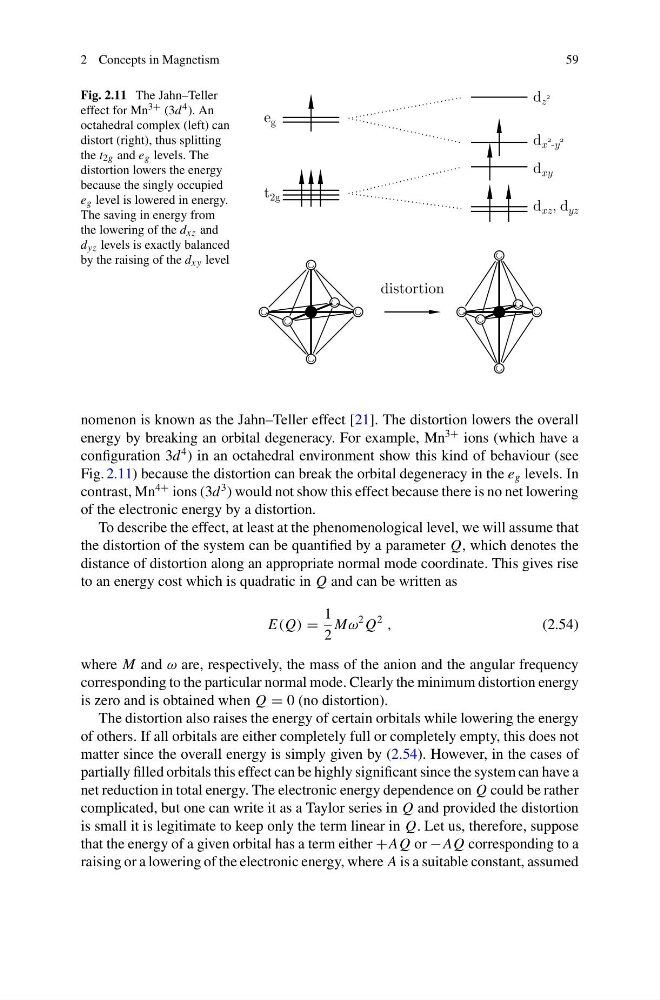
Fig. 2.11 The Jahn–Teller
effect for Mn 3+ (3d 4 ). An
octahedral complex (left) can
distort (right), thus splitting
the t 2g and e g levels. The
distortion lowers the energy
because the singly occupied
e g level is lowered in energy.
The saving in energy from
the lowering of the d xz and
d yz levels is exactly balanced
by the raising of the d xy level
nomenon is known as the Jahn–Teller effect [21]. The distortion lowers the overall
energy by breaking an orbital degeneracy. For example, Mn
3+ ions (which have a
configuration 3d
4 ) in an octahedral environment show this kind of behaviour (see
Fig. 2.11) because the distortion can break the orbital degeneracy in the e g levels. In
contrast, Mn
4+ ions (3d
3 ) would not show this effect because there is no net lowering
of the electronic energy by a distortion.
To describe the effect, at least at the phenomenological level, we will assume that
the distortion of the system can be quantified by a parameter Q, which denotes the
distance of distortion along an appropriate normal mode coordinate. This gives rise
to an energy cost which is quadratic in Q and can be written as
E(Q) =
1
2
Mω
2 Q
2
,
(2.54)
where M and ω are, respectively, the mass of the anion and the angular frequency
corresponding to the particular normal mode. Clearly the minimum distortion energy
is zero and is obtained when Q = 0 (no distortion).
The distortion also raises the energy of certain orbitals while lowering the energy
of others. If all orbitals are either completely full or completely empty, this does not
matter since the overall energy is simply given by (2.54). However, in the cases of
partially filled orbitals this effect can be highly significant since the system can have a
net reduction in total energy. The electronic energy dependence on Q could be rather
complicated, but one can write it as a Taylor series in Q and provided the distortion
is small it is legitimate to keep only the term linear in Q. Let us, therefore, suppose
that the energy of a given orbital has a term either +AQ or −AQ corresponding to a
raising or a lowering of the electronic energy, where A is a suitable constant, assumed
59
Fig. 2.11 The Jahn–Teller
effect for Mn 3+ (3d 4 ). An
octahedral complex (left) can
distort (right), thus splitting
the t 2g and e g levels. The
distortion lowers the energy
because the singly occupied
e g level is lowered in energy.
The saving in energy from
the lowering of the d xz and
d yz levels is exactly balanced
by the raising of the d xy level
nomenon is known as the Jahn–Teller effect [21]. The distortion lowers the overall
energy by breaking an orbital degeneracy. For example, Mn
3+ ions (which have a
configuration 3d
4 ) in an octahedral environment show this kind of behaviour (see
Fig. 2.11) because the distortion can break the orbital degeneracy in the e g levels. In
contrast, Mn
4+ ions (3d
3 ) would not show this effect because there is no net lowering
of the electronic energy by a distortion.
To describe the effect, at least at the phenomenological level, we will assume that
the distortion of the system can be quantified by a parameter Q, which denotes the
distance of distortion along an appropriate normal mode coordinate. This gives rise
to an energy cost which is quadratic in Q and can be written as
E(Q) =
1
2
Mω
2 Q
2
,
(2.54)
where M and ω are, respectively, the mass of the anion and the angular frequency
corresponding to the particular normal mode. Clearly the minimum distortion energy
is zero and is obtained when Q = 0 (no distortion).
The distortion also raises the energy of certain orbitals while lowering the energy
of others. If all orbitals are either completely full or completely empty, this does not
matter since the overall energy is simply given by (2.54). However, in the cases of
partially filled orbitals this effect can be highly significant since the system can have a
net reduction in total energy. The electronic energy dependence on Q could be rather
complicated, but one can write it as a Taylor series in Q and provided the distortion
is small it is legitimate to keep only the term linear in Q. Let us, therefore, suppose
that the energy of a given orbital has a term either +AQ or −AQ corresponding to a
raising or a lowering of the electronic energy, where A is a suitable constant, assumed