

54
S. J. Blundell
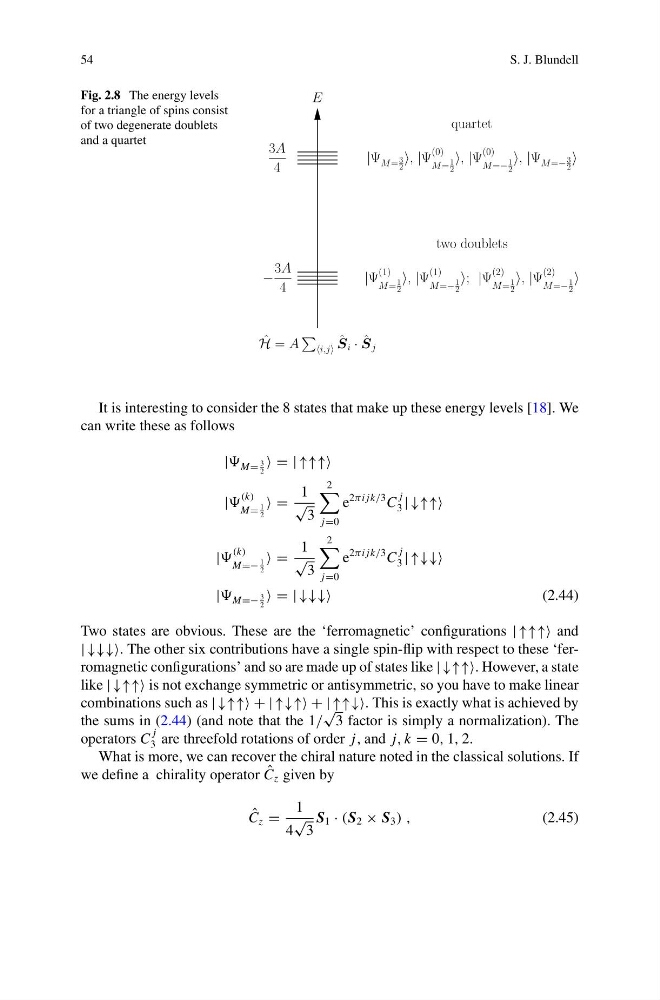
Fig. 2.8 The energy levels
for a triangle of spins consist
of two degenerate doublets
and a quartet
3A
4
−
3A
4
E
|Ψ M= 3
2
, |Ψ
(0)
M= 1
2
, |Ψ
(0)
M=− 1
2
, |Ψ M=− 3
2
|Ψ
(1)
M= 1
2
, |Ψ
(1)
M=− 1
2
; |Ψ
(2)
M= 1
2
, |Ψ
(2)
M=− 1
2
quartet
two doublets
ˆ
H = A i,j
ˆ
S i · ˆ
S j
It is interesting to consider the 8 states that make up these energy levels [18]. We
can write these as follows
| M=
3
2
= | ↑↑↑↑
|
(k)
M=
1
2
=
1
√
3
2
j=0
e
2πi jk/3 C
j
3 | ↓↑↑↑
|
(k)
M=−
1
2
=
1
√
3
2
j=0
e
2πi jk/3 C
j
3 | ↑↓↓↓
| M=−
3
2
= | ↓↓↓↓
(2.44)
Two states are obvious. These are the ‘ferromagnetic’ configurations | ↑↑↑↑ and
| ↓↓↓↓. The other six contributions have a single spin-flip with respect to these ‘ferromagnetic configurations’ and so are made up of states like | ↓↑↑↑. However, a state
like | ↓↑↑↑ is not exchange symmetric or antisymmetric, so you have to make linear
combinations such as | ↓↑↑↑ + | ↑↓↑↑ + | ↑↑↓↓. This is exactly what is achieved by
the sums in (2.44) (and note that the 1/
√
3 factor is simply a normalization). The
operators C
j
3 are threefold rotations of order j, and j, k = 0, 1, 2.
What is more, we can recover the chiral nature noted in the classical solutions. If
we define a chirality operator ˆ
C z given by
ˆ
C z =
1
4
√
3
S 1 · (S 2 × S 3 ) ,
(2.45)
S. J. Blundell
Fig. 2.8 The energy levels
for a triangle of spins consist
of two degenerate doublets
and a quartet
3A
4
−
3A
4
E
|Ψ M= 3
2
, |Ψ
(0)
M= 1
2
, |Ψ
(0)
M=− 1
2
, |Ψ M=− 3
2
|Ψ
(1)
M= 1
2
, |Ψ
(1)
M=− 1
2
; |Ψ
(2)
M= 1
2
, |Ψ
(2)
M=− 1
2
quartet
two doublets
ˆ
H = A i,j
ˆ
S i · ˆ
S j
It is interesting to consider the 8 states that make up these energy levels [18]. We
can write these as follows
| M=
3
2
= | ↑↑↑↑
|
(k)
M=
1
2
=
1
√
3
2
j=0
e
2πi jk/3 C
j
3 | ↓↑↑↑
|
(k)
M=−
1
2
=
1
√
3
2
j=0
e
2πi jk/3 C
j
3 | ↑↓↓↓
| M=−
3
2
= | ↓↓↓↓
(2.44)
Two states are obvious. These are the ‘ferromagnetic’ configurations | ↑↑↑↑ and
| ↓↓↓↓. The other six contributions have a single spin-flip with respect to these ‘ferromagnetic configurations’ and so are made up of states like | ↓↑↑↑. However, a state
like | ↓↑↑↑ is not exchange symmetric or antisymmetric, so you have to make linear
combinations such as | ↓↑↑↑ + | ↑↓↑↑ + | ↑↑↓↓. This is exactly what is achieved by
the sums in (2.44) (and note that the 1/
√
3 factor is simply a normalization). The
operators C
j
3 are threefold rotations of order j, and j, k = 0, 1, 2.
What is more, we can recover the chiral nature noted in the classical solutions. If
we define a chirality operator ˆ
C z given by
ˆ
C z =
1
4
√
3
S 1 · (S 2 × S 3 ) ,
(2.45)